Skip to content

Different Daggerboard Designs

Catamaran Designs Explained: C-Boards vs Straight Boards vs Canted Boards vs Centreboards

Catamaran Design Series

Daggerboard Design Types: The Four Approaches

A visual guide to the four daggerboard configurations on today’s performance catamarans, the physics behind each choice, and the trade-offs no brochure tells you about.

Topic / Daggerboard architecture Read / 6 minutes Builds on / Daggerboards Guide

Comparison of catamaran daggerboard types
The HH44 curved C-boards lift roughly 12 percent of displacement at speed

Two lift vectors, not one

The reason there is more than one type of board design is that water flowing past a foil does two different jobs. A vertical board provides a horizontal force and resistance to leeway. A curved or canted board provides horizontal and vertical lift to different degrees.
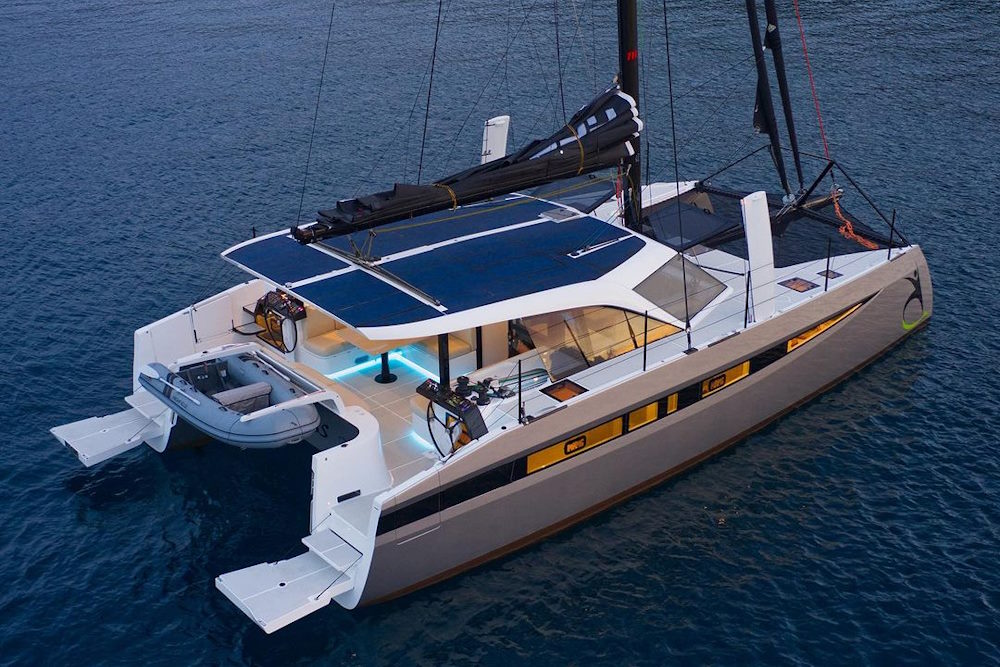
That principle is the reason for the four designs you see on performance cats like the Shift 54+ today. In reality, with heel, all boards provide both components to a certain extent.

The two jobs a foil can do

Whether the increased lift (at speed) is worth the extra cost, complexity and structural load is where the builders differ. Here is how the principle breaks down.

Horizontal

Sideways lift

Provides lateral resistance and a force to counter leeway. Stops the boat slipping to leeward. Every board does this, it is the reason for putting one through the hull in the first place.

Vertical

Upward lift

Reduces effective displacement. Less hull in the water means less wetted surface and less drag. Curved and canted boards generate this. Straight boards do as well to some extent when you factor in the heel of the boat.

Shift 54
Shift 54+

Same problem, four answers

Type 01

Straight Daggerboards

Outremer, Catana, Balance, Bañuls

~15° Outremer’s claimed windward gain over a comparable mini-keel boat

The oldest and most common solution. A high-aspect carbon or composite board runs vertically through a trunk in each hull and provides horizontal lift with some vertical component when the boat is heeling. Designed to be sacrifial: in a heavy grounding the board breaks before the trunk fails.

Pros
  • Strong upwind pointing
  • Simple, well understood
  • Easy to ship and replace
Cons
  • Less vertical lift bonus
  • Windage when raised
  • Takes up hull volume

Type 02

Curved C-Boards

HH 44, 50, 52, 55-SC, 66 / Catana 59

15 to 20% Of displacement lifted at 20 knots boat speed on the HH66 (HH published figures)

A daggerboard with a pronounced inward curve at the lower section. The vertical upper portion fights the leeward force; the curved tip provides lift. Vertical lift scales with speed, feeding the speed loop. At lower speeds, the difference is minimal.

Pros
  • Real vertical lift
  • Higher pointing
  • Better motion in waves
Cons
  • Expensive moulds
  • Hard to ship a spare
  • Added complexity
  • High trunk loads

Type 03

Canted Straight Boards

Gunboat 68 (designed by VPLP)

14 iterations Studies VPLP ran on board configurations before settling on canted straight boards

A straight, symmetrical foil mounted at an inward angle rather than vertical. The cant splits force into horizontal and vertical components: less vertical lift than a true C-board, but useful heave damping and a smoother ride at speed. Easier to build, easier to ship.

Pros
  • Some vertical lift
  • Heave damping
  • Cheaper than curved
Cons
  • Less lift than C-boards
  • Still more complex
  • Higher windage
  • Cant takes more hull space

Type 04

Pivoting Centreboards

Kinetic KC54, K6 / older Gunboat 55

Pivots up If the board hits an object, it swings clear rather than transferring full impact into the hull

Instead of lifting vertically, a centreboard pivots on a pin at the top and swings up and forward into a horizontal cavity in the hull. Frees up cabin volume and acts as its own safety fuse. Less efficient hydrodynamically than a clean daggerboard.

Pros
  • Built-in grounding fuse
  • Frees cabin space
  • Less vertical lift component
  • Less windage (boards hidden below deck
Cons
  • More complexity
  • More disturbed flow

Above 20 knots, L-tipped boards generate up to 30 to 40% of displacement in lift. Below that, they just add drag. VPLP / Gunboat 68 design study

Comparison of catamaran daggerboard types
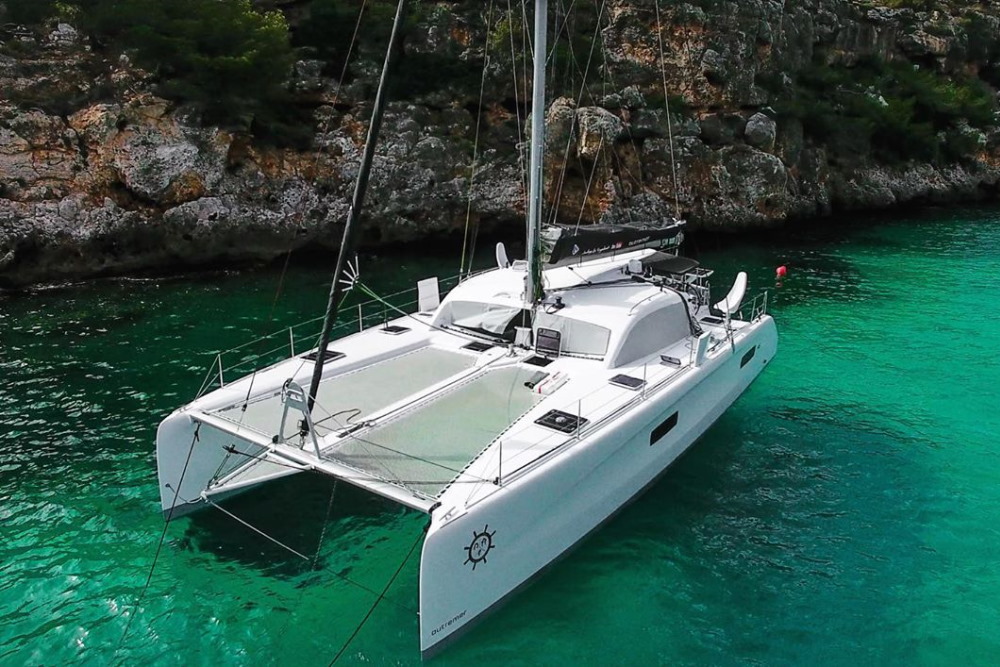
Outremer boards typically have less windage like this Outremer 45.

The comparison matrix

Feature Straight C-Board Canted Centreboard
Vertical lift ●○○ Minimal ●●● Strong ●●○ Moderate ●○○ Minimal
Build complexity Low High Medium Medium
Cost to replace Lower High Medium Medium
Shipping a spare Easier Difficult Manageable Easier
Windage when raised High Higher Higher None
Cabin volume impact Trunk in hull Trunk in hull Trunk in hull Cavity in bilge
Grounding behaviour Designed to break Designed to break Designed to break Pivots up safely
Reaching at speed Good Best Very good Good

Three things often overlooked

No. 01

Replacement – a reality check

A straight board, even a long one, can be crated and freighted internationally without much fuss. A curved C-board is more expensive to ship. The mould is unique to the boat, the part is bulky, and you are typically waiting on the original yard.

No. 02

Windage Penalty

A full-length board sitting two metres above the deck acts like a small sail. Outremer noticed this and shortened the trunks on the newer 52 and 55. Centreboards win this by hiding entirely inside the hulls.

No. 03

Loads scale with speed squared

A board generating useful vertical lift at 20 knots produces four times the force it generated at 10. The structure has to take it. HH tests HH66 boards to 17 tonnes. That engineering is part of the price tag. The benefit of curved boards is lower in lighter conditions

Comparison of catamaran daggerboard types
The Kinetic KC54 has tidy centreboards

Which is right for you

i
If you push hard in 15 knots and up

You want raw performance, you have the budget, and you sail in conditions where the lift bonus kicks in. C-boards earn their keep. Aesthetically, you get maximum kerbside appeal.

ii
If you want a fast bluewater cruiser

Ease of replacement matters. The system needs to be forgiving for a couple sailing shorthanded. High-aspect straight daggerboards remain the most sensible choice.

iii
If you want a cruiser-racer compromise

You want lift benefits without the full complexity, cost and shipping headache of curved boards. Canted straight boards are a clever middle ground. But they take up more space in the hull, so are more suitable for larger catamarans

iv
If you sail in shallow crusing grounds, value cabin space and still want to beat to wind efficiently.

Bahamas, lagoons, beaching. You want more safety and the volume from not having a vertical trunk in each hull. A centreboard set-up is hard to beat. And there is no windage penalty.

The Designer’s Summary

Each of the configurations solves the same problem: how to convert rig power into forward motion without slipping sideways. What makes them different is how much of that force gets redirected upwards, and how much complexity, cost and structural load the builder is willing to absorb to get there.

There is no universally correct answer, only the right one for how and where you sail. The manufacturers have all made deliberate choices. Once you understand the physics, the choices start to make sense.