
Shift 54+
New Zealand Ambition Meets Performance Catamaran Design
A father-son team with serious credentials has launched one of the most interesting new catamaran brands of 2026: Shift Yachts. Their first launch will be a mid-50-footer.

Background
Shift Yachts Ltd is a New Zealand design outfit with a yard in Thailand that has launched with the Shift 54+. The brand was announced in April 2026 after roughly 18 months of development, and the first hull is expected in the water in early 2028. Tooling begins in 2026.
The company’s mission is to build a lightweight, high-performance cruising catamaran optimised for short-handed sailing by a couple or small family. The design brief was described by Paul Hakes as creating “the ultimate couples performance cruiser.”
The boat will be built at Adventure Yachts in Thailand, a yard Paul Hakes selected after visiting seven facilities across the region over a six-month period.
The People
Shift Yachts is founded by Paul and James Hakes, father and son, with Paul overseeing construction on-site and James responsible for design and engineering, from concept through to shop floor drawings.
Paul Hakes has an impressive CV in the yachting world. He started his career over 40 years ago in New Zealand, trained with leading race yacht builders of that era, then set up his own yard, Hakes Marine, which built racing TP52s, IMOCA 60s for the Vendée Globe, and the Supermaxi Zana.
He project-managed America’s Cup builds and refits, and 13 years ago became a founding partner of HH Catamarans.
James Hakes graduated with an honours degree in Naval Architecture from the Australian Maritime College and worked alongside his father for a decade. He led the design of the HH44 and HH52, and was a finalist for Designer of the Year at the 2023 International Boat Industry awards.
The Yacht
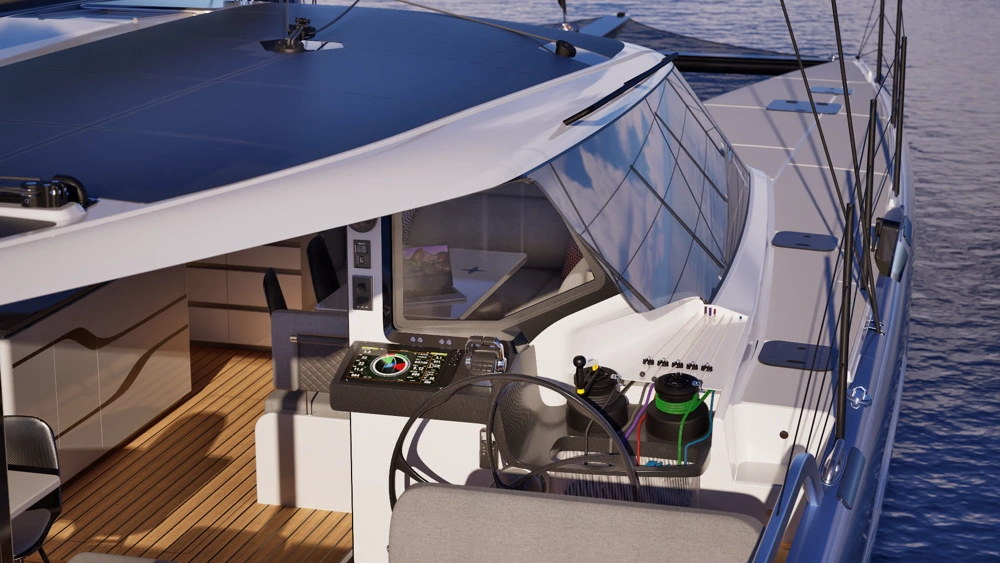
The Shift 54+ is a two-cabin performance cruising catamaran with daggerboards, wave-piercing bows, and a hull form developed through multiple rounds of hydrodynamic simulation. It is available in two main construction variants: a carbon-reinforced E-glass hull with aluminium rig, or a full carbon/epoxy build with a rotating carbon mast. Both versions use epoxy resin and thermoformed foam core throughout.
USPs and Key Features
Weight and structure. The design prioritises weight reduction at every stage. A “less is more” approach to composite construction delivers a lightweight platform with best-in-class power-to-weight performance, and boat speeds that can match and exceed wind speed in a breeze. In carbon race trim, the boat displaces 10.4 tonnes at around 16.45m LOA, giving a displacement/length ratio of 67.6.
Appendages. The daggerboards are asymmetric for additional upwind lift. The rudders are positioned outboard of centerline, canted at 6 degrees, and sit against a hull flat spot. These design choices should make the boat easier to control at speed.
Mast position. The mast was deliberately moved aft relative to a conventional layout to improve the relationship between mast, daggerboards, and rudders. This came at the expend of some saloon volume, a trade-off that the team accepted for sailing efficiency.
Optional rotating carbon rig. The rotating mast adds performance without increasing sail area, and also makes reefing easier and safer by aligning the mast with the mainsail battens.
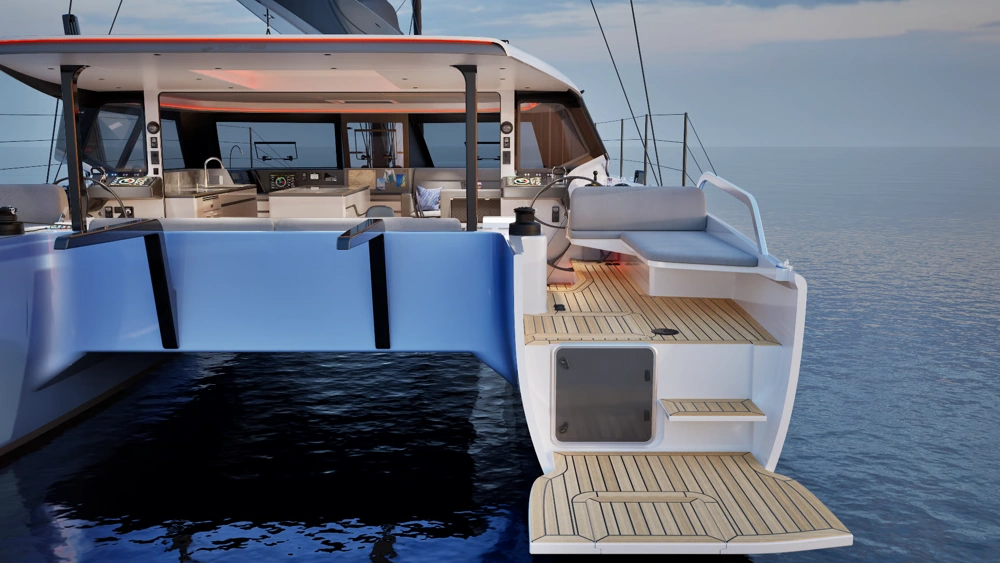
Salon-to-cockpit connection. The salon doors stow under the floorboards, removing all visual and physical barriers between the interior and cockpit. The system is engineered to be light, easy to deploy, and fully stowed in under two minutes. This is one of the more distinctive designs on the boat.
Storage. Aft lockers are large enough to hold five surfboards each side, with direct, unobstructed access.
Cockpit flexibility. Helm chairs have reversible backrests that convert to day beds, and the aft cockpit can be configured as an eight-person dining setup, two separate tables, or a flat daybed.
ORC Performance Certificate. The Shift website publishes ORCmh velocity prediction data for multiple build configurations, allowing direct comparison with other catamarans at equivalent displacements.

Sailing
The performance figures published are based on ORC VPP modelling, not sailed data at this point. With that qualification, the numbers are impressive.
In carbon race trim (12,050 kg displacement), the SA/D ratio is 37.3 and the Bruce Number is 1.53. For context, a Bruce Number above 1.4 is generally associated with a fast yacht; 1.53 places the Shift 54+ in the upper tier of the class.
James Hakes is striving for performance that is “inherent, not pushed,” with the ORC polars available for download from the Shift website so prospective buyers can make direct comparisons with competitors.
The rudders and daggerboards are tuned for upwind perfromance, and the high-aspect mainsail with low boom is designed to give power without the need for a tall, heavy rig. The engines are positioned further to the bow to help centralise weight, balancing the boat and reducing pitching in a seaway.
Living Space

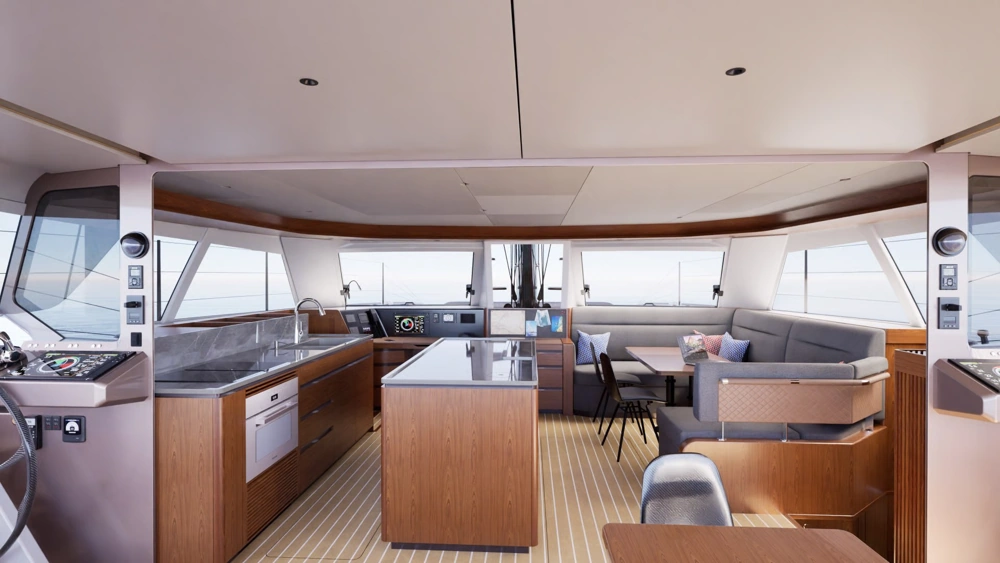
The interior design aims for a “luxury apartment at sea.” The saloon is open-plan: the galley is enclosed by a large island for safety, with clean worktops and plenty of refrigeration and storage below. The saloon has an oversized sofa and a large dining table that lowers to form a lounging space or additional berth.
The two-cabin layout means each hull receives a dedicated owner’s cabin rather than dividing the space into a larger number of smaller berths. This is a deliberate choice targeted at bluewater couples and small families.
The cockpit design is designed to be flexibile with multiple seating configurations, integrated helm lounging, and direct access between cockpit and interior.
Principal Specs
| Features | Value |
|---|---|
| LOA | 54 ft / 16.45 m |
| LWL | 52 ft 6 in / 15.99 m |
| Beam | 25 ft 6 in / 7.77 m |
| Draft (boards up / down) | 2 ft / 12 ft (0.62 m / 3.65 m) |
| Light displacement | 22,900 lbs / 10.38 t |
| Mainsail | 1,098 sq ft / 102 m² |
| Genoa | 883 sq ft / 82 m² |
| Engines | 2x Yanmar 4JH57 (hybrid option available) |
| CE Category | A |
| SA/D (carbon race trim) | 37.3 |
| D/L ratio | 67.6 |
| Bruce Number | 1.53 |
| Construction | Carbon/fiberglass/epoxy or 100% carbon/epoxy |
| Builder | Adventure Yachts, Thailand |
| First hull | Expected Q1 2028 |
Comparison: Shift 54+ vs. Rivals
The Shift 54+ enters a small but competitive segment: performance-oriented cruising catamarans in the 52 to 56-foot range with daggerboards, lightweight construction, and prices north of $1.5 million. Its closest rivals are the Cure 55, Kinetic KC54, McConaghy MC55, and HH52.
| Features | Shift 54+ | Cure 55 | Kinetic KC54 | McConaghy MC55 | HH52 |
|---|---|---|---|---|---|
| LOA | 54 ft / 16.45 m | 57.7 ft / 17.59 m | 54 ft 2 in / 16.5 m | 52 ft 1 in / 15.87 m | 55 ft 11 in / 17.05 m |
| Beam | 25 ft 6 in / 7.77 m | 28.6 ft / 8.69 m | 27 ft 11 in / 8.5 m | 27 ft / 8.24 m | 24 ft 5 in / 7.44 m |
| Light displacement | 10.38 t (carbon race) | 10.9 t | 16.25 t | ~12 t (est.) | 11.1–11.8 t |
| Sail area | 1,981 sq ft / 184 m² total | 1,765 sq ft / 164 m² | 1,593–1,745 sq ft | 1,615 sq ft / 150 m² | 1,742 sq ft / 161 m² |
| Boards | Asymmetric daggerboards | Daggerboards | Centreboards or Daggerboards | Centreboards (hydraulic) | Curved daggerboards (SC) / fixed fins (OC) |
| Construction | Carbon/epoxy or carbon-E-glass/epoxy | Full carbon | Full carbon | Carbon composite + E-glass/Corecell | Carbon/epoxy (SC) or E-glass/carbon (OC) |
| Engines | 2x Yanmar 4JH57 | 2x Yanmar 57hp | 2x Yanmar 80hp | 2x 57hp | 2x 38hp + electric hybrid |
| Est. price | TBC | ~$1.6m USD (base) | ~$3.5m USD | ~$2.975m USD | Contact (OC ~Outremer 52 price; SC less than KC54) |
| Build | Thailand (NZ brand) | China/Australia design | South Africa (US-led brand) | China | China |
| Cabins | 2 (couples-focused) | 3 (configurable) | 3 or 4 | 3 or 4 | 3 or 4 |
| Status | Pre-production (hull 1 in 2028) | In production | In production | In production | In production |
Notes on the comparison:
The Cure 55 is the lightest in class at 9.5 tonnes and is the only boat lighter than the Shift 54+ in carbon trim. It is in production and has been independently tested. Both boats prioritise similar values: low weight, high aspect rig, and performance-first construction.
The Kinetic KC54 is the heaviest of the group at 16.25 tonnes. It is a semi-custom boat with a high-quality finish and a strong reputation, but the performance ceiling is lower because of the heavier displacement. Pricing reflects the craftsmanship. It was born from the same South African ecosystem as the original Gunboat 62.
The McConaghy MC55 takes a different technical approach: centreboards rather than daggerboards, and a stronger emphasis on luxury cruising over outright speed. Its centreboards are hydraulically deployed with three pre-set positions, and are designed to avoid the hull breach risk associated with daggerboards. The Ker Yacht Design-penned hull is narrower at the beam than most in this class. It is a well-finished boat in production, with an established track record.
The HH52 is an interesting comparison to the Shift 54+, given Paul and James Hakes’s roles at HH Catamarans. The HH52 features strongly inverted bows, curved daggerboards, and is available in an all-carbon Sports Cruising version or a mixed E-glass/carbon Ocean Cruising version, with optional hybrid electric propulsion. The beam at 7.44m is narrower than the Shift and the Kinetic, but the waterline length is longer at 17.05m. The HH52 SC is directly comparable in performance intent to the Shift 54+ carbon build, and both come from the same creative lineage.
Pros and Cons
Pros
- Exceptional on-paper performance data: SA/D of 37.3 and Bruce Number of 1.53 in carbon race trim are best-in-class figures for this size range
- Design team with proven credentials at the highest levels of race and performance yacht construction
- Asymmetric daggerboards and purpose-designed rudder geometry engineered for upwind efficiency and stability
- Rotating carbon rig option adds measurable performance without sail area increase
- Salon/cockpit door system is a practical and novel solution for indoor-outdoor flow
- Two-cabin layout maximises quality of owner accommodation rather than diluting it across four smaller cabins
- ORC performance certificates published: allows objective, third-party comparison with rivals
- Adventure Yachts (Thailand) is described by Paul Hakes as producing work above the quality standards of HH Catamarans
Cons
- Pre-production: no physical boat exists, no independent sea trial is possible, and all performance data is VPP-modelled
- Adventure Yachts is a smaller operation although Paul Hakes’s endorsement is there.
- Price has not been confirmed publicly.
- Two-cabin layout rules out the boat for anyone needing three or four berths for extended family
- Narrower beam (7.77m) than rivals such as the Kinetic KC54 (8.5m) and Cure 55 (8.69m) may result in a less spacious bridgedeck saloon
- Hull 1 delivery is not expected until Q1 2028, with sea trials to follow. First buyers will have a 2-year wait from now
- The brand is new and, by definition, has no delivery track record or owner community to draw on
Polars

Summary
The Shift 54+ is one of the more compelling new catamaran concepts to emerge in 2026. Paul and James Hakes bring a rare combination of practical boatbuilding experience and naval architecture pedigree to the project, and the design choices are focued on the boat rather than being marketing-driven.
The focus on a two-cabin layout, weight discipline, and performance-first engineering puts the Shift 54+ squarely in the serious bluewater cruising couple segment. This is for sailors who want to sail at above average speeds, maintain control short-handed, and avoid the weight penalty of a conventional production catamaran. It’s nearest rival is the Cure 55.
We are lookig forwatd to seeing the first hull in the water. The Adventure Yachts partnership looks sound – its a yard that is delivering very high quality power yachts with an impressive finish. Buyers booking early build slots will be making a commitment on the basis of promise the team’s considerable experience in design and production. The first hull will give us a clearer picture of the performance details.