
Excess 11 Hybrid: Affordable Hybrid Propulsion
Intro
We have seen a flurry of activity in the market when it come to hybrid power. One company that seem to have done their homework on the benefit/price balance is Excess Catamarans.
Hybrid electic propulsion is here to stay. And it has now arrived at a price point that now places it well within reach of a broad range of buyers.
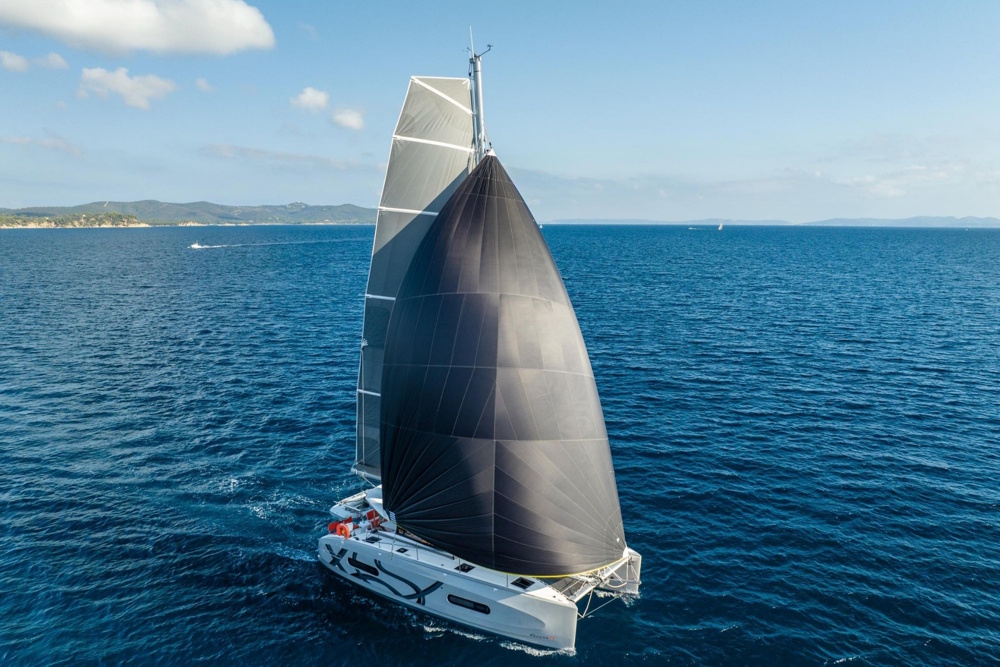
The Excess 11 Hybrid is the first production hybrid catamaran from Excess Catamarans, a brand under the Beneteau Group.

With close to 300 Excess 11s already delivered worldwide, the overall design is proven. The hybrid option builds on that foundation by integrating electric pod drives, a substantial lithium battery bank, and a generator backup into a compact 11-metre cruising catamaran.
The result is a yacht that meets a growing demand for quieter, cleaner marina manouevres, anchoring and quiet short hops with a back-up for longer passages.
Let’s take a closer look:
Key Points
- The Excess 11 Hybrid uses underwater electric pod drives, 2 x 10 kW, running at 48V
- A generator provides backup charging and range extension
- Victron lithium batteries total 46 kWh across six units, split equally port and starboard
- The full hybrid package costs €84,000, approximately €50,000 euros than an equivalent diesel Excess 11 with the lithium battery upgrade
- Nearly 300 Excess 11 units have been sold
- The boat is available with the newer overlapping genoa or a self-tacking jib.
- Folding Flexofold 4-blade propellers reduce drag under sail
Background and Development
Excess Catamarans did not rush into hybrids, they have been developing and testing prototypes for years.

The brand used its Excess 15 E-Lab prototype, launched in 2021, as a development platform, spending two years refining the system before committing to a production model. That testing period shaped the component choices, the placement of hardware, and the energy management approach that appears in the Excess 11.
The Hybrid option was officially launched in late 2025. Similar hybrid options will be developed for other models in its range.
The Propulsion System
Excess have strived to keep things simple here. The heart of the system is a pair of Fischer Panda underwater electric pods, each rated at 10 kW. These are mounted below the aft cabins keeping the intrusion into living space to a minimum. This design does away for the need for angle gears, so 100% of the energy is transferred directly to the propeller.
It’s also a great option for motor-sailing in light winds to increase apparent wind without the smell and noise of diesel power.

Because the motors are submerged, they are cooled by seawater passively, removing the need for a dedicated cooling circuit. The direct-drive also eliminates mechanical transmission losses.
Electric motors provide higher torque, making a maneuverable boat even nippier even in strong winds or currents.
The system runs on 48 volts, a deliberate design decision. At this voltage level, no high-voltage certification is required for servicing. Any competent marine electrician can work on the system, which is an important factor for boats cruising away from specialist facilities.
The Flexofold 4-blade folding propellers, 22 x 18 inches in diameter, are used on both drives. A folding propeller reduces drag significantly when sailing.
Energy Storage and Management
The battery bank consists of six Victron LFP 25.6V/300Ah units, three per hull, giving a total capacity of 46 kWh. Each bank has its own BMS Master LV unit (Battery Management System). The split arrangement, one bank per engine compartment, keeps weight distribution symmetrical and separates the two systems.
This battery technology (Lithium Iron Phosphate (LiFePO4)), is the most stable and safe lithium technology available.
A Victron Multiplus II 48/8000 charger/inverter, rated at 8 kVA, handles conversion between AC and DC and manages shore power charging. This unit is located in the aft engine compartment on the port side.
The battery capacity provides between two and five hours of electric propulsion, suitable for harbour manoeuvres, coastal passages, and anchoring operations. For longer passages or when the batteries are depleted, a Fischer Panda AGT 22000/48 PMS generator, rated at 22 kVA and located in the forward locker to port, takes over.
Another benefit to this set-up is the large battery bank which powers both the motors and the boat’s “house” loads (service). This allows you to run air conditioning all night if you have it without starting the generator.
The generator charges the batteries directly, meaning the electric drives remain the sole interface between the energy system and the propellers at all times: a series hybrid configuration.
How Much Does it Cost?
The full hybrid package is priced at €84,000 euros. That is around €50,000 above the equivalent diesel-equipped Excess 11 with the same battery upgrade.
This represents a very competitive solution from an established builder, with their extensive dealer and support network in place.
Sailing Performance and Rig Options
The Excess 11 has been built to sail, first and foremost. The boat now comes with an overlapping genoa, which shows a speed gain of approximately one knot over the standard self-tacking jib. The benefit is most noticeable in lighter wind conditions, where the larger sail area allows the boat to keep moving.
The standard self-tacking jib is still available as an option for buyers looking for ease of handling and simplicity. Coupled with a Code 0, the boat performs well in light conditions.
The Market Context
The Excess 11 Hybrid has a clear position in the market. Most hybrid and electric propulsion systems are either fitted to larger, more expensive boats, available as semi-custom installations, or they remain prohibitively expensive. The Excess 11 Hybrid is a production catamaran with an attractive price tag. With the extra battery capacity, reduced noise and instant power it ticks many boxes.
The 48V design, the use of established brands (Fischer Panda and Victron), and the generator backup all reflect a system designed for simplicity and real-world cruising. The generator solves the range anxiety debate.
Sailors who want to cover longer distances still have a reliable fallback and of course with two pods you have redundancy baked into the design.
With 300 Excess 11s already sailing, there’s a developed spare parts network, an active owner community, and plenty of practical feedback on how the boat performs in varied conditions.
FEATURES TABLE
| Category | Detail |
|---|---|
| Electric Motors | 2 x Fischer Panda B00-150-8AZ, 10 kW each |
| Motor Type | Underwater pod, direct drive |
| Motor Voltage | 48V |
| Motor Speed | 600 RPM |
| Motor Location | Under aft cabin beds |
| Generator | Fischer Panda AGT 22000/48 PMS |
| Generator Output | 22 kVA |
| Generator Location | Forward locker, port side |
| Charger/Inverter | Victron Multiplus II 48/8000 |
| Charger/Inverter Output | 8 kVA |
| Charger/Inverter Location | Aft engine compartment, port side |
| Batteries | 6 x Victron LFP 25.6V / 300Ah |
| Total Battery Capacity | 46 kWh |
| Battery Configuration | 3 units port, 3 units starboard |
| Battery Management | 1 x BMS Master LV per bank |
| Battery Location | One bank per engine compartment |
| Propellers | Flexofold 4-blade folding, 22 x 18 inches |
| Estimated Electric Range | 2 to 5 hours under power |
| Hybrid Package Price | 84,000 euros excl. tax |
| Price Premium vs Diesel | Approx. 50,000 euros |
| Units Sold (all Excess 11) | Nearly 300 |
| Rig Options | Overlapping genoa (self-tacker option) |
| Genoa Speed Gain | Approx. 1 knot average vs jib |
Summary
We’d say that the Excess 11 Hybrid is the most accessible hybrid catamaran currently available.
Its series hybrid design, using Fischer Panda electric pods backed by a Fischer Panda generator and Victron energy management, is straightforward, serviceable, and engineered for offshore use. The 48V system keeps maintenance accessible without specialist certification.
At €84,000 euros for the full hybrid package, the cost is very reasonable relative to the market, especially when you factor in the additional battery capacity that you enjoy with this set-up.
For buyers looking at hybrid electric propulsion, the Excess 11 Hybrid makes a compelling case. We can see this one doing well.
More Info @ Excess