Cutting Through Water
Catamaran Bow Shapes: a Science and an Art. A guide to why the shape of the bow of your catamaran is so key – for speed, comfort, safety, and overall enjoyment.
Before we throw the lines, we need to go forward and talk about the bow of the boat. The bow is where the hull meets the sea, and how that meeting is managed shapes everything: how fast you go, how dry your cockpit stays, how safe you are in a storm, and how much sail area you need to make good VMG.
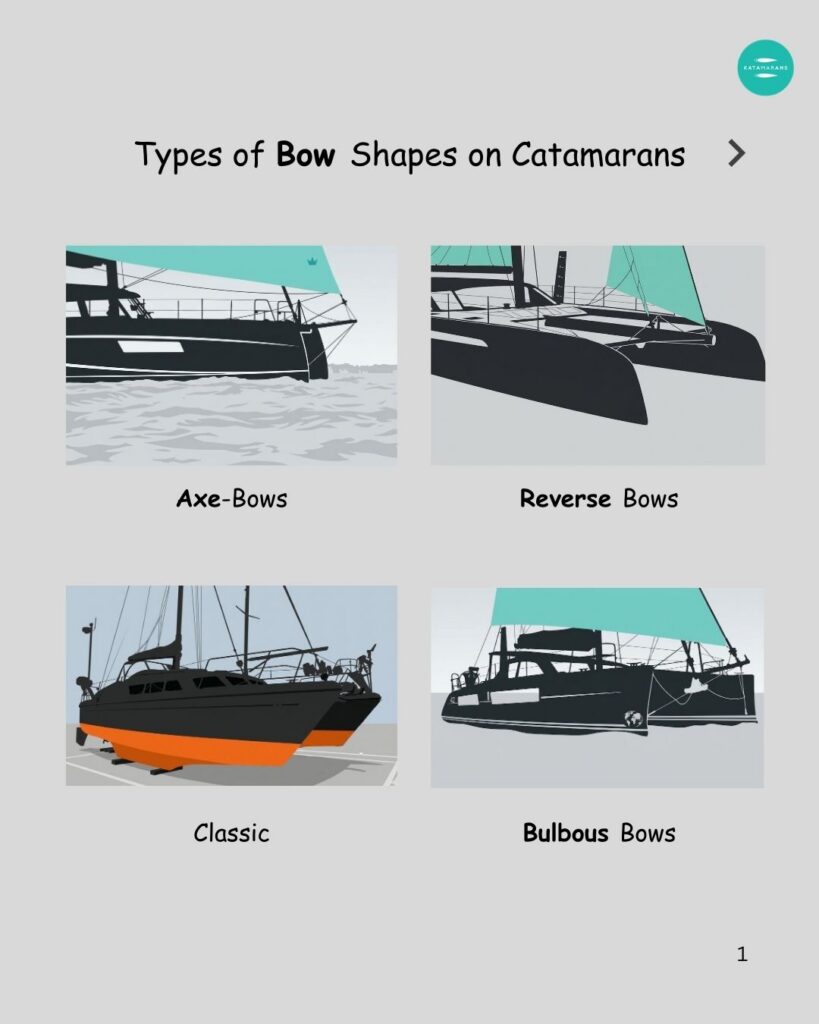
In this guide we look at the four main bow shapes on modern and classic catamarans – the Axe Bow, the Reverse Bow, the Classic Bow, and the Bulbous Bow – explaining what each one does, the pros, and where the design falls short. We’ll take ideas from commercial shipbuilding, demystify the industry terminology, and dip into the physics that explain why shape matters so much.
Think of the bow as a catamaran’s first connection with the ocean. Some bows are designed to force their way through the waves; others work with the waves, or dampen the force from the waves. Each one tells you something important about the boat’s character and have their advantages and disadvantages.
“The bow is a catamaran’s first connection with the ocean – it tells you much about the boat’s character before you’ve even left the dock.”
The Axe Bow (Plumb Bow)
The no-nonsense modernist – vertical, aggressive, and unapologetically efficient.
What It Looks Like
Stand on a dock and look at a catamaran with an axe bow: the stem – the leading edge of the hull – is very nearly vertical, like cliff face. It doesn’t lean forward into the water and it doesn’t sweep elegantly back. The name “plumb bow” comes from the builders’ plumb line, a weight on a string that hangs vertical. That’s exactly how the stem looks. “Axe bow” refers to a particularly thin, knife-like entry – literally shaped like the blade of an axe.
What It Does
The axe/plumb bow is a good balance between waterline length and deck length. Because the bow doesn’t overhang the water, every inch of hull is doing useful work – effectively giving you a longer racing lane for the same overall boat length. The vertical entry also means the hull slices into oncoming waves rather than riding up over them. Think of the difference between chopping through a log and sawing through one.
Advantages
- Maximum waterline length for given overall length
- Excellent upwind performance – reduced pitching
- Very efficient at speed – less wave-making energy wasted
- Better performance in choppy head seas
- Clean, modern aesthetic
Disadvantages
- Can be “wet” – waves come aboard more readily without flare
- Reduced buoyancy forward – risk of bow-diving in big seas
- Less forgiving if pushed hard in extreme conditions
- Reduced accommodation space forward
The Reverse Bow
The futuristic look – leaning back against convention, trading tradition for physics.
What It Looks Like
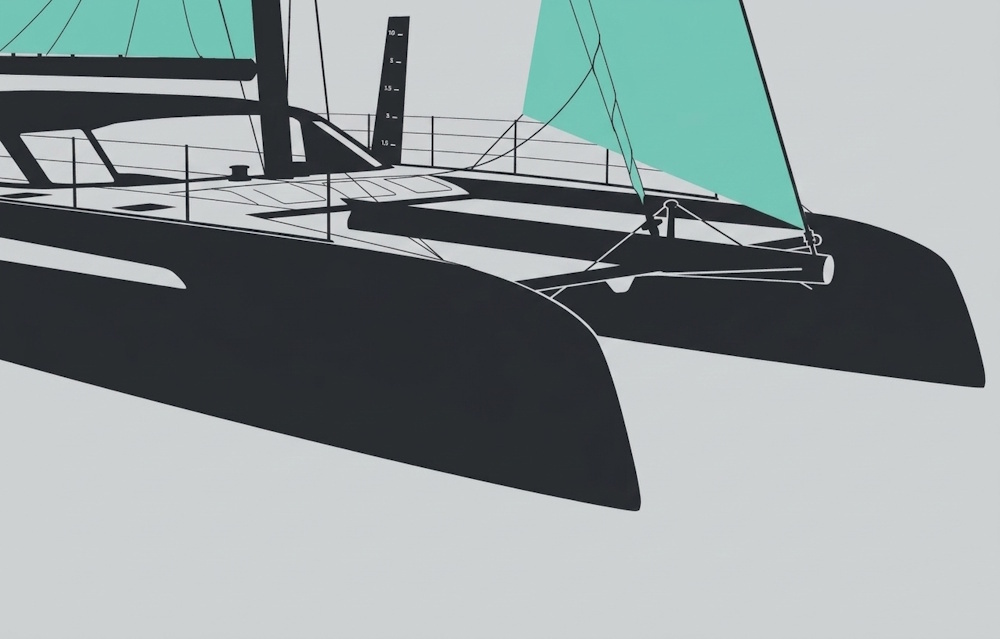
The reverse bow angles back from the waterline as it rises. At deck level, the bow is set noticeably further back than where the hull enters the water. The stem rakes aft rather than forward or straight, giving a distinctive backwards slant. You’ll also hear it called an “inverted bow,” a “wave-piercing bow,” or the commercial X-bow™ – trademarked by Norwegian design firm Ulstein for their offshore supply vessels.
What It Does
The reverse bow amplifies the wave-piercing properties of the axe bow. Rather than slicing into a wave at a vertical angle, the reverse bow drives the hull into the wave and uses the overhanging deck structure to shed water sideways. The result: a smoother motion in head seas – the bow doesn’t rise up over the wave crest, it bores through it. On large offshore workboats, the Ulstein X-bow has demonstrated fuel savings of 8–10% in rough conditions. Less pitching means less energy loss. Work is needed to ensure that spray from the leeward bow is safely channelled downwind.
Advantages
- Improved motion comfort in steep, short head seas
- Less hobby-horsing than conventional bow shapes
- Longer waterline than classic overhanging bows
- Striking, distinctive looks
Disadvantages
- More Complex to build – structure must handle reversed wave loads
- Reduced anchor locker volume at the bow
- More susceptible to damage from floating debris or at the dock
- Less intuitive for traditionally-trained sailors in marinas
- A poorly designed reverse bow can be worse than a conventional one
The Classic (Raked / Flared) Bow
The grand tradition – forward rake, generous flare, and centuries of accumulated wisdom.
What It Looks Like
This is the bow shape most people picture when they close their eyes and imagine a sailing yacht – a graceful design, with the stem raking towards the bow at perhaps 20–35 degrees from vertical, and the topsides flaring outward as they rise. The bow overhangs the water slightly. It’s handsome, familiar, and there’s a reason it’s been used for over a century. “Flare” refers to how quickly the hull sides angle outward above the waterline; a classic bow typically has generous flare.
What It Does
The forward rake increases buoyancy when the bow dips into a wave – as the flared hull presses down, more volume enters the water, pushing back. Think of it as a built-in self-righting mechanism. The flare also acts as a defelctions for incoming water, throwing spray away from the boat and keeping the deck drier. On a catamaran, this is useful because of the bridgedeck. The classic bow is still an excellent choice for trade-wind cruising – consistent beam or broad reaching in moderate seas – where its compromises matter least.
Advantages
- Good reserve buoyancy – forgiving in moderate conditions
- Proven design with centuries of refinement
- Generous forward accommodation – volume for a large bow cabin
- Familiar handling for traditionally-trained sailors
- Graceful, classic aesthetics appeal to many buyers
Disadvantages
- More hobby-horsing than plumb or reverse bows
- Shorter effective waterline for a given overall length
- More wave-making resistance at higher speeds
- Overhang adds weight without adding useful waterline
- Can slam in steep, short seas
The Bulbous Bow
The underwater secret weapon – beloved by supertankers, occasionally seen on sailing catamarans.
What It Looks Like
Look at any large container ship or cruise liner in dry dock and you’ll see a rounded protrusion extending forward from the hull below the waterline – sometimes described as a “bulge,” a “nose,” or more elegantly, a “ram.” It resembles the forehead of a sperm whale. This is the bulbous bow. The technology was pioneered by US Navy Admiral David Taylor around 1907 (the “Taylor bulb”) and adopted by commercial shipping from the 1950s onward, saving the industry billions in fuel annually.
What It Does
On catamarans, the design is more about increasing bouyancy lower down in the bow without the increasing the susceptibility to damage in collisions.
Advantages
- Can reduce wave resistance at design speed
- Well proven in commercial shipping at large scale
- May reduce fuel consumption in catamarans at cruise speed
- Can add useful buoyancy if designed cleverly
Disadvantages
- Speed-specific – benefits disappear outside the design speed range
- Displacement-sensitive – only works at designed loading
- Adds complexity, weight, and cost
- Grounding damage risk from the protruding bulb
- Marginal benefit on a lightweight sailing catamarans
The Language of Bow Design
Naval architecture has its own vocabulary. Here are the terms most likely to crop up when designers, builders, and owners discuss bow shapes.
The foremost structural member of the hull – the actual leading edge. A vertical stem = plumb bow; forward-raked = classic bow; backward-raked = reverse bow.
The angle of the stem from vertical. Positive rake = bow leans forward (classic). Negative rake = leans backward (reverse). Plumb = zero rake.
The outward angle of the hull topsides above the waterline. High flare sheds spray and keeps the deck dry; it also increases reserve buoyancy. Performance cats often have minimal flare.
LWL = Length at Waterline. LOA = Length Overall (including overhangs). Minimising the gap between them is a key element of modern plumb bow design. A classic bow may have LWL 5–10% shorter than LOA.
The half-angle at which the bow waterlines meet the centreline in plan view. A fine (narrow) entry cuts through waves with less resistance; a blunt entry is more forgiving but slower.
Hull volume above the waterline at the bow. High volume pushes back when the bow dips (helpful cruising); low volume lets the bow pierce through the wave (helpful at speed).
Fore-and-aft pitching motion on waves. Reduced by minimising bow volume and bringing weight toward amidships. Plumb and reverse bows help by reducing pitch-restoring forces at the bow tip.
A design philosophy where the bow goes through waves rather than over them. Adopted by catamaran ferry designers (Incat, Austal) in the 1990s. Reverse and axe bows both embrace this principle.
The original name for the bulbous bow, honouring US Navy Admiral David Taylor who pioneered the concept circa 1907. Most effective on large, heavy displacement ships at consistent speeds.
Registered trademark of Norwegian firm Ulstein Group – a highly developed reverse bow for offshore supply vessels. Has demonstrated significant fuel savings in North Sea conditions and influenced catamaran designers.
The opposite of flare – hull sides angle inward above the waterline. Creates a narrower deck than hull beam. Rare on catamarans where deck space is precious.
How far from the pitch axis (amidships) the boat’s mass is distributed. A large gyradius = violent hobby-horsing. Concentrating mass amidships reduces it, improving seakeeping.
The Physics & Mathematics – A Gentle Dive
You don’t need a degree in naval architecture to understand the physics at work, but a flavour of the mathematics is interesting. These aren’t aesthetic choices – they’re engineering decisions with real, quantifiable consequences.
Hull Speed – Waterline Length Matters
The concept of “hull speed” – the theoretical maximum speed of a displacement hull – was formalised by William Froude in the 1860s. The relationship is beautifully simple:
V_hull ≈ 2.43 × √LWL (knots, LWL in metres). This gives the speed at which wave-making resistance rises sharply – the “hull speed wall.” A boat with LWL of 40ft has a theoretical hull speed of 8.5 knots; increase LWL to 44ft and it rises to 8.9 knots. For sailing catamarans, that’s significant.
That Froude Dude
Note that catamarans – being light, narrow, and slender – routinely exceed their “hull speed” by operating in a semi-planing or wave-piercing mode. The Froude Number (the non-dimensional ratio of speed to √(LWL × g)) is the more useful tool for multihulls. Catamaran designers typically aim for Froude Numbers above 0.4 where wave-piercing behaviour dominates.
The Kelvin Wake – A Universal Law
Lord Kelvin, 1887
Any object moving on the surface of deep water creates a wake with a characteristic angle of approximately 19.47° – regardless of speed. This is a consequence of the dispersion relationship for gravity waves. Every bow shape must manage this Kelvin wake system. The question is whether it fights it, surrenders to it, or cleverly works with it. The bulbous bow’s trick is to introduce a third wave system that destructively interferes with the bow’s transverse wave, reducing energy lost to wave-making.
Wave-Making Resistance
Pitch Gyradius & Seakeeping
The tendency of a vessel to hobby-horse is governed by its “pitch gyradius” – how far from the pitch axis (roughly amidships) the boat’s mass is distributed. A long, heavy bow increases the gyradius and makes the boat pitch more, like a see-saw with weights at both ends. This is the justification for the wave-piercing reverse bow: by removing buoyancy from the bow tip, the designer reduces the pitch-restoring force at the bow, which lowers the natural pitching frequency and makes the boat less likely to resonate with common wave periods of 6–12 seconds.
Summary – Four Bows, Four Philosophies
Here’s how the four bow types stack up across key criteria for catamaran owner:
| Bow Type | Upwind Speed | Comfort in Chop | Accommodation | Ideal For |
|---|---|---|---|---|
| Axe / Plumb | ★★★★★ | ★★★★☆ | ★★★☆☆ | Performance |
| Reverse | ★★★★☆ | ★★★★★ | ★★★☆☆ | Offshore Comfort |
| Classic Raked | ★★★☆☆ | ★★★☆☆ | ★★★★★ | Charter / Cruising |
| Bulbous | ★★★★☆ | ★★★☆☆ | ★★★☆☆ | Motor / Ferry |
“There is no perfect bow. There is only the right bow for the right sea, sailed by the right crew, at the right speed.”
The trend is towards plumb and reverse bows as sailors demand better upwind performance and offshore capability – and as design software and modern materials make more complex hull forms achievable at production-boat prices. The classic bow isn’t going anywhere, but it is more applicable to the volume-oriented charter fleet, where space upfront pays dividends in rental income. Even in this sector, plumb bows dominate these days with the trend for fatter bows to accommodate spacious master cabins.
Whatever bow your catamaran has, understanding the theory behind the design is important. You’ll know when to push the boat and when to ease off; you’ll read the sea differently; and you’ll have more to discuss at the dock!