Yacht Design Collective: Multihulls Expertise and the Future
We recently met François Pérus from the Yacht Design Collective at the Cannes Yachting Festival, and it was not just the multihulls in YDC’s portfolio that impressed – it was the variety of their design journey: with performance, elegance, innovation, use of space and light and connection to the water all shining through.
From their work on ITA Catamarans to the striking SwissCat 55, floating restaurants on the Seine, and houseboat projects, Pérus and co-founder Romain Scolari are building a reputation in multihull design and beyond that is making waves.
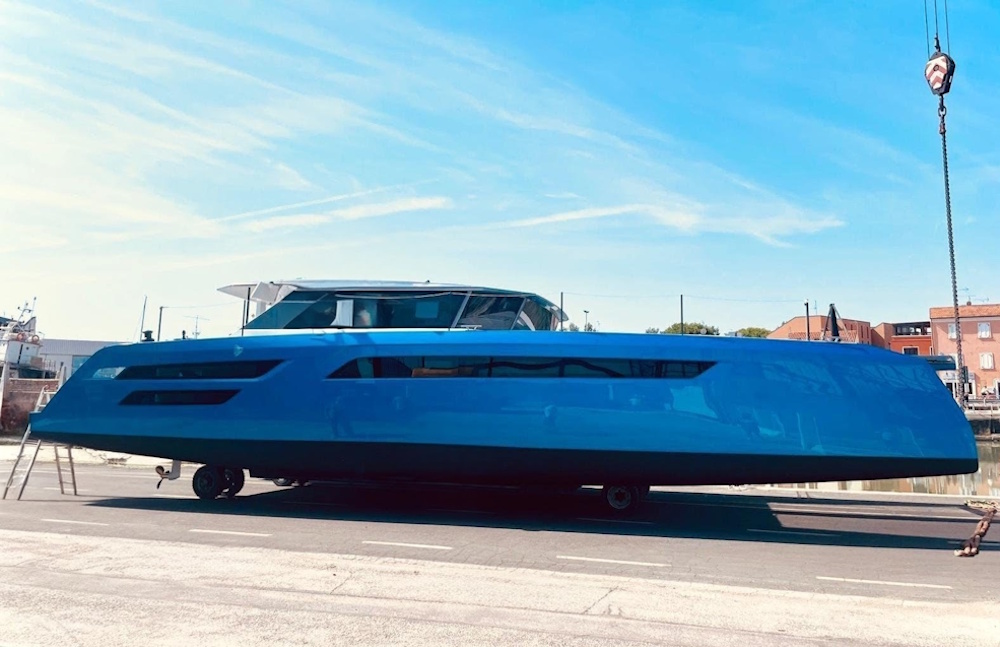
Swisscat 55
Origins & Team
Yacht Design Collective was founded in 2015 by François Pérus and Romain Scolari.
François Pérus trained in France (Brittany, Paris) and abroad with a strong interest in multihulls and composite construction. One of his first projects was building his own catamaran, which introduced him very quickly to the practical demands of hull form, structural integrity, weight and sailing behaviour.
Romain was Project Manager at Seine Design in Paris for 5 years, managing the studies and the building of large custom ships and floating buildings.
Key Projects: Multihull Design at the Core
Below are some of the projects that have helped build the reputation of YDC so far
| Project | Type & Scale | Unique Features / What Makes It Distinctive |
|---|---|---|
| SwissCat 55 | 55-foot performance cruising catamaran (semi-custom) | Designed by Pérus and YDC, built by Top Marine Construction in Italy. The SwissCat 55 uses wave-piercing reverse sheer bows, semi-planing hulls, daggerboards for improved upwind ability and reduced wetted surface, while maintaining a comfortable and light interior. With plenty of natural light via large hull and roof openings. An impressive blend of comfort and performance. |
| ITA Catamarans (ITA 14.99, 15.49.) | Fast cruising catamarans. | The ITA range shows YDC’s skills in designing performance boats: light displacement, clean lines, material innovation (epoxy, carbon where needed) and attention to sailing characteristics. These boats are designed to be safe, fast, and comfortable. |
| Trimaran / Eco-Trimaran “Kanka” | Small-scale, experiment/ecological prototype | Kanka is a 4-metre trimaran, built in plywood + eco-based epoxy resin. It’s portable, simple, affordable. It reflects YDC’s interest in more than just large blue water yachts: the craft traditions, light footprints, sustainability, and hands-on sailing. |
Other projects include the Corsair 880, Corsair 760, Pulse 600 (trimarans) among others, with a strong emphasis not only on speed but foldability, ease of transport, and simplified building methods.

Corsair 880
They have also designed floating buildings including a restaurant on the Seine, and houseboats which demonstrates the interest that YDC has in general marine architecture. These projects have fuelled their design philosophy: a focus on weight control, form, space, and flooding their projects with natural light.
Design Philosophy
What strikes me about the Yacht Design Collective is their multihull work which is central to their portfolio. They balance performance (daggerboards, lightweight hulls, planing/semi-planing forms) with comfort (interior layout, light, living up to sea conditions).
They place a strong value on sustainability: in materials (composites, epoxy resin, carbon where necessary), in smaller boats / prototypes (e.g. the Kanka trimaran project) and in build methods.

ITA Catamarans
They have been expanding from custom, one-off designs towards more significant production/semi-production designs (the ITA Catamarans, Corsair Trimarans and Seawind 1370 being key markers). Their ability to deliver on both aesthetic and technical fronts continues to build their reputation in the industry.
Pandora
Another project worth mentioning is the Pandora 8.50 catamaran, which later became the Xquisite30.
This project started as a school project for François’ 2nd master degree, and a year after graduating he set about building her.
He built the prototype himself with a carpenter in Turkey, set up a small shipyard and worked there for a couple of months.
That boat allowed the team to have a hands on experience and understand that what works on the 3D CAD is not always so easy to handle in real life. A valuable experience.
Amd it allowed the team to push their design concept on the hull shape with a flatter wider section to limit rocker and improve acceleration and top speed.
François still sails her in the Morbihan Gulf.
The Black Pepper Code 69 is another key design milestone.
Aims for the Future

Maison de la Radio
Some of the challenges we look forward to seeing them tackle in the future include the following:
- Scaling up: moving from custom or semi-custom to larger series while maintaining quality, innovation, and performance. Their successful Seawind 1370 design is a key marker.
- Sustainability: both in materials (less carbon/epoxy/composites with high environmental cost) and in operations (fuel, emissions, energy use aboard). Balancing performance with environmental impact.
- Innovation in construction & form: daggerboards, hull shapes, integrated bridgedecks, wave-piercing bows, etc. Also in production methods, weight control, perhaps foils.
- User experience: balancing luxury or comfortable living spaces with speed, seaworthiness, ease of handling (single-handed or small crew) and safety. Continuing the use of light and transparency (views, openings).
- New markets: floating architecture, restaurants, houseboats, river boats.
Looking Ahead
Other notable projects include the Black Pepper Code C.69, a vessel that looks like it might take podium place in the luxury performance multihull segment.
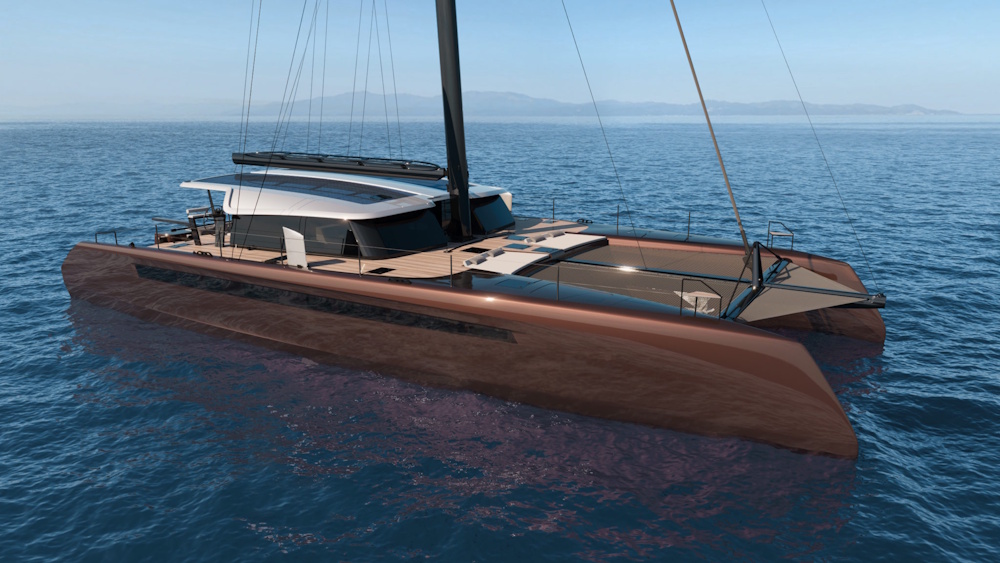
Rather than resting on their laurels with that project, the brief was extended to the Black Pepper C.100, which will surely be the flagship for the group.
This carbon-built catamaran will be over 30 meters in length, a striking design with sharply inverted bows.
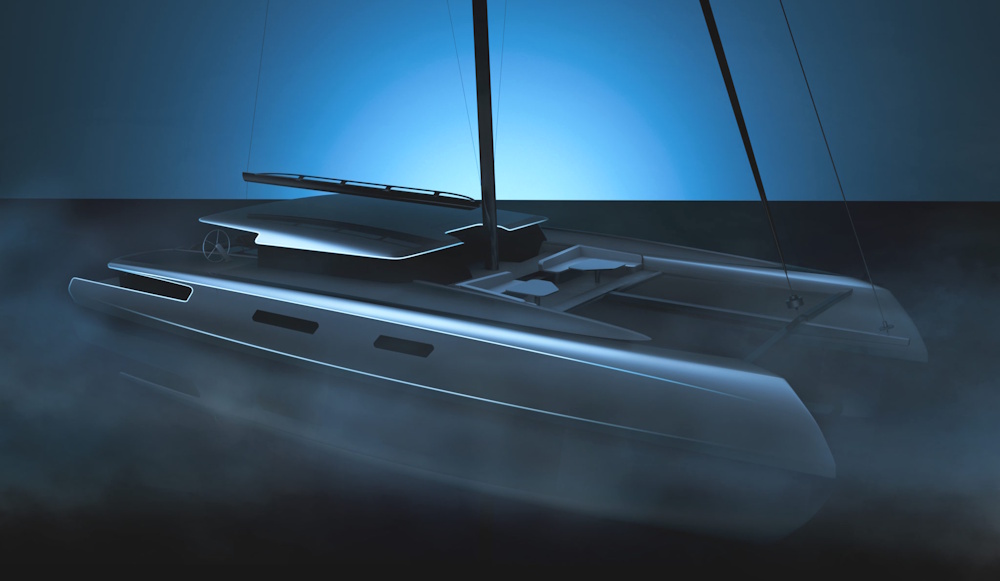
The sculpted coachroof adds refinement, while the aggressive profile promises exceptional performances with the most luxurious comfort.
The team is also looking at
- hybrid or alternative propulsion (electric, solar, foils) especially for motor-multihulls or support vessels, or as auxiliaries.
- Integration of more sustainable materials (bio-resins, recycled composites, etc.), with attention to whole lifecycle (build, maintenance, end-of-life).
- More crossovers between floating architecture and multihull boats: houseboats, floating restaurants as design labs for new techniques, optimal use of space and light, etc.
- Development of “kit” catamarans—widening the accessibility of their designs and looking at ease of transport, and shared ownership models.
Sustainability for the Yacht Design Collective is primarily about designing boats with good sailing abilities.
They are looking closely at the new wing designs, especially the ACC-Wing, which looks like a great solution for bigger yachts, where it can be tricky for crew to handle big sails and high loads.
Summary
Yacht Design Collective is a maturing studio with a strong foundation in multihull naval architecture, excelling in the performance-comfort balance, with elegant forms, and increasing ambition. Their work on the ITA range, Black Pepper Code Yachts and the SwissCat 55 shows they are walking the talk with speed, style, and livability.
We’re looking forward to following them in the years ahead!