
Electric-Hybrid Catamarans: The Future?
The catamaran market is experiencing a transformation as manufacturers embrace electric-hybrid propulsion systems, creating yachts that are redefining sailing. This emerging segment represents a technological evolution, a reimagining of how boats are powered when the wind drops.
Market Drivers: A Perfect Storm for Change
The electric-hybrid catamaran market is experiencing healthy growth, driven by powerful converging forces. The hybrid boat market is estimated at USD 1.9 billion by 2024 and is expected to reach USD 5.9 billion by 2034, an impressive CAGR of 11.7%. This growth reflects a fundamental shift in consumer priorities and regulatory landscapes.
Antares 44 Hybrid
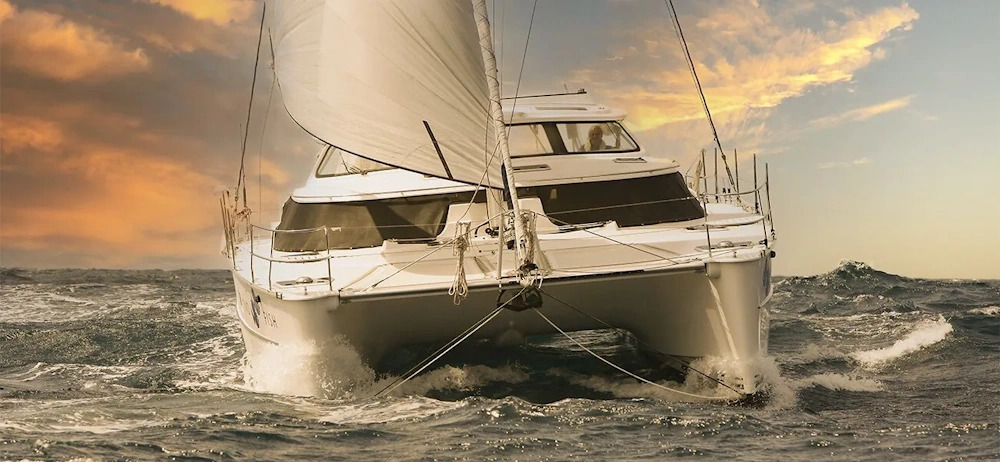
Environmental regulations are providing the strongest driver for this market transformation. The International Maritime Organization’s newly approved Net-Zero Framework, set to enter force in 2027, mandates ships to reduce greenhouse gas emissions by 30% by 2035 and 65% by 2040. While these regulations target commercial vessels over 5,000 gross tonnes, they’re creating ripple effects throughout the marine industry as manufacturers anticipate similar requirements for leisure craft.
Rising environmental consciousness among boaters is another powerful driver. Current boat buyer, particularly younger demographics, are seeking sustainable alternatives that align with their values. “Green boating” has evolved from a niche to a mainstream expectation, with marinas now offering preferential treatment to low-emission vessels.
The Technology has reached a critical inflection point. Lithium battery technology has achieved the energy density and reliability necessary for marine applications, while electric motors have become more efficient and maintenance-free. This has made hybrid systems more viable, and in some cases superior to traditional diesel-only propulsion.
Manufacturers are leading with innovative solutions. Windelo has pioneered comprehensive hybrid systems that combine 20kW electric motors with extensive solar arrays and hydrogeneration capabilities. Leopard Catamarans introduced the Leopard 46 Hybrid, featuring 25kW electric pod saildrives that can provide four hours of motoring at 6 knots or 920 miles in hybrid mode. Sunreef has pushed boundaries further with their Eco series, featuring integrated solar “skin” technology and battery banks approaching one megawatt-hour capacity.
Serial vs. Parallel Hybrid Systems: The Technical Divide
The choice between serial and parallel hybrid configurations is one of the key decisions you’ll need to make in electric-hybrid catamaran design, with each approach offering distinct advantages and challenges.
Serial Hybrid Systems
Serial hybrid systems operate by decoupling the energy generation systems from the propulsion system. In this configuration, diesel generators work as back-up to solar, hydrogeneration and wind turbine power that charge the batteries, which power the electric motors connected to the propellers. This arrangement offers several advantages:
Optimised engine operation is the primary benefit of serial systems. The diesel generator (if even needed) can operate at its most efficient RPM regardless of vessel speed, maximizing fuel efficiency and minimising emissions.
Simplified control systems make serial hybrids attractive for certain applications. The electric motors provide instant torque and precise control, making docking and manoeuvring easier. The system also operates quietly when running on batteries alone.
Windelo has emerged as the leading proponent of serial hybrid systems in the catamaran market. Their 50-foot model features dual 20kW electric motors powered by a 1,120Ah 48V lithium battery bank, with charging provided by solar panels (over 5kW), wind turbines, hydrogeneration, and an 18kW backup generator. At 6 knots, the system provides approximately 3 hours and 45 minutes of pure electric operation, with the ability to cruise over 1,100 nautical miles in hybrid mode.
However, serial systems face challenges. The electric motors must be sized for worst-case conditions, requiring substantial power and cost. Additionally, double energy conversion (diesel to electricity to propulsion) reduces overall efficiency when the back-up generator is in use compared to direct mechanical drive.systems. There is arguably less redundancy here and it is important to keep the electrical connections in the system well maintained.
Parallel Hybrid Systems
Parallel hybrid systems maintain the traditional mechanical connection between the engine and propeller while adding an electric motor on the same shaft that can either assist or replace the diesel engine. This configuration offers several advantages:
Operational flexibility is a key advantage to parallel systems. You can choose to run on diesel alone, electric alone, or combine both power sources as needed. This redundancy is valuable for long-range cruising, where the backup capability of either system gives you peace of mind.
Higher efficiency at cruising speeds (when using the diesel backup) gives parallel systems an advantage. When operating under diesel power, the system avoids the energy losses associated with double conversion, making it more efficient for extended motoring. The diesel part acts as a generator charging batteries for later use.
HH Catamarans has installed one of the most well known parallel hybrid systems. Their HH44 features electric motors that can provide 7.5 knots for 2.5 hours (18 nautical miles) on battery power alone, with up to 3.2kW of solar panels and hydrogeneration capabilities. The system allows you to switch between diesel and electric modes, with both systems capable of operating independently.
Antares Catamarans has also embraced parallel hybrid technology, partnering with Hybrid Marine to develop a system that provides dual 12kW electric motors alongside traditional diesel engines. This configuration offers good redundancy—you can run one side on diesel and the other on electric, providing multiple options in the event of a system failure.
But parallel systems are less of a “pure” solution when you are running on solar and hydrogeneration alone, and arguably more complex.
Comparative Analysis: Choosing the Right System
The choice between serial and parallel systems depends on the use of your boat and your priorities:
For coastal cruising and short-range applications, serial systems excel due to their ability to operate in pure electric mode for extended periods. The Windelo approach works well for European coastal cruising, where port-to-port distances are moderate and environmental regulations are becoming stricter.
For bluewater cruising and long-range voyaging, parallel systems offer practicality. The ability to fall back on traditional diesel propulsion provides confidence for ocean passages, while the electric component delivers significant fuel savings and environmental benefits. That said, serial systems are building the long term miles with Windelo logging more and more ocean crossings.
Cost and weight also play a crucial role. Serial systems require larger, more expensive electric motors and battery banks, while parallel systems use smaller electric components supplemented by conventional diesel engines. However, long-term savings from reduced fuel consumption and maintenance can offset higher initial investments. The serial set-up is arguably a simpler set up and you can set sail with 2 back up generators to increase redundancy.
Maintenance varies between systems. Serial systems have fewer mechanical components, reducing maintenance requirements. However, the sophisticated battery management and power electronics have their own service challenges. Parallel systems have more familiar diesel components while adding electrical complexity.
The Road Ahead
The electric-hybrid catamaran segment is a convergence of technological capability and market demand. As battery technology continues to improve and costs decrease, we expect to see even more capable systems with greater range. The marine hybrid and full electric propulsion market is expected to grow to $8.22 billion by 2029.
Leading manufacturers are pushing boundaries further. Fountaine Pajot has announced plans to make 100% of its fleet hybrid-electric by 2030, while Sunreef continues to develop solar integration technology with their Solar Skin 3.0 system. Max Cruise Marine has proven theviability of hybrid systems by sailing their 44SC hybrid catamaran 10,000 nautical miles from Vietnam to France using only 656 liters of diesel fuel.
The choice between serial and parallel hybrid system depends on individual cruising patterns, budget considerations, and personal priorities. Both approaches offer advantages over traditional diesel-only propulsion, delivering reduced emissions, lower operating costs, and higher onboard comfort.
As the technology matures and infrastructure develops, electric-hybrid catamarans are poised to become the new standard for cruising, offering sailors the ability to explore our oceans with a reduced environmental impact while maintaining the performance and reliability essential for safe passage-making.
ed showing propulsion type, power and battery capacity
Electric-Hybrid Catamarans: Propulsion System Comparison
Below is a table summarizing key specifications for the electric-hybrid catamarans discussed previously. The information focuses on propulsion type, power output, and battery capacity as available from reported sources.
| Yacht | Propulsion Type | Power | Battery Capacity |
|---|---|---|---|
| Windelo 50 | Serial Hybrid | Dual 20kW electric motors, 18kW backup generator. Shaft. | 1,120Ah 48V lithium battery bank |
| Leopard 46 Hybrid | Serial Hybrid | 25kW electric pod saildrives | Not explicitly mentioned |
| Sunreef Eco Series | Serial Hybrid | Not explicitly mentioned | Approaching 1 megawatt-hour capacity |
| HH44 | Parallel Hybrid | Electric motors providing 7.5 knots for 2.5 hours | Not explicitly mentioned, 3.2kW solar panels |
| Antares Catamarans | Parallel Hybrid | Dual 10kW electric motors alongside diesel engines. Shaft- | 48kWh Lithium |
| Max Cruise Marine 44SC | Parallel Hybrid (type not specified) | Not explicitly mentioned | Not explicitly mentioned |
- Windelo leads the serial hybrid system pack with substantial battery storage and multiple renewable charging methods.
- Sunreef is embracing a similar approach, pushing for increased electric-only range and solar integration.
- HH, Leopard and Antares favour parallel systems, providing diesel redundancy alongside electric operation.
- Max Cruise Marine demonstrates long-range hybrid cruising.