
Windelo Adds a Parallel Hybrid Option
The Key Changes
Windelo, the eco-performance catamaran builder based in Canet-en-Roussillon, has announced a second propulsion option for its 50- to 62-foot range. The shipyard launched their brand with a standard serial hybrid configuration: electric motors drive the boat, and one or two diesel generators act as backup, with no direct mechanical link between the combustion engine and the drivetrain.
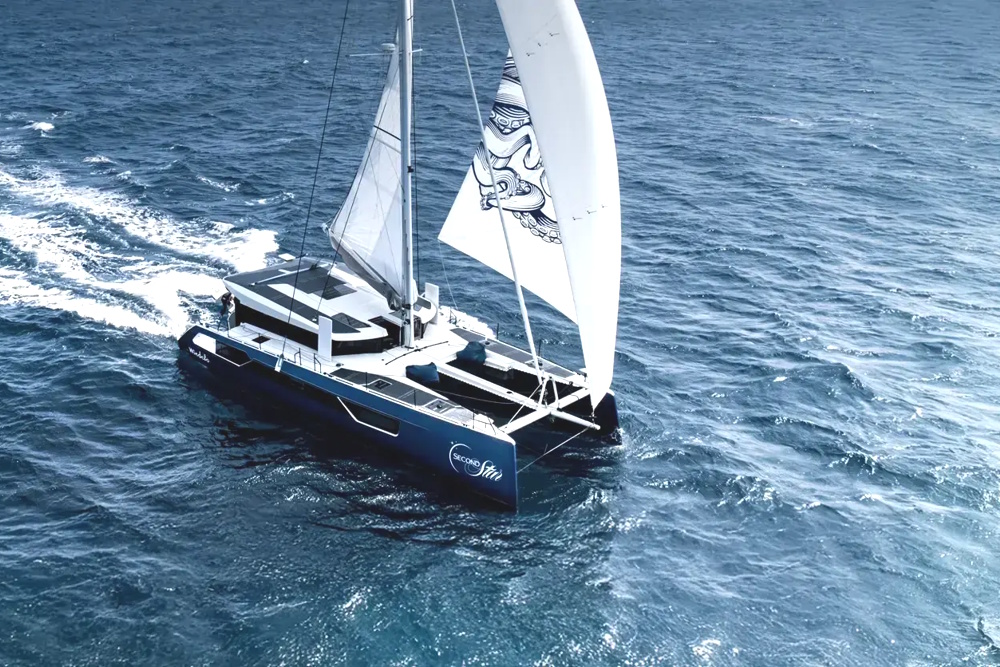
That system remains the default. The new Dual Propulsion option is a parallel hybrid, pairing diesel engines on saildrives with secondary electric motors. Both sources of power can drive the boat independently, or together.
This represents a widening of the market for Windelo. Electric Propulsion, (its serial hybrid configuration), remains the standard system across the range. Dual Propulsion is an alternative for buyers who want diesel back up without giving up electric operation for day-to-day use.
Comparison Tool
Interactive comparison of Windelo Electric Propulsion (serial hybrid) versus Dual Propulsion (parallel hybrid)Electric Propulsion
Serial hybrid: generator charges batteries only; electric motors drive the boat
Motoring range (50–55ft models)
Background
Windelo was founded in 2019 by Olivier Kauffmann and his son Gautier, following several years of materials research with the Mines d’Alès engineering school in France. The shipyard is relatively boutique, with around 10 boats per year, and has positioned itself around three principles: eco-design & materials, energy autonomy, and electric propulsion.
The hull construction sets Windelo apart. The sandwich composite uses basalt fibre (from volcanic rock) alongside a PET foam core made largely from recycled plastic bottles. This reduces CO2 emissions in production by roughly 50% compared to conventional GRP construction. PET foam accounts for around 56% of the build by area, with the remainder in PVC where structural demands require it.
The current range includes the Windelo 50, 54, 58, and 62, with Sport variants of each (51, 55, 59, 63) offering more performance, lighter displacement and sharper handling. The first hull, a Windelo 50 Adventure named Hakuna Matata, completed a 20,000-mile Atlantic circuit and has become something of a reference point for the brand who are now “walking the talk” with many transoceanic passages.
The electric propulsion system was developed with Bellmarine, a Dutch specialist in marine electric drive systems, and that relationship now extends to the Dual Propulsion hardware.
The Standard System: Electric Propulsion (Serial Hybrid)
In a serial hybrid, the combustion engine has no direct mechanical connection to the propellers. It functions purely as a generator, charging the battery bank. Propulsion is handled entirely by the electric motors. On a Windelo, this means the 18 kW diesel generator only kicks in when renewable inputs (solar, hydrogeneration, wind turbines) are insufficient to maintain battery state of charge or when extended motoring is required.
On the 50- to 55-foot models, the system consists of:
- Two 20 kW Bellmarine brushless, liquid-cooled electric motors on shaft drives
- A 48V lithium battery bank of approximately 60 kWh (1,120 Ah).
- An 18 kW diesel generator (with 500-litre fuel tank) as backup
- Solar panels (up to 5,680 W on the 54, up to 8,000 W on the 62)
- Hydrogeneration as standard
- Optional 48V wind turbines
The Windelo 50 draws 10 kW at 6 knots and 15.6 kW at 7 knots. Power demand rises steeply above that: 27 kW at 8 knots. The practical all-electric range at 6 knots is approximately 4 hours, or roughly 22 to 24 nautical miles. With the generator running continuously, the motoring range extends to around 1,000 nautical miles.
This set up comes with shaft-drive known for its low maintenece and involving a simpler, more accessible drivetrain. Combined with brushless electric motors, which have minimal wear parts and no belts, servicing requirements are lower.
The system is managed through a unified console that displays energy production, consumption, battery status, and propulsion state. All systems are connected through a single interface, ideal on long passages when mamanging power balance is key.
The New Option: Dual Propulsion (Parallel Hybrid)
In a parallel hybrid, combustion and electric sources can each drive the boat independently, or in combination. Windelo’s Dual Propulsion system, also developed with Bellmarine, uses:
- Two 57 hp diesel engines on saildrives
- Two 18 kW Bellmarine brushless, liquid-cooled electric motors (also on saildrives)
- 48V lithium battery banks
- Hydrogeneration, solar, and wind turbines (the same renewable inputs as Electric Propulsion)
The electric motors handle harbour manoeuvres, anchorage approaches, and short-duration motoring (under 4 hours), which Windelo estimates accounts for more than 80% of engine use on a bluewater cruising catamaran. Electric range is the same as the standard system: up to 4 hours at 6 knots.
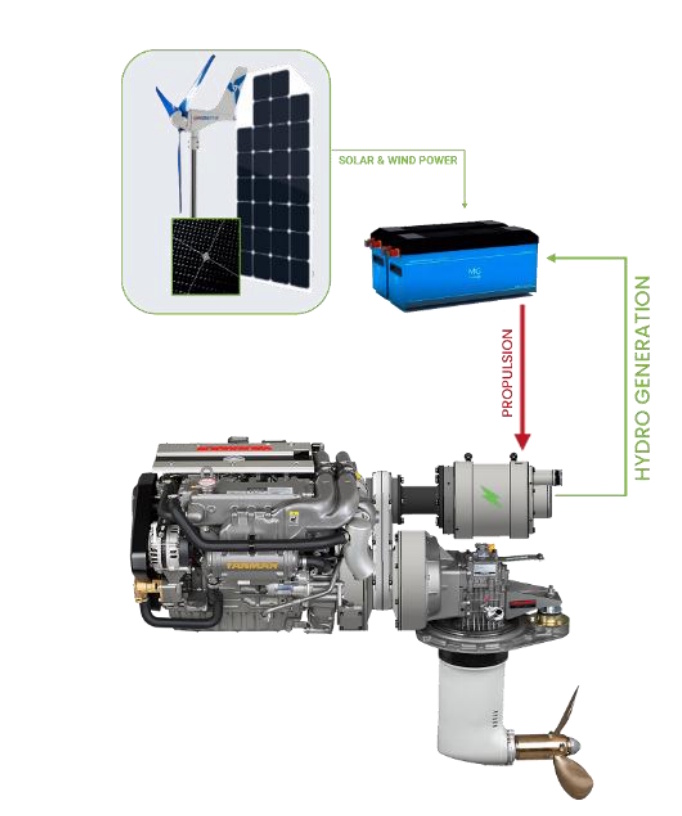
For extended passages at sustained speed, the diesel engines take over, providing a motoring range of 600 to 800 nautical miles.
One interesting feature of the parallel set-up is mixed-mode operation: one hull running diesel, the other in electric. Windelo claim this reduces overall consumption and emissions relative to running both diesel engines at the same time.
The diesel engines also function as generators, capable of pushing in up to 24 kW (48V) to recharge the batteries while powering the boat.
This set-up uses saildrives (Dual Propulsion) rather than shaft drives (on the Electric Propulsion). It does come with more maintenance, but is, of course, a proven design offshore.
Comparing the Two Systems
Both systems share the same emphasis on renewable energy (solar, hydrogeneration, wind), the same Bellmarine electric motor supplier, and the same aim of using electric drive for the majority of powered operation. The key differences are in the drivetrain design, the combustion hardware, and the extended range capability.
The electric motors in Dual Propulsion are rated at 18 kW rather than 20 kW, a modest reduction.
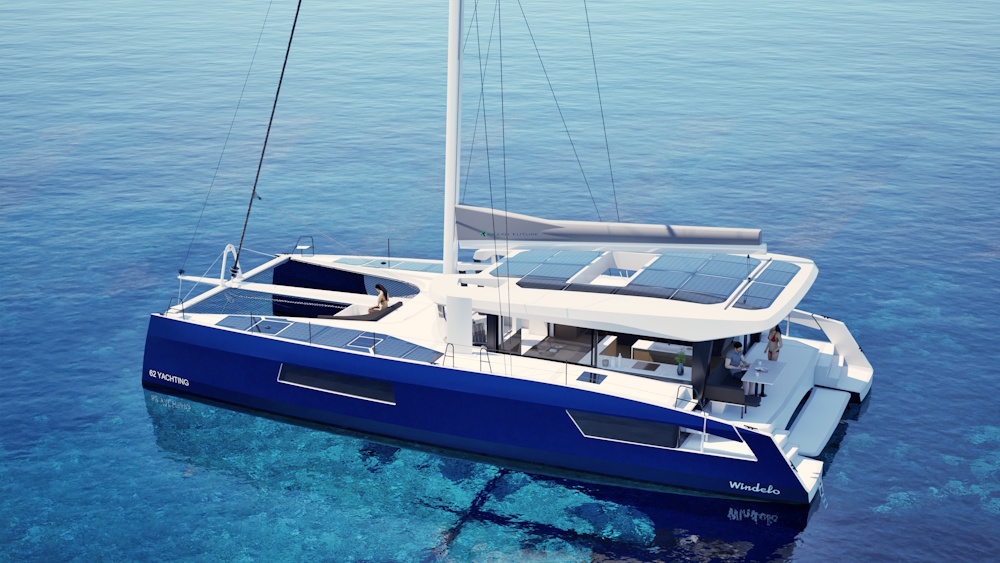
Windelo 62
On extended range, the serial hybrid has an advantage. A single 18 kW generator running continuously is more fuel-efficient for generating electricity and charging batteries than two 57 hp propulsion-sized diesels running at moderate load. The 1,000 nm figure for Electric Propulsion against 600 to 800 nm for Dual Propulsion reflects this.
The Dual Propulsion solution is the more complex with two diesel engines, two electric motors, saildrives, plus the battery bank and energy management. But arguably, you have greater redundancy. The serial hybrid’s drivetrain is simpler: two electric motors on shaft drives, one generator, one battery bank. You have an option to instal a backup generator
The two dofferent ooptions will appeal to a wider market.
Pros and Cons
Electric Propulsion (Serial Hybrid)
Pros:
- Simpler: shaft drives, electric motors, one generator
- Lower maintenance burden (no gearbox wear, no saildrive diaphragm)
- Greater motoring range with generator running (around 1,000 nm)
- Consistent with the shipyard’s eco-design philosophy
- Lower system weight overall
Cons:
- Generator is still diesel-dependent for range beyond 4 hours
- All propulsive power passes through the battery bank, adding a conversion step
- Not suited to sustained high-speed motoring without the generator running
- The electric range (4 hours at 6 knots) may feel restrictive in areas with long calms
- Arguably there is less redundamcy
Dual Propulsion (Parallel Hybrid)
Pros:
- Direct diesel propulsion available for long offshore passages or delivery legs
- Mixed-mode operation (one diesel, one electric) is a useful mix-mode feature
- The diesel engines double as generators (up to 24 kW charging capacity)
- A more familiar proposition for sailors making the switch to electric, more akin to a hybrid car.
Cons:
- More complex: four power units (2 electric + 2 diesel) on saildrives
- Higher maintenance, including saildrive seal inspection
- Shorter maximum motoring range on diesel alone (600 to 800 nm vs approx. 1,000 nm)
- Slightly lower electric motor output (18 kW vs 20 kW per motor)
- Greater system weight, which on a performance-oriented catamaran is a relevant consideration
The Windelo 58 and 62
Windelo is also introducing two larger models: the Windelo 58 and Windelo 62. Both are designed around the same energy philosopy, with larger solar arrays (up to 8,000 W on the 62), expanded battery capacity, and built from the outset to optimise energy use and management rather than retrofitted to accommodate it. Both Dual Propulsion and Electric Propulsion will be available on the larger models.
Summary
Windelo’s Dual Propulsion is a logical extension of the shipyard’ already offers, rather than a pivo’s existing offer and should widen the appeal of the brand. The serial hybrid system remains the default and the stronger choice for fuel efficiency and extended range. The parallel hybrid option is for sailors who want the comfort of direct diesels and the benefits of an electric drivetrain.
The choice comes down to your personal priorities. Sailors who prioritise minimal fuel use, simpler maintenance, and have confidence in renewable energy production will continue to opt for the standard Electric Propulsion. Those planning long passages through low-wind regions, and who want the backup of direct combustion propulsion now have a very interesting alternative in Dual Propulsion.
What Windelo has avoided is a bolt on solution. Windelo Catamarans have been engineered from the start around electric daily use, with combustion as backup or extension.