
Rules of the Sea
COLREGs for Yachts
The International Regulations for Preventing Collisions at Sea (COLREGs) apply to all vessels navigating international waters and their connecting waterways. For sailors, understanding these rules is not an option: the sea is a shared space, and the rules are there to prevent collisions (not to establish who has the more right to proceed).
This is part of our Kat School series of articles.
Quick-Reference Guide
COLREGs quick reference guide for sailing catamarans
COLREGs quick reference
Stand-On and Give-Way: the Core Concept
One of the most important things to understand about COLREGs is that no vessel has an absolute right of way. The rules define two roles in any potential collision situation: the stand-on vessel and the give-way vessel.
The give-way vessel is required to take early, obvious action to keep clear. That means altering course or speed in a way that leaves no doubt about your intentions. A small, last-minute adjustment does not satisfy this obligation.
The stand-on vessel must maintain its course and speed, giving the give-way vessel the chance to respond predictably. However, if it becomes clear that the give-way vessel is not taking the appropriate action, the stand-on vessel is obliged to take whatever action is necessary to avoid a collision. Standing on regardless is not an option.
In short: both vessels share responsibility for avoiding a collision. The rules just determine who moves first.

1: Sailing yachts on different tacks
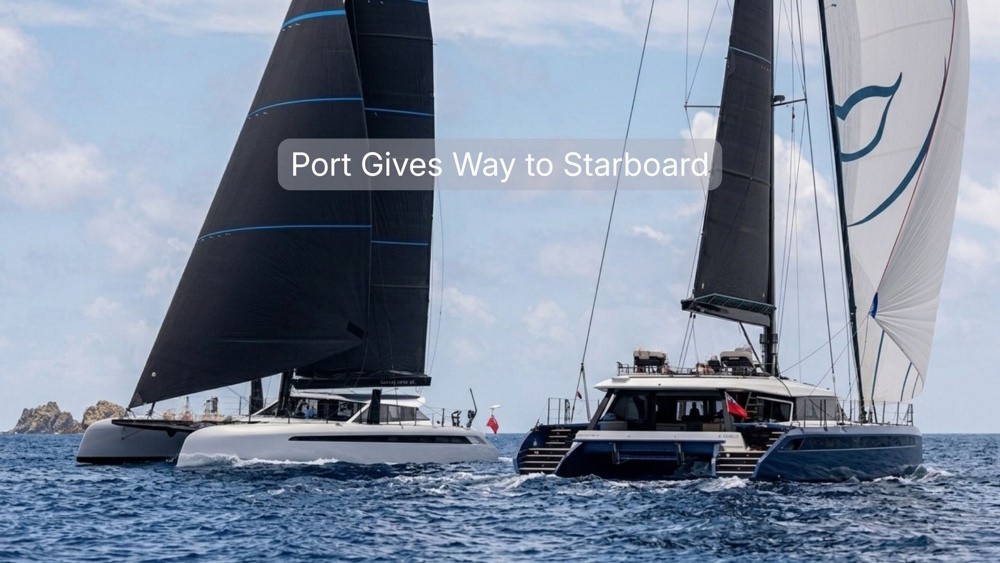
When two sailing vessels are on different tacks, the vessel on port tack must give way to the vessel on starboard tack.
How to determine your tack: if the wind is hitting your port (left-facing-front) side first, you are on port tack. If it hits your starboard (right-facing-front) side first, you are on starboard tack.
On a yacht, you can also check which side the mainsail is set. If the sail is out to port, you are on starboard tack. If the sail is out to starboard, you are on port tack. The sail blows away from the tack side.
Port tack is the give-way vessel. Starboard tack is the stand-on vessel. You can remember this by thinking “starboard is right (correct)”
If you are the stand-on vessel on starboard tack, do not assume the other boat has seen you. Hail them, wave at them or get them up on VHF Channel 16 to make your presence known, and be prepared to act in good time if they do not give way in time.
2: Boats on the Same Tack
When two sailing vessels are on the same tack, the windward vessel must give way to the leeward vessel.
The leeward vessel is the one further downwind. The windward vessel is the one sitting higher up into the wind. The windward vessel must keep clear, and should do so with plenty of time and sea room.
Leeward vessel: stand-on. Windward vessel: give-way.
The leeward boat, as stand-on vessel, must still allow sufficient time and space. Being the stand-on vessel does not justify holding a course that will cause a collision.
3: Overtaking
Any vessel overtaking another, whether under sail or power, must keep clear of the vessel being overtaken. This applies regardless of what type of vessel is doing the overtaking.
A sailing catamaran overtaking a slower power boat does not benefit from the “power gives way to sail” rule: the act of overtaking overrides it. The overtaking vessel takes on the give-way obligation and retains it until the pass is complete and the vessels are well clear of each other.
Overtaking vessel (any type): give-way. Vessel being overtaken: stand-on.
Rule 4: Power gives way to sail
A power-driven vessel must give way to a sailing vessel. This is one of the most widely known COLREGs rules, but it carries an important caveat.
A sailing catamaran using its engines, even with sails up, is classified as a power-driven vessel. If your engines are running and contributing to your progress, the sail gives you no special status. You are a power boat.
Remember, large commercial vessels such as oil tankers and container ships are often constrained by their draught and may not be able to manoeuvre quickly. The rules recognise this: a vessel constrained by draught or a vessel not under command takes priority. If you are sailing near a large ship in a channel, do not rely on the “power gives way to sail” principle. Give way early, clearly, and with plenty of sea room.
Sailing vessel (engines off): stand-on. Power vessel: give-way. Exception: if the sailing vessel is overtaking, the sailing vessel becomes give-way.
5: Two Power Boats Meeting Head-On
When two power-driven vessels are approaching each other head-on, or nearly so, both must alter course to starboard so that they pass each other port side to port side.
This rule requires both vessels to act. Neither is the stand-on vessel in a head-on situation: both are give-way, and both turn to starboard. If there is any doubt about whether a situation is truly head-on, treat it as if it is and act accordingly.
Both vessels: alter to starboard, pass port-to-port.
6. 2 Power Boats Crossing, on a Collision Course
When two power-driven vessels are crossing (not head-on), the vessel that has the other on its starboard side is the give-way vessel and must keep clear.
Extra Notes for Catamaran Sailors
Catamarans can be fast. Their speed and acceleration can cause close-quarter situations to develop quickly. Act early, act clearly, and never assume the other vessel has seen you.
VHF Channel 16 is the distress and calling channel and should always be monitored at sea. If a collision risk is developing and the other vessel is not responding, hail them.
The COLREG requirement is not merely to avoid the collision at the last moment. Rule 8 requires that any action taken to avoid a collision must be taken in ample time and must be large enough to be obvious to the other vessel.