
Windelo 58 and 62 Innovation
Windelo has spent more than five years proving that a light, basalt-fibre catamaran with serial-hybrid propulsion, hydrogeneration and plenty of solar can cross oceans without much diesel.
The Windelo 50 and 54 continues to prove the case. The Windelo 58 and 62, unveiled at Cannes in September 2025, scales this up a notch.
Both are Barreau & Neuman designs with exterior and interior styling by the Stellantis Design Studio, and both will have Sport versions: the 59 and 63.
The Platform: a Step Up
The big advantage with these longer platforms is beam. The 50 and 54 have a beam of 7.95 m and 7.98 m respectively. The 58 and 62 have 9.48 m, a jump of 1.5 m. That translates to a much bigger space. The two new models share a single mould, with the 62 taking the longer hull
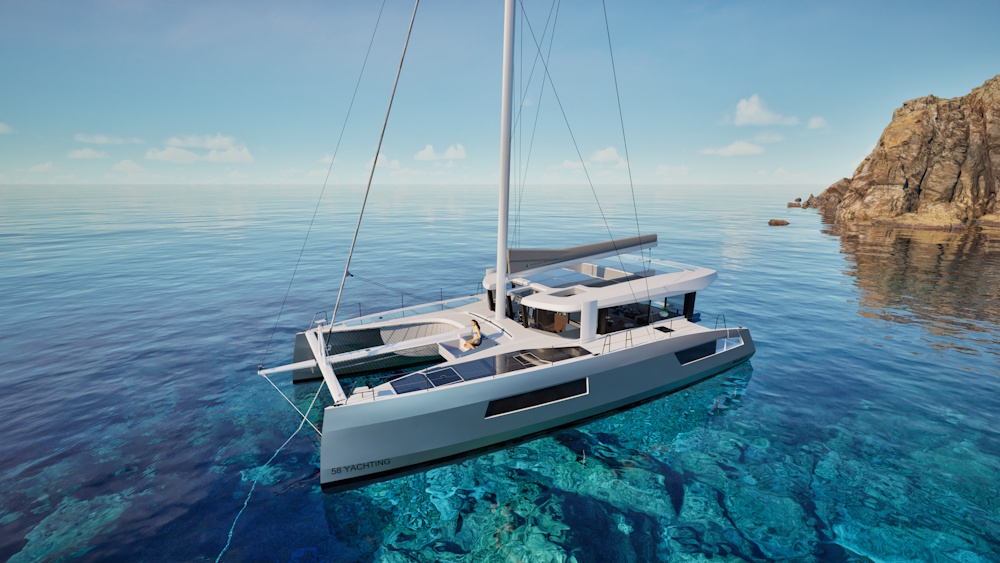
Windelo 58
Length goes to 17.68 m on the 58 and 18.88 m on the 62. Light displacement rises to 18.0 t and 22.0 t, against 11.2 t for the 50 and 12.8 t for the 54.
Draft with daggerboards is 1.35 m to 3.00 m on both new models, from 1.05 m to 2.35 m on the 54, so the upwind resistance grows in proportion.
Tankage reveals what these boats are for. The 50 and 54 carry 400 L of fresh water and 500 L of diesel. The 58 and 62 both carry 600 L of water and 1,200 L of diesel. On a serial hybrid, diesel is for the backup generator, not propulsion fuel, so 1,200 L represents a big reserve for windless passages.
Key Figures Compared
Swipe left to see all four models →
| Windelo 58 | Windelo 62 | Windelo 50 | Windelo 54 | |
|---|---|---|---|---|
| Length | 17.68 m | 18.88 m | 15.24 m | 16.24 m |
| Beam | 9.48 m | 9.48 m | 7.95 m | 7.98 m |
| Light displacement | 18.0 t | 22.0 t | 11.2 t | 12.8 t |
| Draft (min/max) | 1.35 / 3.00 m | 1.35 / 3.00 m | 1.03 / 2.32 m | 1.05 / 2.35 m |
| Mainsail | 129 m² | 140 m² | 92 m² | 99 m² |
| Headsail | 57 m² | 64 m² (solent) | 43 m² | 45 m² |
| Fresh / black water | 600 / 260 l | 600 / 260 l | 400 / 200 l | 400 / 200 l |
| Diesel | 1,200 l | 1,200 l | 500 l | 500 l |
| Max cabins | 5 (+1 skipper)* | 5 (+1 skipper) | 4 (+1 skipper) | 4 (+1 skipper) |
| Base price (Adventure) Prices correct Jul/26 | €2,100,000 | €2,850,000 | €1,195,000 | €1,450,000 |
| Sport version | 59 Sport | 63 Sport | 51 Sport | 55 Sport |
All prices ex-VAT, as listed by Windelo July 2026. Yachting trim adds roughly €100,000 to €250,000 depending on model. *Five cabins on the 58 requires the J-shaped galley; the island galley caps at four.
Power: Two Options, One Philosophy
The 58 and 62 arrive alongside a change on what Windelo offers for its propulsion options. Buyers can now choose between two systems across the 50 to 62 range, and both are available on the new models.
Electric Propulsion remains the standard and the yard’s preferred route. It is a serial hybrid: the diesel generator has no mechanical link to the propellers. Electric motors on shaft drives do all the work, fed by a 48 V lithium bank that is charged first by solar, hydrogeneration and wind turbines, and only then by a backup 18 kW diesel genset. On the 50, that delivers roughly four hours at 6 knots on batteries alone, and about 1,100 nautical miles with the generator carrying the load.
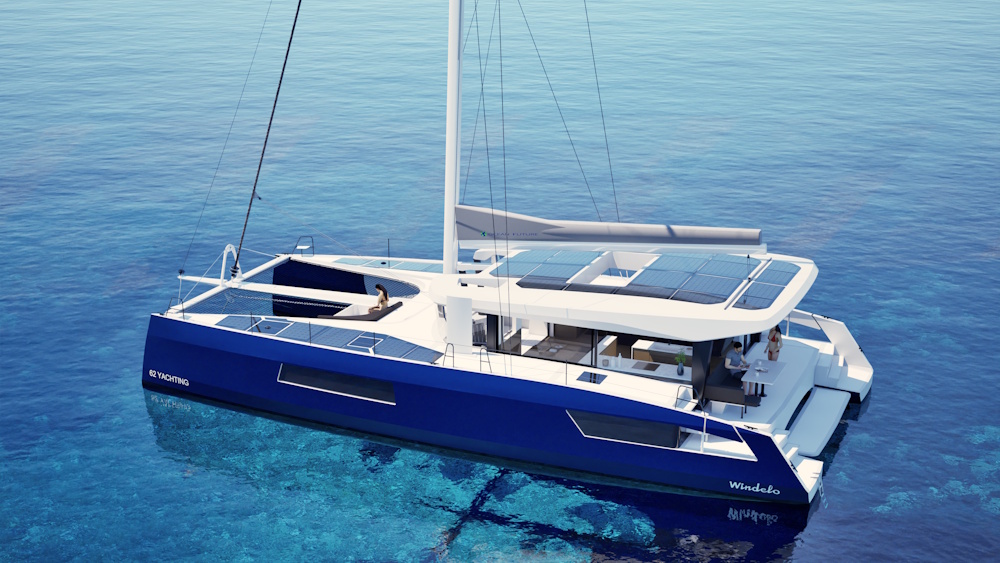
Windelo 62
Dual Propulsion is the parallel option. Two 57 hp diesels on saildrives are coupled to two 18 kW Bellmarine electric motors. The electric side handles harbour work and anchorage approaches, which Windelo puts at more than 80% of engine hours on a bluewater cat. The diesels take over for sustained passages, giving 600 to 800 nautical miles, and double as generators pushing up to 24 kW back into the bank while driving the boat. Mixed-mode running, one hull on diesel and one on electric, is possible.
The trade is clear. The serial system is simpler mechanically and better on fuel; the parallel system gives you a direct diesel drive and the reassurance that goes with it, at the cost of weight, a second maintenance regime and a less pure renewable setup.
What is new on the 58 and 62 is that the platform was drawn around this choice from the start rather than adapted to it, with the technical spaces, tankage and electrical architecture sized for either configuration.
Solar: Windelo Continues to Impress
Solar capacity on the 50 to 55 range tops out at around 6,000 W, using flush-mount monocrystalline flexible panels rated at 24% conversion, walkable, split into four zones with separate regulators so shading in one area does not affect the whole array. Windelo claim that 6 kW at anchor will run a 220 V air conditioning system without the generator.
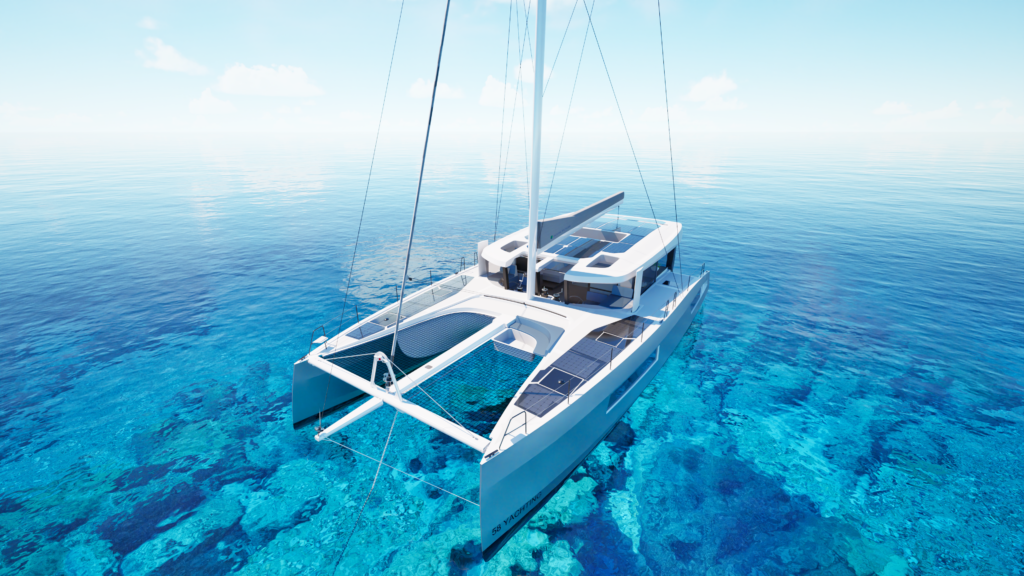
Windelo 58
The 62 takes that top figure to up to 8,000 W. It is a one-third increase, a direct dividend of the extra 1.5 m of beam and the larger coachroof: more deck means more panels.
Hydrogeneration and wind carry over. The props will start generating usefully from around 8 knots of boat speed, with drag described as near-imperceptible above 10 knots.
Layout: New Galley Options
The 50 and 54 offer the galley in an L or a U shape. The 58 and 62 replace both with two new configurations: an island galley and a J galley, each with its own set of layout plans. This is a significant interior change, because on a Windelo the galley is not hidden away, it sits in the open as the centre of the living space, and its shape governs how everything else is arranged.
Forward, a curved windscreen loses its pillars. Combined with 2.20 m of headroom in the saloon, the effect Windelo has developed is an uninterrupted view of sails, deck and horizon from inside.
Cabin count goes to five plus a skipper, with four heads on the 58 and en-suite arrangements throughout. At the other end of the range you can specify an owner-dedicated hull. The 58 adds direct access from the forward cockpit to the crew cabin, which is a nice detail. The 62 uses its extra volume for a dressing room, a laundry space, and the payload to carry more gear for long distance cruising.
Both models have a fixed aft terrace, a second living space rather than a fold-down platform, plus a forward trampoline lounge with integrated seating and sunpads.
Sport: 59 and 63
In parallel with their smaller sisters, Windelo has confirmed a 59 Sport and a 63 Sport: bows inverted to 17 degrees, waterline lengthened by 33 cm, daggerboards extended 65 cm and heavier use of carbon: carbon rudders, a carbon mast a metre taller with Kevlar rigging, a carbon cross beam in place of the alloy bowsprit adding up to 20% downwind sail area, 3D membrane sails, carbon structural bulkheads, and over 500 kg saved against the standard boats.
Summary
The 50 and 54 continue to prove make the eco-performance argument cleanly. At 11 to 13 tonnes the renewable inputs comfortably cover the loads.
The 58 and 62 offer more space, more solar, more battery and more beam. The 62 in particular with its dressing room and laundry, is a different proposition to the boat that built the brand’s reputation.