
Lagoon 47: The Next Chapter Showing in Cannes
Lagoon’s Top-Selling Size Class
The name Lagoon 47 has some history behind it. The first boat to carry the name left the yard in 1992, a VPLP-designed cruiser built under Jeanneau that helped establish Lagoon as a serious builder of bluewater catamarans. More than three decades on, the name is back, this time on a boat built to replace one of the most successful catamarans the yard has ever produced: the Lagoon 46.
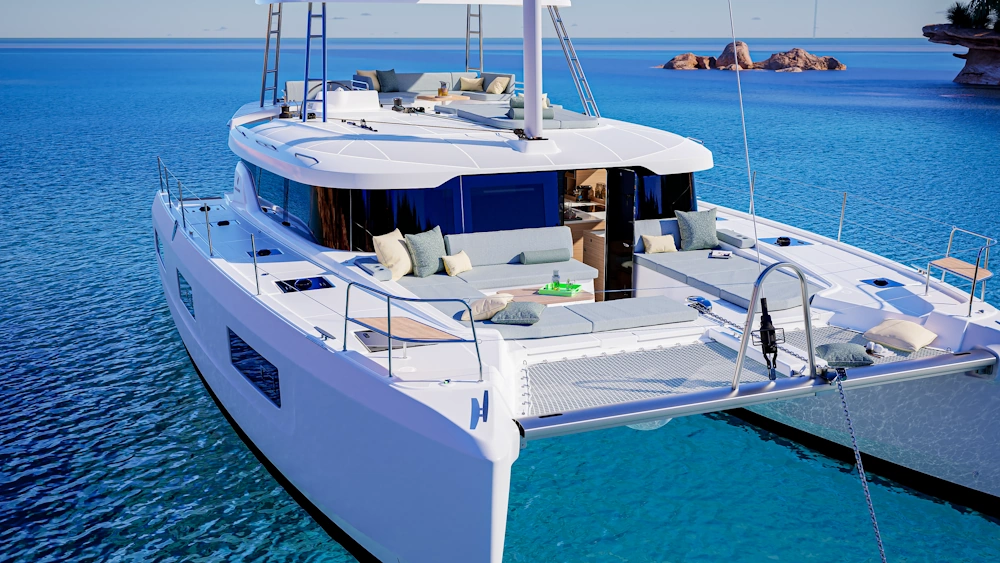
The new Lagoon 47 will have its world premiere at the Cannes Yachting Festival in September 2026. It arrives in the 45 to 47 foot bracket that Lagoon has quietly dominated since the Lagoon 450 and, more recently, the Lagoon 46, which has sold in the region of 700 hulls since it joined the range in 2019.
Replacing a boat with that track record is no small undertaking, and Lagoon’s approach was to go back to the customers who actually sail and live aboard these boats.
Built from Owner Feedback
Lagoon describes the 47 as a boat built piece by piece, like a puzzle. Rather than starting from a blank sheet, the design team gathered more than 200 reviews, ideas and requests from Lagoon owners and used them as an integral part of the design brief.
The result is a yacht that matches the size of the 46 (hull length 13.96 metres against 13.99 metres, beam unchanged at 7.96 metres) but reworks the layout, the flow between the spaces, and the finish level in ways that only come from listening to expereinced customers.
The Door that Changes the Front
Welcome to the new forward cockpit door. A door connects the saloon directly to a forward cockpit, a layout previously reserved for larger yachts in the range. VPLP’s Mathias Maurios describes the space it creates as “a spacious forward cockpit, accessed directly through the front of the saloon on the same level,” adding that it provides “a comfortable and welcoming relaxation area” and, in his words, “the ideal place to spend some time with family or friends after a full day out on the water.”
This turns the foredeck into a genuine outdoor room. The forward cockpit measures 12 square metres, with bench seating and a table, and it is now directlt connected to the saloon. Along with the full-width sliding glass door between the saloon and the aft cockpit, this gives the Lagoon 47 a continuous line of sight and movement from bow to stern. The three areas, aft cockpit, saloon and forward cockpit, add up to more than 40 square metres of connected living space.
Nauta Design’s Massimo Gino had this to say: the 47 is “designed to enhance the connection with nature, to create a fluid dialogue with the horizon, and offer a pure experience of light and open space.”
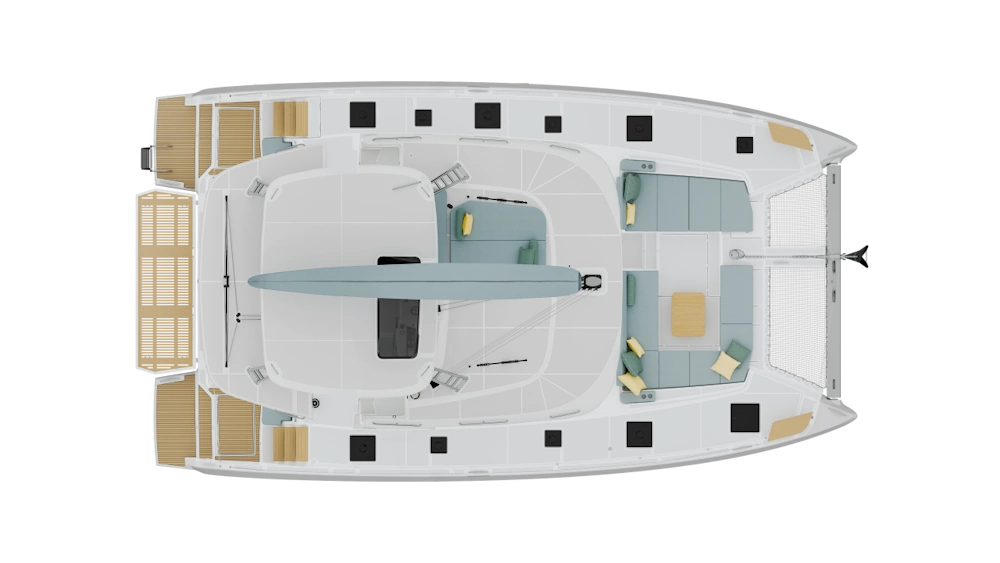
Aft Cockpit and Flybridge
The aft cockpit grows to 16 square metres and seats eight around a table, with a bench seat and reclining backrests aimed at long, slow afternoons at anchor. Access to the flybridge now comes from two points, one on each side, and the flybridge has a bench seat, a coffee table and sun loungers, adding a fourth living area to the boat. The helm has also moved: its new position gives the helmsman a clearer line of sight while sailing, and keeping them within easy reach of the crew in the cockpit below, useful when docking, reefing, or anchoring in a crowded bay.
Create your Own Space
Down below, the most flexible space on the boat is the Smartroom. The port midship cabin on the 47 can convert into a walk-in closet, a utility room, or a cabin with its own private bathroom. For long passages, that might mean a dedicated laundry and storage room. For charter operators, it adds the possibility of an extra berth to add to the boat’s capacity. Lagoon has built the yacht around durable, simple systems with easy access for maintenance.
Three cabin layouts are offered: a three-cabin owner’s version with the Smartroom fitted as a utility room or walk-in closet, a five-cabin charter version, and the Smartroom cabin configuration for owners who want the extra berth. All guest cabins feature transverse double beds and sea views, a change from the layouts used on the outgoing model.
Interior Atmosphere
Nauta Design has drawn up two interior schemes for the 47, Panarea and Sorrento. Panarea takes its inspiration from the ocean at sunset, built around pastel shades and neutral tones. Sorrento is intended to feel brighter and more Mediterranean, built around warmer, more vibrant colours. Both are offered as a choice at the point of order, letting owners set the tone of the interior without altering the layout itself.
A Responsible Build
The Lagoon 47 carries an eco-certified design. The deck and hull are built using vacuum infusion, a construction process that reduces resin waste and improves the consistency of the composite, while cutting the environmental impact of the build itself. Non-structural fibreglass parts have been replaced with hemp fibre, and the boat also uses bio-based resins, plant-based fibres, timber sourced from FSC-certified forests, and upholstery made from recycled materials. None of this changes how the boat sails, but it is a shift in how it is built, and it reflects a wider move across the range toward lower-impact construction.
Lagoon 47 Specifications
| Specification | Value |
|---|---|
| Hull length | 13.96 m / 45’10” |
| Hull width | 7.96 m / 26’1″ |
| Air draft | 23.2 m / 76’1″ |
| Draft | 1.25 m / 4’1″ |
| Light displacement | 18 t / 39,690 lbs |
| Upwind sail area | 127 m² / 1,367 sq.ft. |
| Mainsail | 84 m² / 904 sq.ft. |
| Genoa | 43 m² / 463 sq.ft. |
| Fuel capacity | 860 L / 227 US gal |
| Water capacity | 700 L / 185 US gal |
| Motorisation | 2 x 57 hp |
| Naval architect | VPLP Design |
| Exterior design | Patrick Le Quément |
| Interior design | Nauta Design |
| CE certification | A:12, B:14, C:20, D:30 |
| Cabin layouts | 3-cabin, 5-cabin, Smartroom configuration |
On the Water this September
The Lagoon 47 makes its world premiere at the Cannes Yachting Festival, running from 8 to 13 September 2026, and production deliveries are expected to follow from early 2027.
It replaces a boat that defined an entire size class, and it does so without repeating the formula: a connected deck plan, a flybridge built for real communication with the crew, a midship space that adapts to how the boat is actually used, and a construction process built with a lighter footprint. A boat built from its owners’ feedback. Lagoon listened.