
The Parts of a Sail
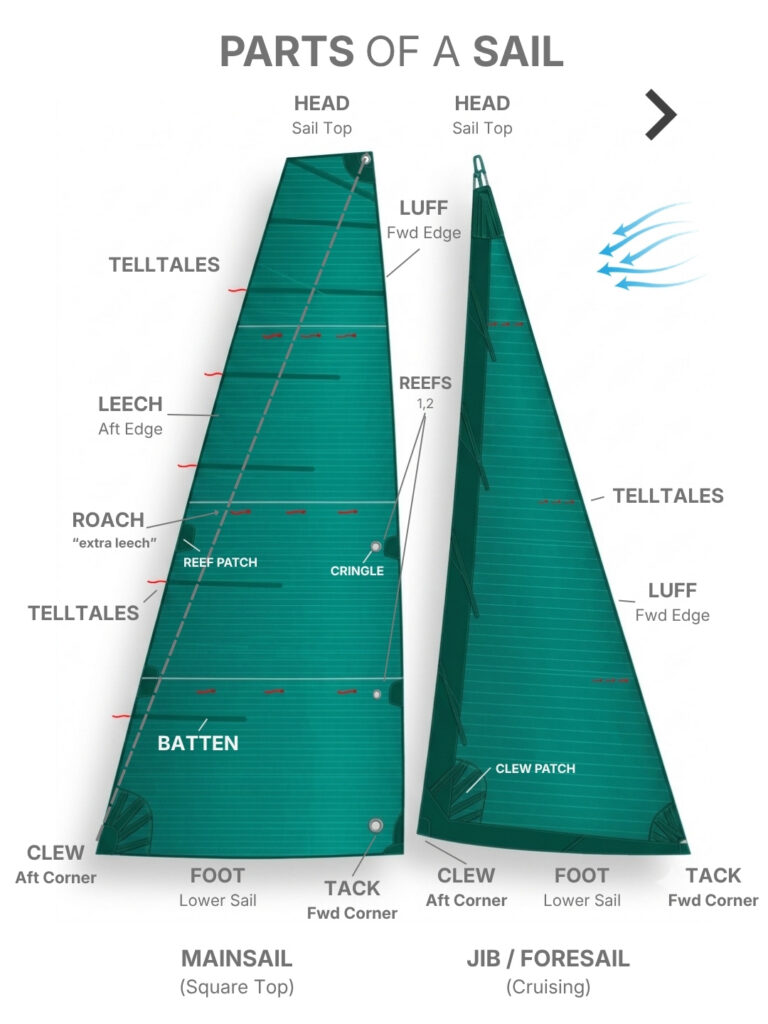
Parts of a sail: a visual glossary covering edges, corners, hardware, and sail types
Visual Reference
PARTS OF
A SAIL
A SAIL
A quick-reference glossary covering every named part of a mainsail and jib. Scroll through by topic or use it as a companion to the diagram above.
01 — The Edges
Forward edge
Luff
The leading edge of any sail, running from tack to head. On a mainsail it feeds into the mast groove or slides; on a jib it attaches to the forestay via hanks or a furler. Luff shape drives how the sail fills and how early it stalls.
Mainsail + Jib
Aft edge
Leech
The trailing edge, running from clew to head. On the mainsail it is supported by battens and carries extra area in the roach. Leech tension is controlled by the mainsheet and traveller: a tight leech stalls airflow, a loose one has a fuller shape for lighter winds.
Mainsail
Lower edge
Foot
The bottom edge of the sail from tack to clew. On a mainsail the foot runs along the boom, or sits loose-footed above it. Outhaul tension flattens the lower sail.
Mainsail + Jib
Extra leech area
Roach
The convex curve of sailcloth that extends beyond a straight line from clew to head. Supported by battens, roach adds area without increasing mast length. Larger roach equals more power.
Mainsail
02 — The Corners
Every sail has three corners
Tack
Forward lower corner
Where luff meets foot. Fixed to the boom (main) or tack fitting (jib).
Clew
Aft lower corner
Where leech meets foot. Sheets attach here to control sail angle and twist.
Head
Top corner (sail top)
The topmost point of the sail. Square-top mains have a wide, flat head panel.
03 — Hardware and Reinforcements
Structural support
Batten
Horizontal fibreglass or carbon rods slotted into pockets across the sail. They support the roach, maintain aerofoil shape, and reduce flogging. Full-length battens run mast-to-leech and are standard on performance mains.
Mainsail
Reefing eye
Cringle
A reinforced eye or ring in the sail at reef points, leech, and luff. Cringles take heavy loads and are typically constructed with multiple layers of sailcloth and a bronze or stainless ring.
Mainsail + Jib
Load distribution
Reef Patch
A reinforcing panel of heavier cloth at each reef cringle. Spreads the load from reefing lines across the sail panel, preventing tearing when the sail is heavily reefed in strong conditions.
Mainsail
Corner reinforcement
Clew Patch
Reinforced sailcloth at the clew, where sheet loads are highest. On a jib this is one of the most stressed points; the patch area and layup quality directly affect sail longevity.
Jib / Foresail
04 — Reefing
How reefing works
-
1First reef Reduces sail area by roughly 15–20%. Used when wind builds to the upper end of the design range.
-
2Second reef Reduces area by a further 15–20%. Appropriate for heavy-air sailing. Most cruising mains carry two reef bands.
-
3+Third reef / deep reef Found on offshore and bluewater mains. Provides storm-canvas-level area reduction without switching to a trysail.
Reef line path
-
AReef cringle pulled down The luff cringle is hooked onto a tack pin or pulled to the boom, locking the forward end of the reef. Or, with single line reefing, it is secured with the reefing line.
-
BClew cringle tensioned The aft reef line pulls the clew cringle down to the boom, setting the new foot tension.
-
CExcess sail secured The bunched sailcloth below the new clew can be tied with sail ties or collected in the lazy bag for a clean reef.
05 — Telltales
Flow indicators
Telltales
Short ribbons of light yarn or film attached to both sides of the sail. They show whether airflow is attached or separated. On the luff of a jib: both streaming aft means optimal trim; windward one lifting means sheet in; leeward one lifting means ease the sheet.
Mainsail + Jib
Trimming tip
Leech telltales on the mainsail indicate whether twist is correct. They should stream parallel to the boom. Play with the traveller and the mainsheet to optimise your sail position and shape so you have good flow across the sail..
06 — Sail Types at a Glance
Primary drive sail
Mainsail
The principal sail, hoisted on the mast. Square-top versions maximise roach area and are standard on performance cruisers and racing cats. Controlled via mainsheet, traveller, and sometimes a vang.
Main
Forward sail
Jib / Foresail
Set on the forestay forward of the mast. A cruising jib is a non-overlapping cut for easy tacking. A genoa overlaps the mast for more power. Self-tacking jibs on a track are common on catamarans. set up for short-handed sailing.
Foresail
Downwind
Code Zero/ Gennaker /Assym Spinnaker /
Asymmetric spinnakers and Code sails come into play in lighter conditions. A Code Zero is good for close reaching. Same luff, leech, and clew terminology applies.
Running + Reaching
