
Points of Sail on a Catamaran
Points of Sail: a Guide
Understanding how a catamaran (or any sailing boat for that matter) relates to the wind is fundamental to sailing well.
Whether you are planning a bluewater passage or day sailing in a bay, knowing your points of sail and the angles that suit your boat is essential. Read our article about Setting the Traveller on a Catamaran as well for a fuller picture.
True Wind Angles Shown Below
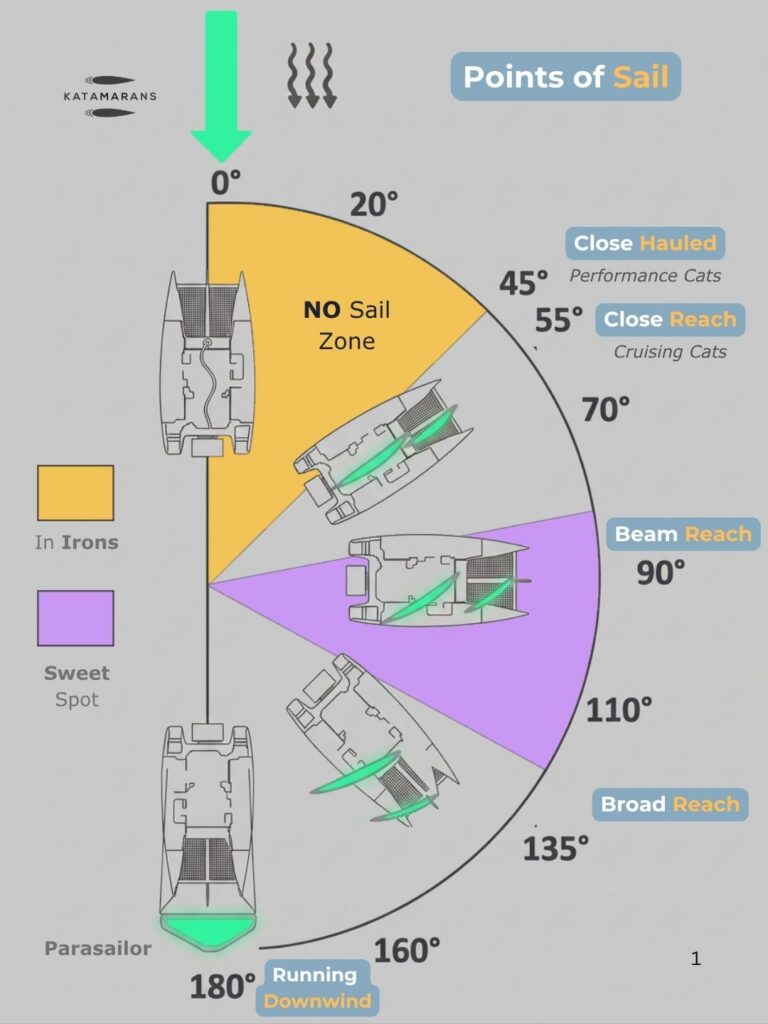
The No-Go Zone and Getting Out of Irons
At 0º to the true wind, head-to-wind, no sail can generate lift. On a catamaran this “no-go zone” (or “low-go-zone”) extends out to roughly 40 – 45º degrees on a performance cat and to around 50 – 55º degrees on a cruising cat with mini keels. If you stall within this area, you are “in irons.”
Use you headsail to push the bow off, or the engines.
Close Hauled
This is sailing as close to the wind as possible while still moving efficiently.
Performance catamarans with daggerboards can point to around 45º true wind angle (TWA) and even higher in some cases in calm seas.
Cruising cats with mini keels are typically more comfortable at 55º TWA. Higher than that and leeway becomes significant, but it does depend on the design. At 7 knots boat speed in 15 knots of true wind, the apparent wind angle (AWA) at close hauled will be closer than the true angle of course. At 55 degrees TWA, you can expect an AWA of around 38-40º. At 45º TWA, the AWA comes in closer still, typically 30º. Sails are sheeted hard in, and your traveller is anchored just upwind
Close Reach
From around 55 to 70º TWA, you are on a close reach. This is where cruising cats start to feel more comfortable, particularly in the 60 to 65 degree range where speed increases and the boat stops sliding. AWA at this angle in the same conditions is typically around 45 degrees. Ease the sheets slightly and the boat accelerates. At higher speeds and with higher apparent wind, the leeward hull starts to dig in which helps to reduce your leeway. This is an efficient point of sail.
Beam Reach
At 80-90º to the true wind, you are on a beam reach. This is the sweet spot for most catamarans, and the range from around 80 to 100 degrees TWA produces the best speed-to-effort ratio on many designs. AWA in these conditions will sit at roughly 55 to 65 degrees due to the boat’s speed pushing the apparent wind forward. Sails are eased a bit more and your cat is in her element. Speed will pick up – enjoy the ride!
Broad Reach
From 120 to 155º TWA, you are broad reaching. AWA will be roughly 90º or so. This remains a fast and manageable point of sail on a catamaran. Sails are eased out further, and a spinnaker or gennaker can be used effectively in this range.
Because your apparent wind will drop off, the boat will cope with bigger sails flying at this angle. This is where we hit the top speed on our cat with the gennaker up, surfing down the swell. Just be careful though, as its easier to get caught out with too much sail up on this point of sail. It’s worth practising reefing downwind in calmer conditions to have an ace up your sleeve if the wind blows up.
Running Downwind
Dead downwind, at 160 to 180 degrees TWA, apparent wind drops because the boat is travelling in the same direction as the wind. In 15 knots true at 7 knots boat speed, you may only feel 8 knots of apparent wind. This makes conventional sails less effective and increases the risk of an accidental gybe.
Most experienced catamaran sailors avoid sailing dead downwind unless they have a spinnaker or a parasailor up. It’s quicker to keep your apparent wind up and “tack” downwind from broad reach to broad reach.
Upwind VMG: Catamaran vs Monohull
Velocity Made Good (VMG) is the measure of your speed that is actually going towards your destination upwind. It is not simply a case of pointing as high as possible. Point too high and the boat slows and makes excessive leeway. Bear away too much and you are sailing extra distance.
On a monohull, upwind VMG is typically best between 40 and 45 degrees TWA, and the keel prevents significant leeway. A well-sailed monohull can point close but must accept more heel and a wetter ride.
A cruising catamaran with mini keels will generally achieve best upwind VMG at around 55-60º TWA. Attempting to point closer results in more leeway, slot effect loss, and speed drop. The mini keels provide lateral resistance but are less efficient than daggerboards at resisting leeway at tight angles, especially at lower speeds or in a heavy chop.
A performance catamaran with daggerboards can achieve her best VMG closer to 45 degrees TWA. The daggerboards bite hard and resist leeway effectively, allowing the boat to point higher while maintaining boat speed. In real terms this can mean a significant difference in the number of tacks required to clear a headland.
In practical terms, a cruising cat will often make similar VMG than a crusing monohull of comparable waterline length, particularly in a 15 to 25 knots of breeze, simply because of the speed advantage at its optimal angle. In lighter conditions, the monohull wins.
Downwind Strategy: Tacking Downwind
One of the most counter-intuitive lessons in catamaran sailing is that sailing dead downwind is rarely the fastest route. Because catamarans sail fastest across the wind rather than with it, the most efficient downwind tactic is to tack downwind, gybing from broad reach to broad reach from 150º TWA on each gybe.
Although this increases the distance sailed, the higher boat speed and apparent wind more than compensates, and you will arrive sooner than if you had run dead downwind. The apparent wind stays up, the sails are more highly powered, and the risk of an unplanned gybe is reduced. In a 15-knot breeze, broad reaching at 135º might give you 8 to 9 knots or even double digits of boat speed versus 6 to 7 knots running at 170 degrees.
Remember to optimise your daggerboards for the point of sail if you have them.
Downwind in the Trades: The Case for a Parasailor
If you are passage making in the trade winds, where the wind is steady in direction and strength and the wind angle is consistently well aft, the calculation changes. Constantly tacking downwind over hundreds of miles adds distance and crew fatigue.
In these conditions, a Parasailor or spinnaker with the main down is a well-proven option. The Parasailor is a spinnaker with a wing profile built into the sail that generates lift and reduces oscillation. Unlike a conventional symmetric or asymmetric spinnaker, it is designed to be flown deep, at 140 to 180 degrees TWA (and even higher), and in trues wind strengths from around 8 to 25 knots. The built-in wing stabilises the sail and reduces the rolling that can plague a catamaran running downwind.
In steady trade wind conditions, a Parasailor allows you to steer a direct rhumb line course rather than zigzagging, saving both miles and crew energy over a long passage.
Quick Reference Guide
Points of Sail Quick Reference Table (15 kn true wind / 7 kn boat speed. AWA figures approximate.)
| Point of sail | True wind angle | Approx AWA (guide) | Notes |
|---|---|---|---|
| In irons / no-go zone | 0 to 45° (perf) / 0 to 50° (cruising) | n/a | No drive. Back headsail or use engines to escape. |
| Close hauled | 45° (perf cat) / 55° (cruising cat) | 30–34° / 38–42° | Daggerboards allow higher pointing. Mini keels suit 55°. |
| Close reach | 55–75° | 44–50° | Cruising cats accelerate well here. Sheets ease, speed increases. |
| Beam reach | 80–120° | 55–80° | Peak speed-to-effort ratio on most designs. |
| Broad reach | 120–160° | 90–120° | Gennaker/spinnaker range. Preferred tacking-downwind gybe angle. |
| Running downwind | 160–180° | ~160–172° | Apparent wind drops sharply. Gybe risk increases. Parasailor suits steady trade wind runs. |
A few notes on the AWA calculations: at 7 knots boat speed and 15 knots true wind, the vector calculation shifts the apparent wind forward by roughly 12 to 15 degrees.
The figures in the table reflect this and should approximate what you see on an AWA instrument in typical cruising conditions. They will vary by boat speed, true wind speed and conditions, but they give a useful working reference.