The New Leopard 43
Evolution of an Icon
Robertson & Caine’s newest sailing catamaran builds on three decades of expereince in this size — with sharper bows, a taller rig, and an eye on tomorrow’s cruiser.
The New Leopard 43: What Changed, and Why
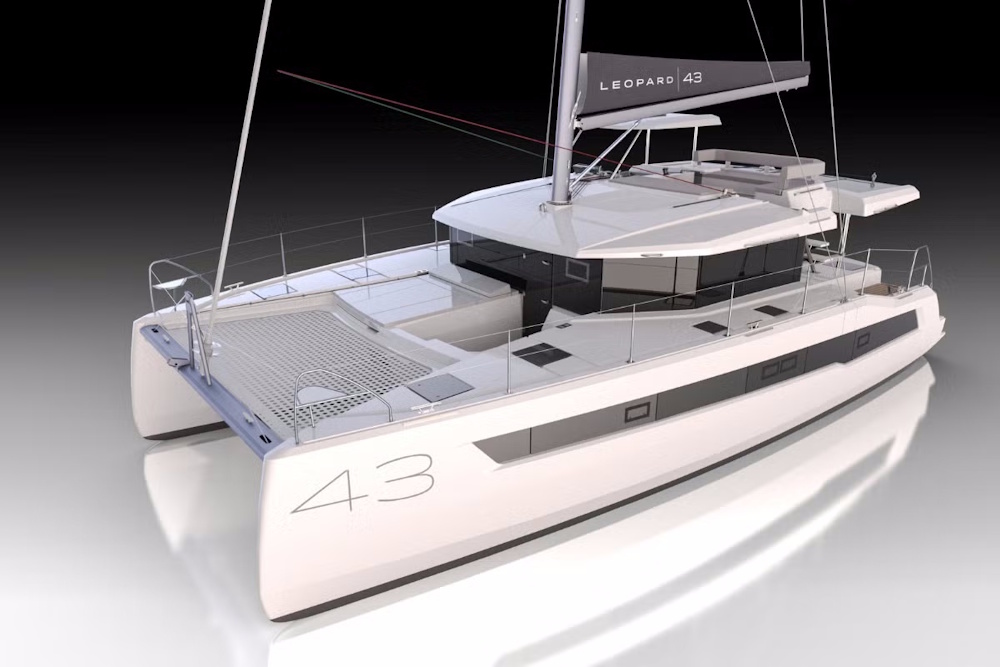
The Leopard 43 project did not start as a ground-up redesign. Robertson & Caine’s original plan was a refresh of the 42, aligning it with the direction already established by the larger Leopard 46 and Leopard 52. But once the naval architects and the design team sat down with the brief, the scope expanded. The result, as Head of Design Michael Robertson puts it, involved every dimension of the boat: hull shape, rig proportions, weight distribution, and deck layout. What started as a facelift became a new generation.
“From the shape of the hulls to the proportions of the rigging, weight distribution and deck layout, every decision has been made to enrich the sailing experience and life on board.” — Michael Robertson, Head of Design, Robertson & Caine
The Hull: Wave-Piercing and Reverse Bows
The most visible change on the 43 is the bow. Where the 42 has more conventional plumb bows, the 43 has inverted, reverse bows with a wave-piercing hull form. This has become a dominant design direction across the industry – but on a Leopard it represents quite a shift. This design reduces hobby-horsing in a chop and cuts through rather than lifting over short head-seas, improving comfort and speed in the kinds of conditions buyers often encounter: trade-wind passages and fetch-limited coastal sailing.
Leopard offer two options for the bowsprit: a classic aluminium spar, or a composite spar integrated beneath the trampoline itself, leaving the bow area as a single unobstructed platform – a great option for families who want a clean foredeck for anchoring manoeuvres or simply lounging.
The Rig: More Power, Especially in Light Air
The mast on the 43 is around three feet – or one metre – taller than the 42’s, and the upwind sail area has increased by 12%. Charter customers and private owners alike spend the bulk of their time sailing in light to moderate conditions, and it is in this range that a bigger, better-proportioned rig makes the difference. The boat accelerates earlier, maintains better angles, and arrives at anchorages under sai more often.
The larger rig does demand a stiffer hull and more attention to weight placement, and Leopard have focused on both areas. The overall design brief centred on a sportier, more responsive character than the 42 — a boat that private owners will find more rewarding to sail, and that charter companies can offer as a capable passage-maker as well as a comfortable platform at anchor.
Deck Layout: Moving the Social Hub Forward
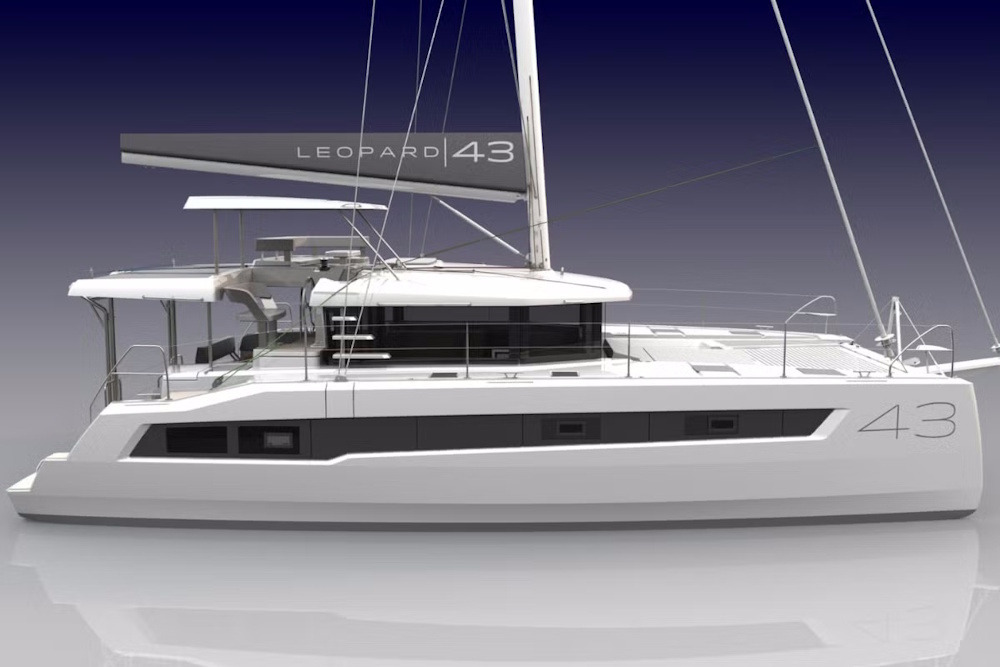
One of the more thoughtful changes on the 43 is the repositioning of the roof lounge. On the 42, this area was further aft. On the 43 it has been moved forward, placing it next the helm station. The effect is to draw the helmsman into the social life of the boat. On a family cruiser or a charter boat with a mixed crew, this means that whoever is on watch feels connected, and communication during manoeuvres is natural.
The forward cockpit – the seating area forward of the mast – has been upgraded with a dedicated bench, improving the relaxation space. It is a great spot for morning coffee underway when conditions are calmer and makes a cool spot for a sundowner at anchor.
An interior door connects the saloon to the forward cockpit area – a signature Leopard feature that serves as ventilation and quick deck access in calmer conditions.
The Saloon: 360-Degree Glass
The saloon on the Leopard 42 already has great views, but the 43 takes this further with 360-degree glass around the saloon. This floods the interior with natural light and maintains a visual connection with the water and horizon from most positions inside the boat. The large saloon spans the full beam, a serious viewing platform.
Solar: A Larger Array
The 43 carries solar panels integrated directly into the bimini hardtop, delivering 1,365 watts of peak capacity. This replaces the stainless steel structure used on the 42 – a solution that reduces weight aloft, reduced clutter, and improves structural cleanliness. For a cruising boat running refrigeration, electronics, and service battery loads through a typical tropical day, 1.3kW of solar is a gignifican contribution to the energy balance, particularly when combined with lithium storage (available as an option).
Dock Access: The Side Step
A small detail, but one that experienced cruisers will appreciate: the 43 has an integrated side step on the hull, making it easier to step aboard from a dock or alongside another vessel. It’s just one of the design details that distinguishes the 43 from the competition.
Charter Identity: Moorings 4300 and Sunsail 434
As with every Leopard in this size bracket, the 43 will fit neatly into the world’s two largest charter fleets. At The Moorings it becomes the Moorings 4300, configured with three cabins in a traditional owner layout. At Sunsail it becomes the Sunsail 434 in a four-cabin charter configuration.
Robertson & Caine and the Leopard Legacy
In 1991, two men with a shared passion for boats and an eye for a gap in the market set up a modest yard in Woodstock, a suburb of Cape Town at the southern tip of Africa. John Robertson and Jerry Caine had a simple brief: build catamarans worthy of the world’s most demanding charter operations. Their first client was The Moorings, already a dominant name in yacht chartering and a company with high standards. The resulting partnership would prove to be one of the most durable in modern yacht production.
For the first six years, Robertson & Caine built exclusively for the charter trade. Then in 1997 they began developing boats for private ownership, and by 2000 the Leopard brand was formally launched as the consumer-facing identity for their sailing catamarans.
The company grew quickly. Today it is the largest boat builder in the Southern Hemisphere by volume, and the third largest catamaran manufacturer globally.
The brand’s success was built on a clear philosophy: that charter experience and private ownership are two sides of a coin and feedback from one area improves the product for the other.
Both markets demand reliability, ease of handling, generous living space, and a hull that can cope with the Caribbean trades as comfortably as the Med. Naval architects Simonis & Voogd became their long-term design partners, delivering iteration after iteration of the brief – refined, but always recognisably Leopard.
Awards followed. The Leopard 45 was named Charter Yacht of the Year by Cruising World in 1998. The brand took Sail Magazine’s Best Boats award in 2005. The Leopard 39 was the 2010 Boat of the Year for Best Multihull Cruiser. The Leopard 42 picked up the 2022 Best Cruising Catamaran Under 50ft award.
These recognise a formula that works.
The 40-Foot Class: A Short History of Leopard’s Mid-Range Models
The 40-to-45-foot bracket has always been the heart of the Leopard range. It is the size class that dominates charter bases from the BVI to the Seychelles, and the one that most private buyers step to when making the transition from smaller boats. Leopard has developed this market methodically, each model building on its predecessor.
1997 — LEOPARD 45
The founding model of the Leopard brand. Built for The Moorings and designed with charters front of mind, the 45 is a sturdy, spacious platform with a low bridgedeck that made her prone to slamming – a compromise of that generation. She won Cruising World’s Charter Yacht of the Year in 1998 and put Robertson & Caine firmly on the international map. Over 400 hulls were produced, making her one of the most successful sailing catamarans of her era.
2001 — LEOPARD 42
The first Leopard to bear the Simonis & Voogd signature prominently, the 42 moved toward slimmer, more performance-oriented hulls with higher bridgedeck clearance. The cat-eye hull profile — narrow at the waterline, flaring to a chine above — maximised interior volume without adding wetted surface. Sold as the Moorings 4200 in charter configuration. Over 45 hulls delivered from 2001 to 2004.
2004 — LEOPARD 43
A direct development of the 42, with a refined hull and updated interior. Designed by Simonis & Voogd and built in vacuum-bagged E-glass over balsa core. Available in three-cabin owner’s version or four-cabin Moorings 4300 charter configuration. Became one of the most recognisable cruising catamarans in the world – 74 hulls built between 2004 and 2007. Many are still ocean cruising today.
2009 — LEOPARD 38
Morelli & Melvin took over the design duties for this smaller model, continuing the push for higher bridgedeck clearance to address the wave-slap issues of earlier Leopards. Available in 3 or 4-cabin layouts, and sold as the Sunsail 384 in charter fleets. Named Best Multihull Cruiser and Import of the Year at the 2010 Boat of the Year awards.
2014 — LEOPARD 44
An important step toward the modern Leopard aesthetic — full-beam windows, integrated hardtop, and the upper lounge area that would become a brand signature. Named Import Boat of the Year and Best Cruising Multihull by Cruising World and Sailing World.
2016 — LEOPARD 40
Returning to the 40-foot bracket with a modern brief, the 40 featured a forward galley, panoramic windows and large sliding doors merging saloon and cockpit. Once again, a Simonis & Voogd design with increased hull volume and an interior layout unlike any previous Leopard. Became a popular entry point for private buyers.
2021 — LEOPARD 42 (second generation)
The 42 name returned on a contemporary hull – the model that the new 43 now succeeds. Designed by Simonis & Voogd, it carried the exterior styling language established by the Leopard 50: continuous hull-side windows, a continuous hardtop, and the rooftop lounge area. Winner of the 2022 Best Cruising Catamaran Under 50ft Boat of the Year award. In the Moorings fleet it was known as the Moorings 4200; at Sunsail, the Sunsail 424.
2026 — LEOPARD 43 (new)
The first public viewing will be at the Cannes Yachting Festival in September 2026.
Specs
| Specification | Leopard 43 (new, 2026) | Leopard 42 (predecessor) |
|---|---|---|
| LOA | ~43 ft / 13.1m (est.) | ~42 ft / 12.8m |
| Rig | Taller mast (+~1m / 3ft) | Standard |
| Upwind sail area | +12% vs Leopard 42 | Baseline |
| Hull form | Wave-piercing, reverse bows | Conventional plumb bows |
| Solar capacity | 1,365 W (bimini-integrated) | Lower (external hoop mount) |
| Rooftop lounge | Repositioned adjacent to helm | Further aft |
| Saloon glazing | 360-degree glass | Generous but conventional |
| Charter versions | Moorings 4300 / Sunsail 434 | Moorings 4200 / Sunsail 424 |
| First public showing | Cannes YF, September 2026 | — |
How the 43 Compares to Its Predecessors
In the charter world, the Leopard 42 was by most accounts a highly successful boat. It picked up the Boat of the Year award in 2022 and kept charter bases operating reliably across the Caribbean, Mediterranean and Indian Ocean. So why replace it, and why now?

The answer lies partly in competitive pressure and partly in the evolution of buyer expectations. The cruising catamaran market has moved rapidly in recent years. Reverse bows and wave-piercing hulls are now the norm rather than the exception among the premium European builders. Larger rigs, more solar, and better glazing are increasingly entry-level expectations rather than upgrades. The 42, designed for a market that existed three or four years ago, was due an upgrade.
The 43 addresses all of these points while preserving the qualities that made the 42 work: the galley-up layout in the social heart of the boat, the roomy cockpit, the robust construction, and the ease of single or short-handed sailing that makes these boats viable for two-person crews on ocean passages.
“With the Leopard 43, we’ve taken everything that makes up the DNA of Leopard yachts – space, performance, visibility and on-board circulation – and taken it one step further.” – Franck Bauguil, Head of Product Development
The bridge-deck clearance that plagued the original 2004 Leopard 43 – with a tendency to slam in steep head-seas like many boats of the era – has been progressively addressed across successive generations and the wave-piercing hull form of the new boat further mitigates it by reducing the pitching motion that causes bridgedeck impact in the first place.
What’s Next?
The Leopard 43 is the most recent hull in a range that now spans from the 43-foot sailing cat through to the 52, with a power catamaran line running alongside. But the interesting story is the direction of propulsion technology that Leopard are taking.
The Hybrid Bet
The Leopard 46 – the model that was launched in 2024 – introduced the first hybrid-electric option in the Leopard fleet. Leopard offer 25kW electric pod saildrives capable of delivering four hours of motoring at six knots in pure electric mode, or 920 miles at the same speed in hybrid configuration. The system can regenerate power through the props once the boat is sailing above four knots, partially replenishing the lithium battery bank. Diesel generators remain available for range, while electric operation handles marina manoeuvring, coastal hops, and anchoring without engine noise or exhaust.
Cruising World named the Leopard 46 their 2025 Boat of the Year – the hybrid formula resonates in actual sea trials by experienced testers.
The Electrification Question for the 43
The obvious question is whether hybrid or electric propulsion will filter down to the 43. The Leopard 46 is proving viability in the charter market – arguably the most demanding use case for any power system, given the frequency of engine hours and the consequences of reliability failures. If that system performs well in fleet service over the next two to three years, the case for offering it on the 43 becomes straightforward. At 43 feet, the battery weight is more challenging than on a 46, but the progress of lithium energy density in the marine market is rapid.
Leopard have also been focusing on the the solar side of the equation. The 1,365-watt bimini array on the new 43 is a step up from the 42, and it points toward a boat that is thinking seriously about energy self-sufficiency at anchor where charter guests spend a substantial proportion of their time.
More solar, better managed by sophisticated battery monitoring systems, reduces the need to run a generator for evening loads. That is a big win on a charter boat, and it is a big selling point for private owners too.
The Broader Market
Robertson & Caine operate Leopard in a competitive space. Lagoon, Leopard’s most direct competitor, has been very active with new models. Other European builders- Excess, Bali, Nautitech – are growing their presence in the cruising segment. And Sunreef continues to push the boundaries of what electric propulsion and solar technology can do at the luxury end of the market.
Leopard’s competitive advantage has always been charter-proven reliability coupled with private-owner appeal – a broad market that the charter ecosystem actually enables. When a Leopard 43 completes five years in a Moorings fleet and comes off charter, it enters the brokerage market with a careefully documented service history, high maintenance standards, and a global network of buyers who have already sailed the yacht on holiday and formed an opinion. That community is an asset that is hard to replicate.
Summary: A Careful Evolution
The new Leopard 43 is an evolution, but a comprehensive one. Reverse bows and wave-piercing hulls meet the performance expectations of a new generation. A taller rig and 12% more sail area help build the light-air performance of the yacht. More space and light, smarter solar, and a repositioned lounge will meet the expectations of both charter guests and private buyers.
In a market full of noise, Leopard’s quiet consistency may be its most underrated quality.