

SV Artemis: The Wheelchair Accessible Dazcat Rounding the World
Tom Hughes was a British Army captain who had just returned from a tour of Afghanistan when a rugby injury in 2011 left him paralysed. Doctors told him he would never walk again.
Fourteen years later, he skippers Artemis, a 52ft expedition catamaran built specifically for his needs, and has sailed her from Cornwall to Cape Horn and beyond with his partner Hannah Grace.
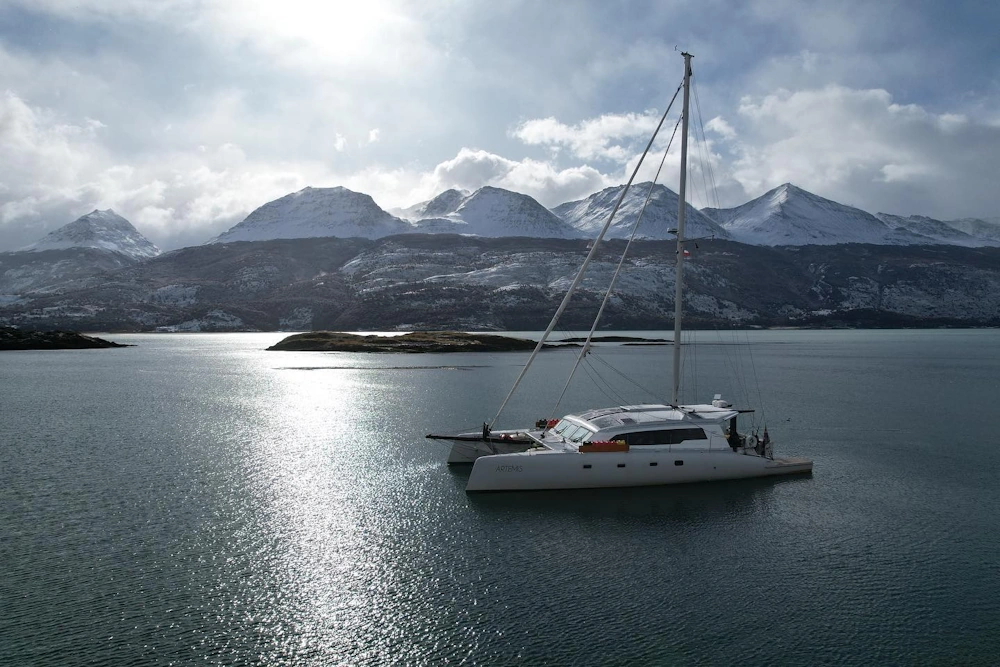
This is one of the more distinctive expedition sailing stories on the water: a circumnavigation attempt that has taken in the Caribbean, the Patagonian channels, and the Southern Ocean.
From injury to Cape Horn: how the trip came together
After his injury, Hughes rebuilt a life around adventure. He completed a PhD, qualified as a technical diver and rebreather instructor so he could get close to marine life without the noise of bubbles, and became a Fellow of the Royal Geographical Society. During the pandemic he built a custom 4×4 camper van from an eBay find, fitting it with its own power and communications systems so it could later be shipped out to meet him at various points on his route.
The boat took six years to plan. Hughes commissioned Dazcat, the Cornwall-based catamaran builder at Millbrook’s Multihull Centre, to design a 52ft expedition cat built for solo and short-handed sailing from a wheelchair. Artemis launched in October 2021 and left Plymouth on the tide soon after.

Resting up in the Golfo de Penas @sv.artemis
The early route ran through Gibraltar, Lanzarote and Cape Verde before crossing to Grenada, where Hannah Grace joined the boat in December 2021. The two had known each other for thirteen years by then, having met as teenagers and drifted in and out of contact through Hughes’ Army postings and Grace’s studies and work in Canada. She came aboard with no sailing experience and stayed.
From Grenada, Artemis worked down the island chain through St Lucia, Antigua, Guadeloupe and Dominica, then on to Suriname, French Guiana and Brazil. The serious sailing began in Argentina, where the boat entered the Beagle Channel before rounding Cape Horn in March 2023, a real milestone for a composite catamaran of her size.
Sailing Sweet Ruca, a fellow YouTube sailing channel, filmed the passage. From there, Hughes and Grace sailed two-handed back up through the ice-flanked Patagonian channels, two months of demanding, beautiful sailing during which Hughes proposed. They announced their engagement later that year.

The boat: Dazcat’s accessible expedition 52
Artemis was built by Dazcat at the Multihull Centre in Millbrook, Cornwall, and is a one-off design rather than a production model. Every element is shaped by one question: how does a wheelchair user sail this boat largely on his own, indefinitely, anywhere in the world.
Key features:
- Long sugar-scoop transoms on both hulls, designed for easy access from the water and from tenders
- Level decks throughout, with no steps between cockpit, saloon and cabins
- A sheltered helm station set forward in the nacelle, out of the weather
- A twin-headsail rig with the option to fly a large spinnaker downwind, set up so sail changes are manageable single-handed
- A custom landing-craft-style tender with a drop-down bow ramp, built to carry Hughes’ Terrainhopper all-terrain wheelchair ashore
- A dive compressor and bottle storage, since Artemis doubles as a technical diving platform
- The boat is named for the Greek goddess of hunting.
The voyage and the people behind it
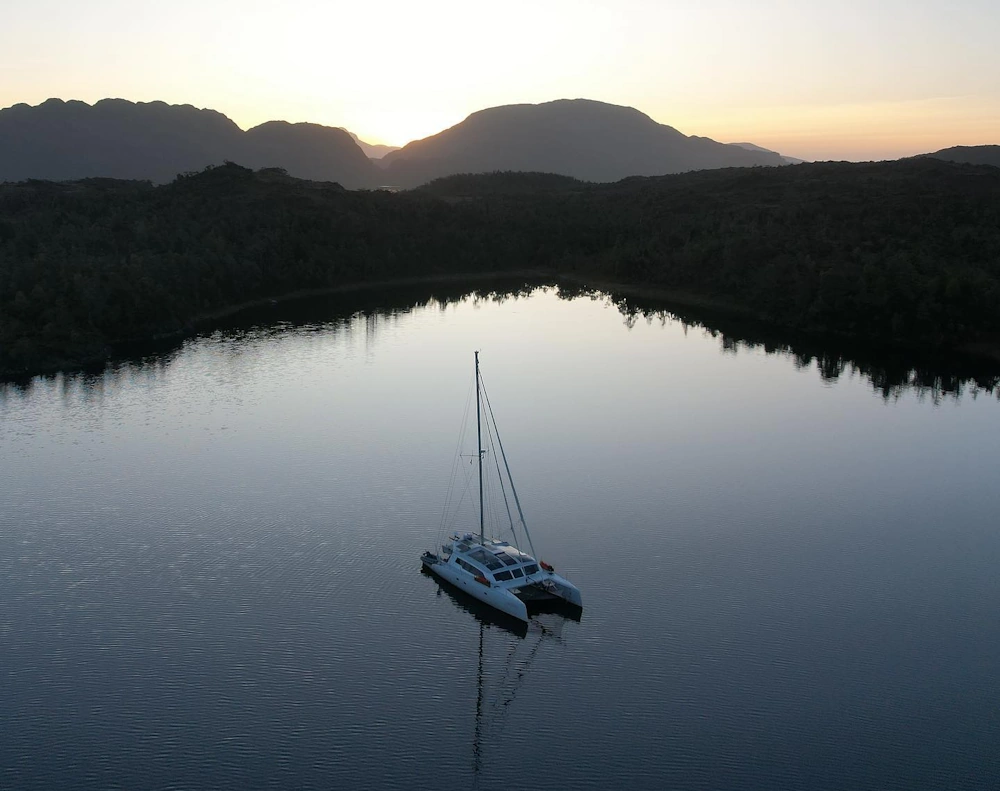
Dusk in Puerto Bueno, Canal Sarmiento @sv.artemis
Artemis’ story is told largely through the @sv.artemis Instagram account, much of the content has been shot by the couple themselves and by sailing friends they have met along the way. Hughes posts as @thughes170, Grace as @mrs.hannahgrace. Between them they cover the sailing, the technical and logistical work of running an accessible expedition boat, and the day-to-day reality of a life built around adapting rather than avoiding.
Grace’s own journey is part of the story. She left a job in Canadian immigration to join Artemis in the Caribbean with zero sailing background, and within two years was crewing a Cape Horn rounding and a two-handed transit of the Patagonian channels, some of the most demanding cruising grounds on the planet.
Hughes remains close to the RFU Injured Players Foundation, which supported him after his injury, and continues to be held up by England Rugby as an example of what’s possible after an injury like this. He has described the charity’s support as instrumental to rebuilding his life.
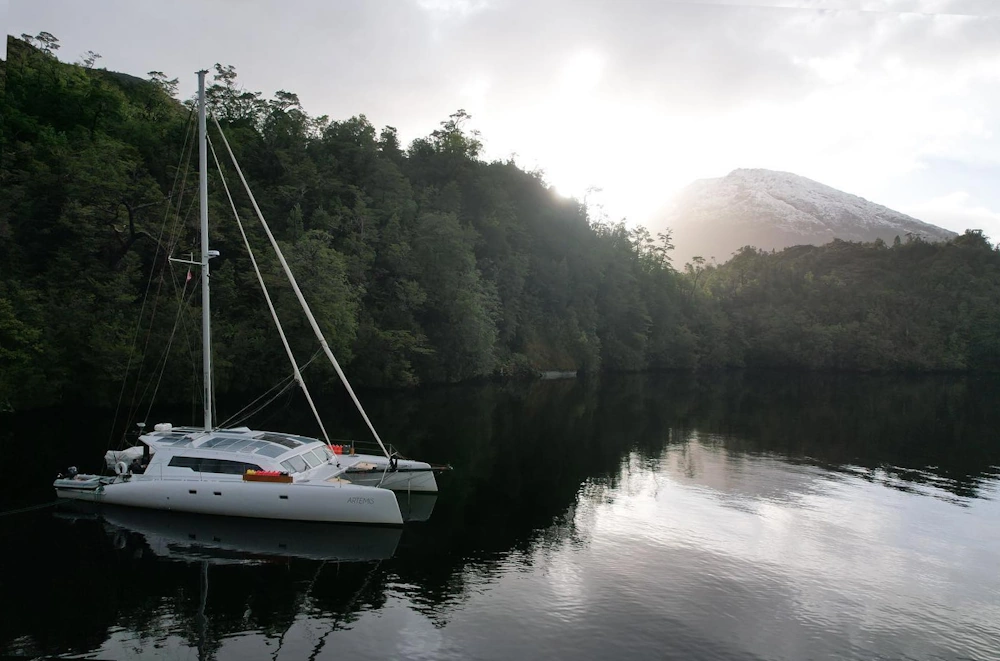
Caleta Chaski, @sv.artemis
Lessons
Artemis is an inspirational story first and foremost. But it is also a sailing trip that happens to demonstrate, in concrete terms, how much of what looks fixed about a disability is actually a design problem.
A few things stand out:
- Access is a design decision, not a compromise. Every feature on Artemis, from the sugar scoops to the tender ramp, exists because accessibility was a starting requirement rather than a retrofit.
- Planning years ahead pays off in remote places. Six years of preparation meant Hughes and Grace could handle a Cape Horn rounding and the Patagonian channels two-handed, in a boat suited to that kind of sailing.
- Competence can be built from zero, fast. Grace went from no sailing experience to serious offshore passages in under two years, which says as much about the boat and the training as it does about her.
- The right platform changes what is possible. A boat built with a tight brief let Hughes keep diving, exploring and skippering rather than being a passenger on someone else’s adventure.