
McConaghy’s Eco Panther Series
Fully Electric Performance Catamarans in Carbon
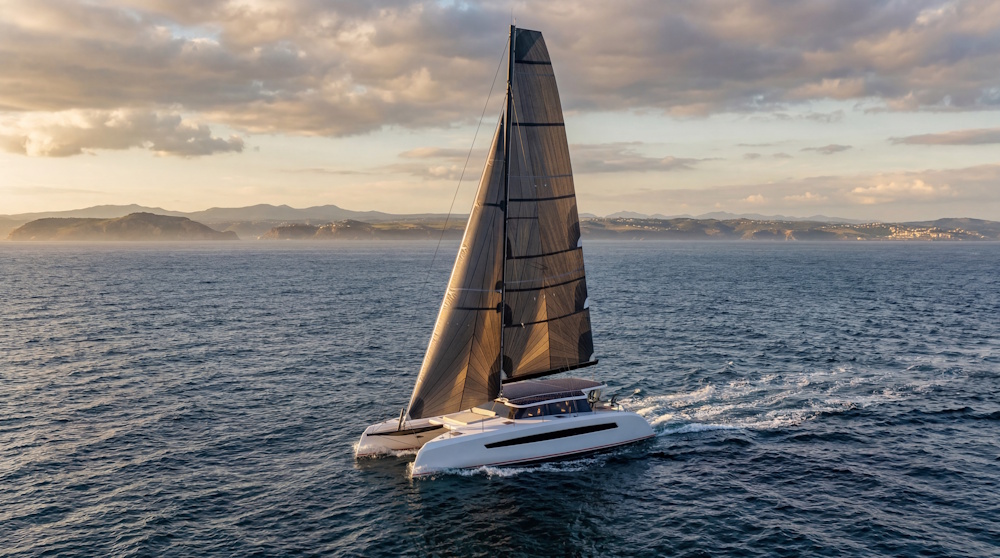
McConaghy Boats has steered its race-boat composite discipline in a new direction: an electric catamaran that performs. The Eco Panther Series spans three models, the Panther 48, 56 and 68, each built in full carbon with electric propulsion, integrated solar and daggerboard-assisted performance hulls.
The 56 has confirmed specifications and two cabin layouts. The 48 is a more compact entry point, and the 68 is the flagship of the range, positioned for longer range, volume and onboard autonomy.
A Composite Yard Turning Its Hand to Electric
McConaghy was founded in Sydney in 1967, building plywood skiffs and Tornado catamarans before moving into vacuum-formed foam sandwich construction. By the mid-1970s the yard was one of the first in the world to bring prepreg carbon into sailing boats, and in 1987 it built the largest composite structure of its era, a Nomex-cored maxi yacht. Ownership passed to long-time employees Jono Morris and Mark Evans in 2000, and the business has since grown into race boats, performance cruisers, multihulls, superyachts, AC40 supply and custom composite work outside the marine world, including submersible construction.
This background is relevant because electric range on a boat is first and foremost a weight challenge. McConaghy’s applies the same construction standards it uses on race boats to a cruising catamaran built to carry batteries, solar and full liveaboard systems.
Where This Sits in the Market
Electric propulsion on catamarans is not new, but many conversions add batteries and motors to a hull designed for diesel, or extend existing diesel powered designs. The Eco Panther Series starts from scratch: a full carbon platform designed around electric systems and daggerboard performance from the outset.
That approach is higly focused on keeping the weight down, which is the difference between an electric catamaran that motors quietly into the dock and one that also sails well and manages its own energy budget underway.
Panther 56
The Panther 56 is 17.94m overall with a hull length of 17.08m and a beam of 8.2m. Draft varies from 1.2m with the daggerboards raised to 2.5m with them down, and lightship displacement is 12.3 tonnes. Mast height is 25m above the waterline.
She is powered by twin 45kW electric drives, rated to 60kW each at peak, drawing from a 125kWh 48V battery bank installed as standard. The drives regenerate under sail, feeding charge back into the batteries and cutting reliance on the backup generator. Around 100m² of solar is worked into the design, and McConaghy quotes a range figure of roughly 800 nautical miles alongside the solar array.
Hull, deck and structure are vacuum infused carbon over epoxy core cell. Fresh water capacity is 400 litres and the fuel tank, feeding the backup generator rather than the main drives, holds 150 litres. The boat is certified CE Category A Ocean.
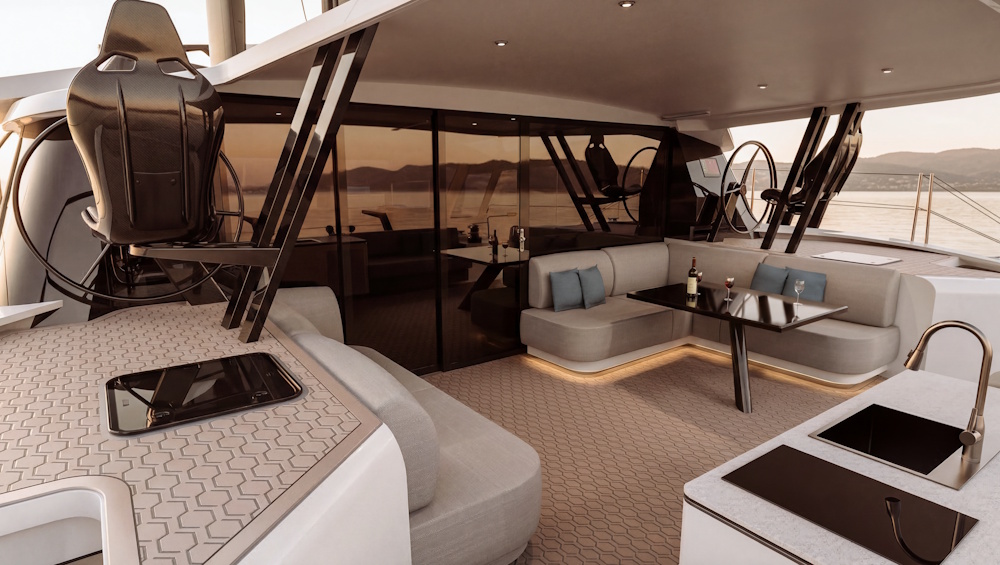
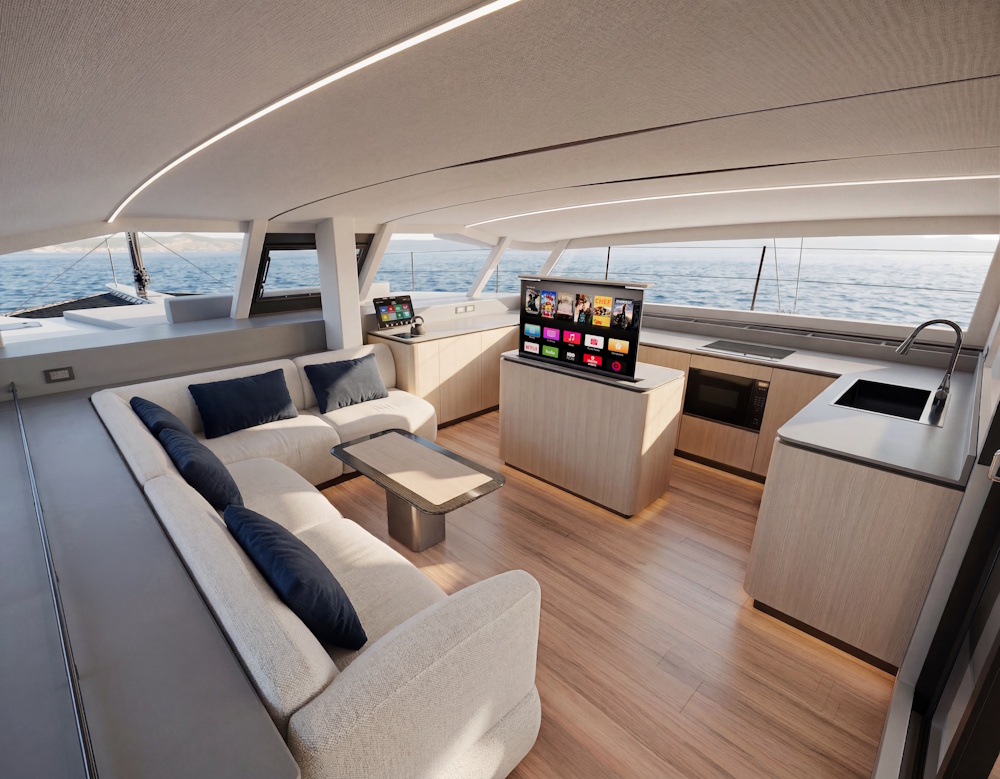
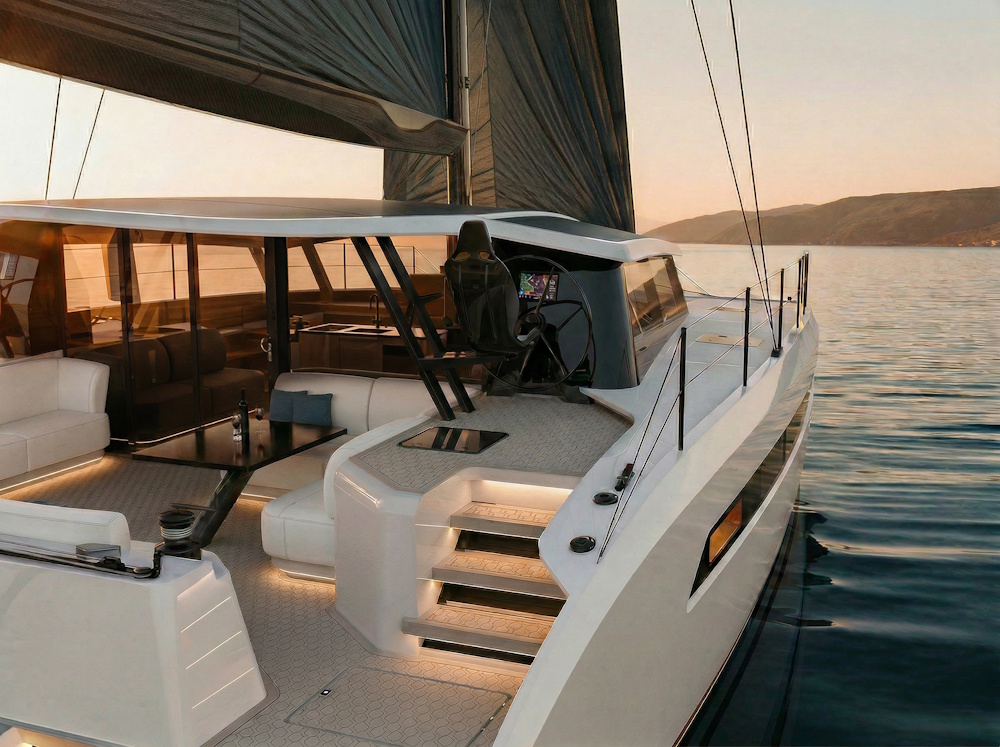
Layout options are three or four cabin configurations, both built around an open-plan main deck that links helm, galley, saloon and cockpit. Twin helm stations use carbon seats and wheels, and the interior is finished with panoramic glazing throughout.
Panther 48
The Panther 48 carries the same construction philosophy into a smaller footprint. LOA is 15.69m with a hull length of 14.62m and beam of 8.05m. Draft runs from 1.16m boards up to 2.5m boards down, bridge deck clearance is 990mm, and lightship displacement is 8.5 tonnes. Mast height is 24m above the waterline including antenna, with combined headsail and mainsail area of 126m².
Standard power is Twin 22kW Zero-Jet electric motors drawing from a 90kWh 48V battery bank installed as standard. Fuel and fresh water capacity are both 400 litres, saloon and hull headroom run 2.0m to 2.3m, and the boat carries the same CE Category A Ocean certification as the 56.
The current layout material shows forward sunbeds, a large saloon and galley on the main deck, an aft entertaining zone, and side deck helm stations, built around a three cabin configuration.
Panther 68: The Range’s Larger Concept
The Panther 68 is positioned as the largest boat in the series, aimed at owners wanting more volume and onboard autonomy than the 56.
Equipment
McConaghy has outlined a standard equipment package across the Eco Panther Series:
- 125kWh 48V battery bank
- Full carbon epoxy construction
- Fully battened mainsail, headsail and A-sail
- Approximately 100m² of integrated solar
- Twin helm stations with carbon helm seats and wheels
- Forward cushions
- Carbon champagne and glass holders
- Carbon mast, boom and longeron
- Water maker, fridge, freezer, electric stove and convection microwave
- Fenders, docking lines and anchoring gear
- Lightweight 21.9kW DC48V as backup power
The Panther series gives McConaghy a powerful electric proposition that sits alongside its other ranges.
For more information, visit the McConaghy Panther page..