

Setting the Traveller on a Catamaran
A Guide
The traveller is one of the most under-used controls on a cruising catamaran. Many charter boats set it somewhere near the middle, cleat it off, and leave it there for the entire season.
That is a shame, because used well, the traveller is a very effective tool for balancing a cat’s rig across all conditions. It controls mainsail twist, manages power delivery, and can save your bacon when the wind picks up unexpectedly.
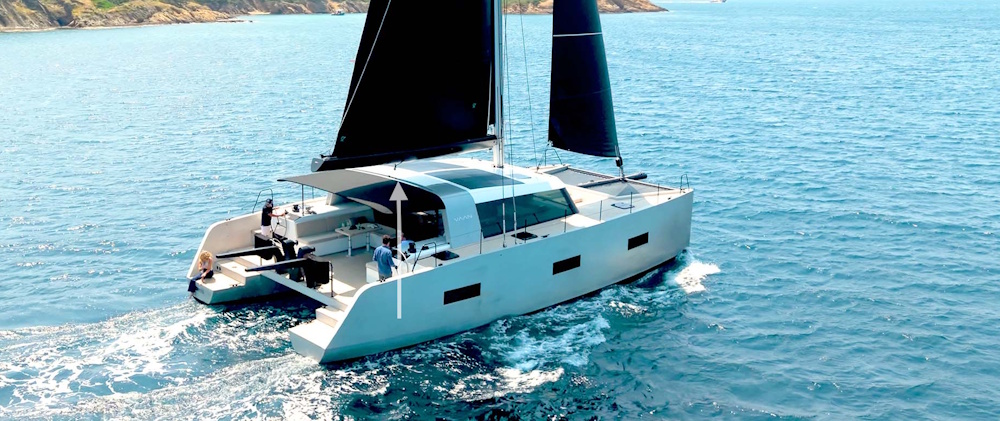
This guide covers how to get the most from a traveller-equipped catamaran, from upwind in a light breeze to reefing on a broad reach in building conditions. A quick-reference table is included below.
The numbers are meant as a starting guide. Always fine-tune your own boat based on your experience on the water. Use your leech telltales.
A good rule of thumb is to set your boom position with the traveller based on the apparent wind direction (angle of attack of the wind). Then fine tune the twist in your mainsail with the main sheet according to the conditions. Most catamarans don’t have a vang (some Leopards do). Set your sail position and the shape with the traveller and mainsheet using your telltales.
Traveller and Sail Trim Quick Reference
Catamaran with mainsail traveller and self-tacking jib. Each boat is different, play around, watch the tell-tales
| Point of sail | Wind | Traveller position | Mainsheet tension | Mainsail twist |
|---|---|---|---|---|
| Close hauled | ||||
| Close hauled 45° true / 30° apparent |
Light 0-10 kn | 20% to windward of centreline | Moderate – open leech slightly | Open – keeps speed in flat water |
| Moderate 10-18 kn | Centreline | Firm — leech telltales just lifting | Moderate — leech telltales flying | |
| Strong 18-25 kn | Ease to leeward 15-50% if no reefs in | Firm but ease traveller to depower. Flatten sail. | Flat. Ease traveller to depower. Then ease sheet if needed. | |
| Close reach | ||||
| Close reach 55-70° true |
Light to moderate | 0-33% leeward | Moderate | Moderate — upper batten roughly parallel to boom |
| Strong 18-25 kn | 25+ % leeward | Firm but ease traveller to depower. Flatten sail. | Flat. Ease traveller to depower. Then ease sheet if needed. | |
| Beam reach | ||||
| Beam reach 80-110° true |
Light to moderate | 50-67% leeward | Eased — let sail find its angle | Open – top of sail twisting off |
| Strong 18-25 kn | 60-75% leeward | Eased further | Use sheet to find optimal twist | |
| Broad reach / run | ||||
| Broad reach 130-160° true |
Light to moderate | 80-100% leeward (end stop) | Eased | Open – let upper sail rotate forward |
| Strong — reef territory | 100% leeward. | Play with sheet to just come off the shrouds | Just enough twist to stay clear of shrouds | |
| Reefing downwind (emergency or planned) | ||||
| Bear away to broad reach / dead run | Bear to 150-160° TWA, traveller to windward of centre | Trim in slightly — keep sail off rigging | Reduce twist to keep sail clear of shrouds | |
Percentages refer to proportion of traveller track from centreline to end stop. Actual settings vary by boat design and rig tune — use as a starting point and observe leech telltales.
Understanding what the Traveller Does
On a monohull, the traveller, if there is one, moves the boom laterally to change the mainsail’s angle of attack.
A traveller on a catamaran also does this, but the dimensions are different. The beam is wider, the rig is often fractional, and the boom sits higher. Moving the traveller car to windward or leeward changes the angle of the boom relative to the centreline across much of the beam.

When the traveller is centred and the mainsheet is pulled on, the leech closes up and the top of the sail powers up.
When you ease the traveller to leeward (without touching the mainsheet), the boom swings out without affecting the twist in the sail. Ease out the mainsheet to add some twist to the sail.
This is the key to catamaran trim: you can use traveller and mainsheet independently to control both the angle of the sail and the shape of its upper section.
Think of it this way:
- Traveller = boom angle = power and balance
- Mainsheet = leech tension = twist control
In practice, the two work together. Getting used to using both takes a little time but becomes instinctive over time.
Mainsail Twist
Twist refers to how much the upper part of the sail rotates away from the lower part. A mainsail with no twist is a flatter, near-vertical surface. A sail with a lot of twist has the upper section angled further off the wind than the foot.
On a catamaran, some twist is nearly always a good thing, particularly in calmer conditions. Here is why: the wind gradient means the breeze up top at the masthead is stronger and slightly further aft than at deck level. A twisted sail allows each horizontal section to present an optimised angle of attack for the wind speed and direction at that height, rather than stalling the top or flogging the bottom.

In light air, you want a more open, twisted leech to keep flow even across the full sail. In stronger breeze, reducing twist slightly (firming the mainsheet) increases power delivery when you want it, but in gusty conditions or a building breeze, opening the twist again is a good way to reduce heel and weather helm without reefing. You can also ease the traveller to depower the sail so that the sail is not flying at the optimal angle for the airflow. Useful if you have too much sail up.
Check your telltales: the top ribbon of the mainsail should be flying roughly parallel to the boom in moderate conditions upwind. If the top telltale is stalling (not flying), open the twist by easing the mainsheet slightly. If the upper leech is flogging back and forth, the twist is too open.
Close Hauled: Going Upwind
This is where the traveller earns its keep.
In light air (0-10 knots): try running the traveller car 20% to windward of centre. This seems counter-intuitive (you’re set on the wrong tack), but it allows the boom to sit closer to the centreline without over-tightening the mainsheet. The leech stays open enough to maintain flow, and the sail develops a fuller, more powerful shape up top.
Ease the mainsheet slightly so the upper leech telltale is just lifting. This is all about good airflow and keeping the boat moving.

In moderate breeze (10-18 knots): Bring the traveller back to centre. Firm up the mainsheet to close the leech and power up the sail. The upper telltale should be flying, or stalling only occasionally. The boat should feel balanced on the helm with minimal weather helm. If the weather helm is increasing, ease the traveller slightly to leeward rather than bearing away.
In stronger winds (18-25+ knots), many catamaran sailors get caught out. Put in a reef first if you can, but if the breeze builds suddenly, ease the traveller progressively to leeward while keeping the mainsheet firm. This depowers the sail by increasing the mainsail’s angle of attack, reducing heel, and bringing the helm back to neutral.
Now you are under control and you can get a reef in safely. You can always dump the mainsheet and head up into wind to depower.
Close Reach and Beam Reach
As you ease off the wind onto a close reach (around 55-70 degrees true), ease the traveller off to leeward in steps. The sail needs to move to leeward to match the changed wind angle. Play with the traveller and mainsheet to keep as many telltales flying parallel to the boom as you can.
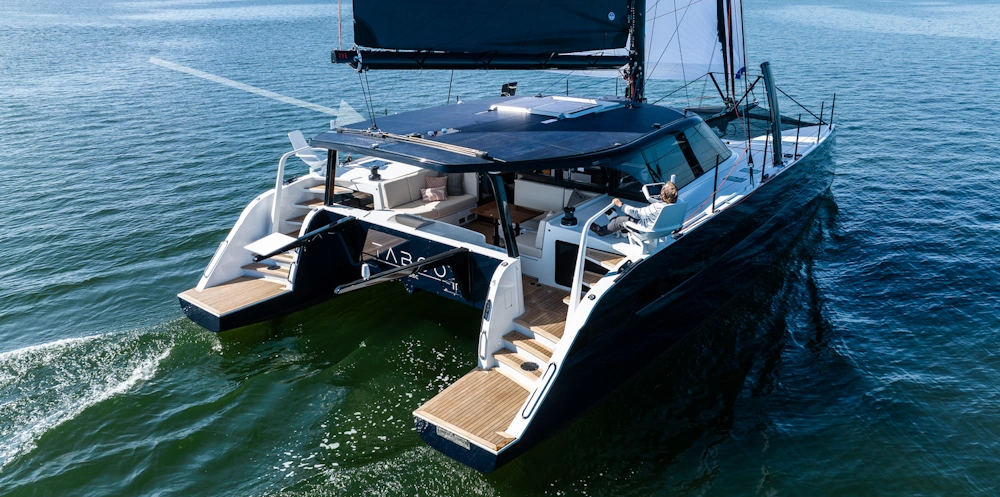
On a beam reach (around 70-110 degrees true), ease the traveller out to around 50-67% leeward like the HH52 above. Here, the mainsheet does less work on the boom angle and more work on leech tension alone. Ease the sheet until the upper leech telltales are streaming.
In stronger winds on a beam reach, ease the traveller car towards the leeward end and flatten the sail. Ease the mainsheet to depower. This is the most powerful point of sail for a cat, and keeping the boat flat and driving is the priority.
Broad Reach
On a broad reach (120-150 degrees true), move the traveller car fully to leeward, right to the end stop or close to it. The boom needs to swing out to present the sail to the wind. The mainsheet should be eased to just before your battens reach the shrouds. Trim the boom height with your mainsheet watching your telltales.
On this point of sale, keep an eye out for your mainsail battens touching the stays. It’s cheaper to sheet in a bit so your batten pockets don’t chafe on the stays!
On a broad reach, remember your apparent wind will come down and you can use this to help you manage gusts or to stay in control if the wind blows up. Bear away in the gusts if you are on a beam reach and you will stay safer and more comfortable in the gusts.
Reefing Downwind: a Manoeuvre Worth Practising
If the wind builds suddenly, head onto a broad reach to keep the apparent wind down. Reefing while sailing downwind can be a safer option than heading up into the wind to reef. Heading up in 25-30 knots on a cat brings the full power of the rig to bear at the worst possible moment.
How to reef downwind:
Always practice this manouuvre in lighter winds.
- Bear away to 150-160 degrees TWA (deep broad reach, almost dead downwind)
- Bring the traveller towards centre, or even a little to windward. The aim is to present a smaller sail area to the wind while remaining in control.
- Tighten the mainsheet to reduce twist and keep the sail away from the rigging up top
- Tighten the topping lift if needed (not too much)
- Ease the halyard and pull the luff down. You might need someone to yank it down, hopefully not, but you should be in a calmer situation with lower apparent wind.
- Put your reef in.
- Re-trim once the reef is set.
A useful trick if you are struggling to move your traveller up to windward is to put in a quick gybe and reef on the other tack. That way you can ease the main traveller on the new tack rather than fighting against the wind. This is easier with a self tacking jib.
Once the reef is in, you can sheet in and sail back to your desired point of sail. The whole process is calmer than reefing upwind with all the mainsail flogging, and once you have done it a couple of times it becomes a go-to option whenever conditions build faster than expected. Practice it in light winds first.
The self-tacking jib and its car position
Most modern cruising catamarans use a self-tacking jib on a track, with a single sheet and a car that slides along a curved or straight traveller. This setup simplifies tacking considerably: you tack, and the jib comes across by itself.
The position of the jib car on its track adjusts the sheeting angle of the jib, which in turn affects both the entry angle and the twist of that sail.
Moving the track car to windward increases twist and to leeward decreases twist. Moving the car to windward raises the clew attachment point relative to the sail’s tack (front of sail), opening the leech and letting the upper sail twist off. Moving it to leeward pulls the clew down and to leeward, closing the leech and flattening the twist.
This is not something that you will be trimming quite as much as the traveller aft, but who knows, you might be racing! Position the track car so that it is leeward of centre, trim the jib so that the lower telltales are both flying in parallel, then look at the mid and upper telltales. Ajust the twist of the sail (with the car) to optimise the flow across the whole sail. Play around with it, would be the best advice.
As you ease the main traveller to leeward in building breeze, easing the jib car to leeward in parallel maintains the trim balance between the two sails.
The A-frame System: Twin Mainsheets
Some catamarans, (Balance Catamarans, Catana for example), use an A-frame or twin-mainsheet system rather than a central traveller. Two separate mainsheet blocks attach to points on beam, and the sail is controlled by adjusting one or both independently.
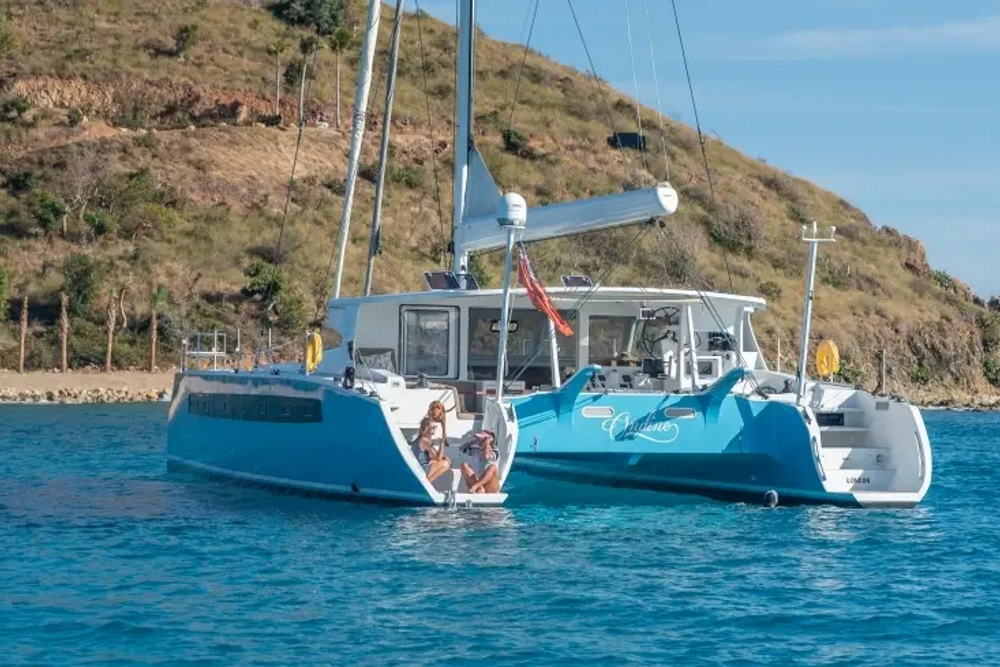
This system eliminates the need for the traveller altogether. It’s just a different way of contolling the twist. The A-frame system has a safety advantage: because the boom is controlled at two points, an accidental gybe is more contained as the boom cannot swing freely across the boat, even if movement is limited in the case of a traveller.
When the leeward sheet is trimmed, the leech closes and the boom moves to leeward. If the windward sheet is trimmed, the leech closes and the boom moves to windward. Perfecting boom position and twist requires adjusting both.
In parctice, most set the windward sheet first to set the boom’s position and then fine tune the leeward sheet to adjust leech tension and twist.
There is no “better” system, they are just different
Overlapping Genoas
Many cats, including more performance-oriented designs, fly an overlapping genoa rather than a self-tacking jib. The genoa requires manual sheeting on each tack to a track running back along the beam or deck.
A genoa provides more sail area and drive upwind, but it is different to trim. The sheet lead angle is critical. Move the cars fore and aft to add or take off the twist in the jib. On perfromance cats like an ORC 57 or Outremer, you might even see a 3D trimming system with the sheet running through a frictionless ring that you can move inboard, outboard, up, down and fore and aft. It’s more complex but give you 100% control onthe sail shape.
Summary
The traveller is not a set-once-and-forget it piece of kit. Treat it as an active trim tool, adjusting it as the wind shifts and strengthens. It’s a good safety feature.