
What is an ECO Catamaran?
What Exactly is an “ECO Catamaran”?
The term gets banded around in marketing materials, at boat shows and across social media. But spend five minutes talking to sailors and builders, and it quickly becomes clear there is no single agreed definition. “ECO catamaran” is less a precise category than a broad direction of travel, and the yachts that lay claim to it arrive there from several starting points.
Here are six boats you can see at the International Multihull Show in La Grande Motte (22-26 April) that illustrate just how varied that claim can be.
The Fully Electric Yacht: MODX 70
The MODX 70 is a 70-foot catamaran combining wind propulsion via Aeroforce wingsails, electric propulsion, hydrogeneration, and 70m² of solar panels for fossil-fuel-free sailing. The twin inflatable wingsails sit on telescopic retractable masts and are powered by electric motors with variable pitch, and the boat comes with hydrogenerating propellers.

There is no diesel generator on board, and the design goal was not to take an existing boat and electrify it, but to build from the ground up around zero emissions. The hull is built in glassfibre using bio-sourced resin and 40% recycled foam, so the sustainable credentials extend to the materials as well as the propulsion.
The MODX 70 won the Multiyacht of the Year 2025.
If your definition of an ECO catamaran is a boat that produces zero carbon emissions underway, the MODX 70 is a key contender. But this is by no means a cheap option and out of the range of most budgets.
The Lightweight Performance Yacht: ORC (Ocean Rider Catamarans)
Sailing is inherently “Eco”. The ORC 57 starts moving well under sail in 5 knots of true wind speed (and even lower) and excels in acceleration, which means the engines remain off more often than on a heavier production boat. The argument here is about efficiency: a hull that is genuinely fast in light air burns less fuel across a season.
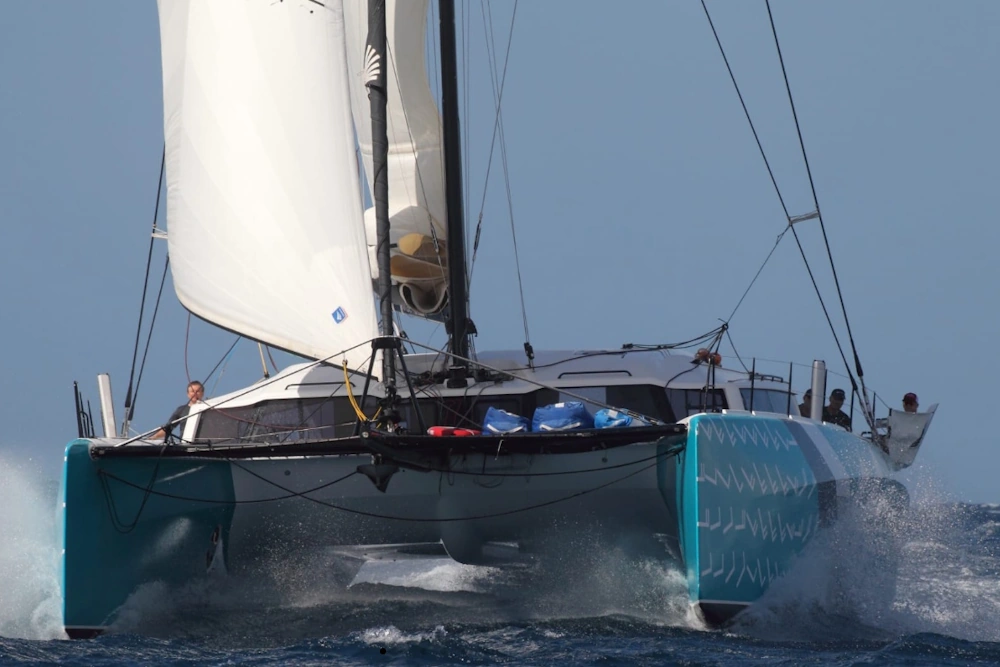
At 11.3 tonnes light ship, the ORC 57 is over 2 tonnes lighter than some boats nominally in the same category. Owners of earlier models have found that solar panels on the davits cover all onboard electricity needs in reasonable weather. Built in Lorient, the ORC range is designed for sailors who want speeed and connection with the sea rather than excess weight or complexity. Less weight, more sailing, fewer engine hours: a legitimate eco case.
The Refurbished Yacht: Lagoon 620 NEO
Lagoon has taken a different approach altogether with its NEO programme. The first 620 NEO, originally launched in 2012, spent four months at the Monfalcone yard in Italy undergoing a full manufacturer refit: structural and mast inspection, bulkhead rework, replacement of engines, sails, electrics, plumbing, electronics, headlinings and upholstery. The catamaran is now equipped with solar panels, a lithium battery bank, low-energy air conditioning and a wastewater treatment system. Multihulls World

Over 70% of uninstalled equipment is reused, and all boats follow a rigorous testing process similar to that applied to new models. Each refurbished catamaran comes with a two-year manufacturer’s warranty, supported by Lagoon’s global dealer network.
The circular economy argument is clear: extending the working life of an existing hull avoids the energy and raw material cost of building a new boat. The total cost of around €2.1m, compares to approximately €3.2m for a new, fully loaded Lagoon 60.
The programme currently covers 620s and a 450 NEO will be launched at the International Multihull Show.
The Recyclable Yacht: Vaan R5
The Dutch builder Vaan Yachts has made circular materials one of its key propositions. The hulls are made of up to 70% recycled aluminium sourced from window frames, number plates and road signs, combined with 30% pure aluminium alloy to reach marine standard 5083. Interior materials include FSC-certified cork decking, leather replacements from pineapple leaves and biological fabrics.
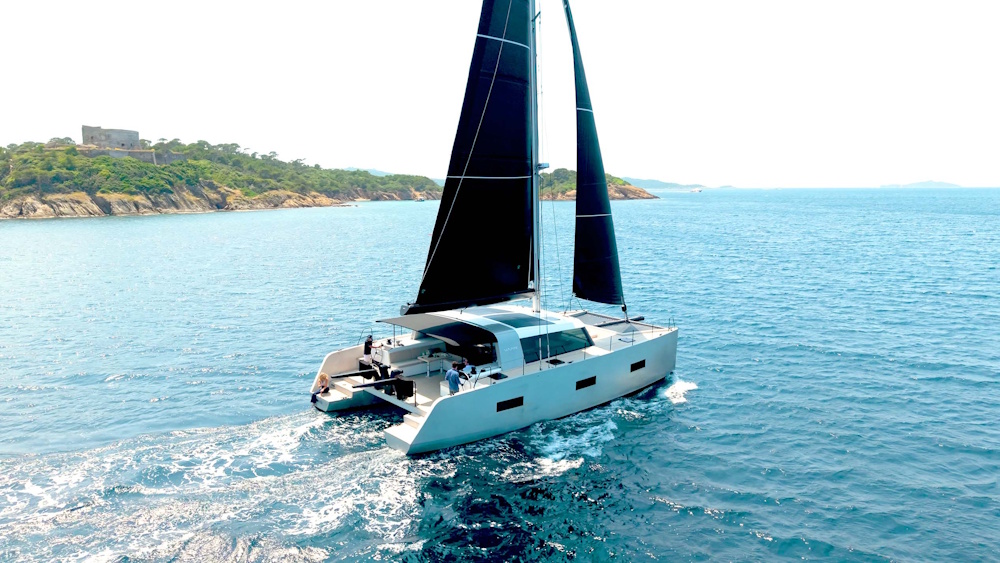
The yacht is a hybrid-electric and, made of sustainable and circular materials and is almost entirely recyclable. According to the yard, production of this recycled aluminium emits only 2kg of CO₂ per kilo of material, seven times less than conventional production.
The Vaan R5 is designed with its eventual end of life in mind from the outset.
The Long-life Yacht: Outremer
Longevity as environmental policy. The La Grande Motte-based yard has been building since 1984, and its argument is straightforward: a boat built to last 20-30 years or more generates a fraction of the manufacturing footprint per year of use compared with a boat replaced every decade. The Outremer shipyard points to its earliest multihulls, built over 35 years ago, still sailing the world. The design target is a lifespan of 50 years.
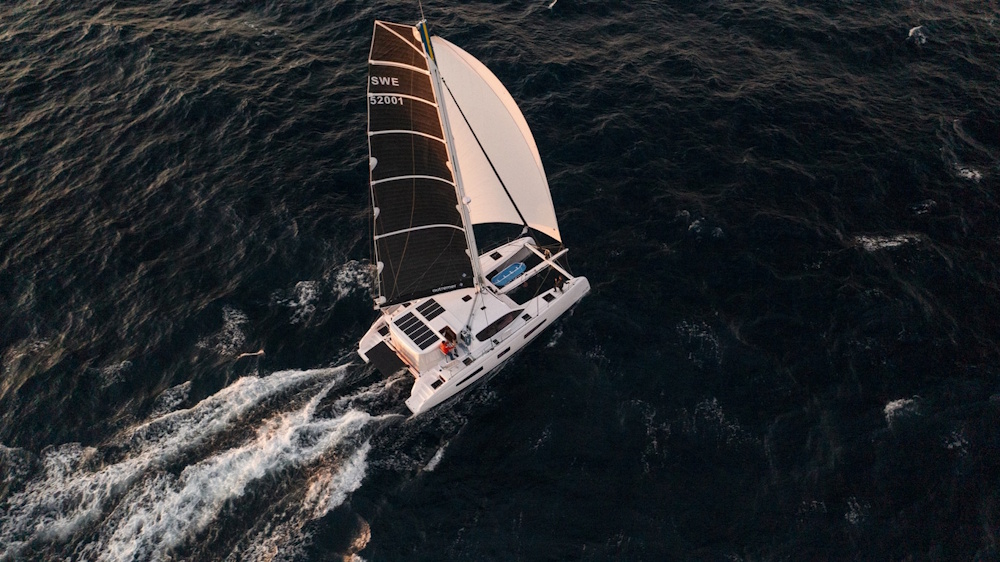
All equipment installed must be documented, accessible, able to be checked and replaceable so the boat can be maintained and upgraded anywhere in the world. High resale values reflect this, keeping boats in active service rather than in a breakers’ yard. It is a quieter claim to the ECO label, but a compelling one.
The Hybrid Yacht: Fountaine Pajot FP44 / Max Cruise SC48 / Excess 11 / Leopard 46
Both Fountaine Pajot and Max Cruise Marine offer hybrid-electric propulsion as either a factory option or core feature of their current ranges.
Fountaine Pajot’s ODSea+ system combines hybrid propulsion with renewable energy production incorporating solar panels, wind turbines and hydro-regeneration, with all energy flows managed from a centralised in-house console that prioritises renewable sources.
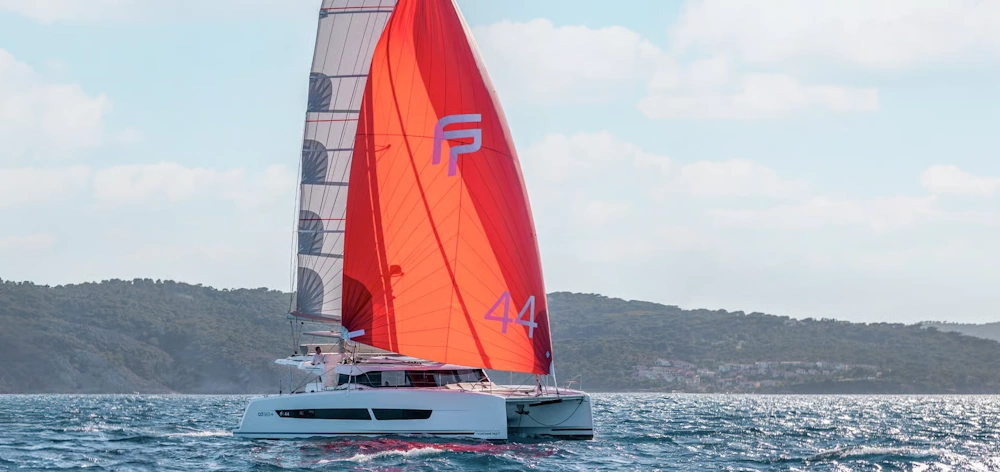
The FP48 features 2,300W of solar panels integrated into the roof. The system is developed entirely in-house and is now available across five sailing models.
Max Cruise Marine’s hybrid packages pair Beta Marine diesel engines with electric drives, substantial lithium battery banks and solar arrays. The Max 48SC, for example, features twin 10 kW electric drives alongside the diesel engines, providing sailors with genuine off-grid capability.
The hybrid approach does not eliminate fossil fuel, but it substantially reduces its use and extends the window during which zero-emission motoring is possible.
The Eco-Materials Yacht: Windelo
As well as focusing on the propulsion and energy systems, Windelo makes the argument at the level of sourcing its materials. The French yard has pioneered the use of a composite sandwich that replaces conventional fibreglass and foam with two unconventional alternatives.
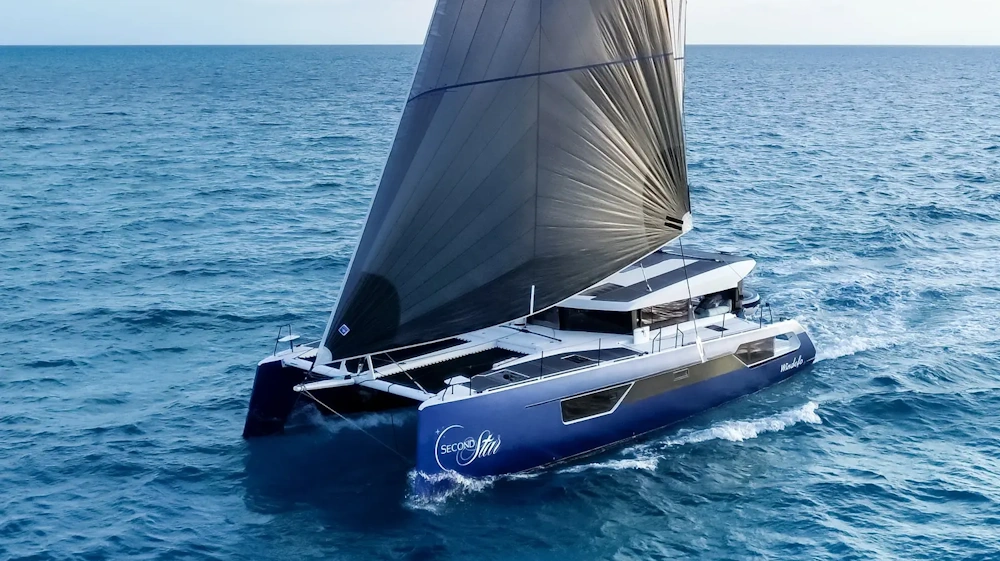
The first is basalt fibre. Basalt is one of the most common volcanic rocks on earth and requires no additives to transform into fibre, which reduces carbon emissions in production by a factor of ten compared to glass fibre. It also offers higher mechanical properties than glass fibre, along with strong fire and heat resistance.
The second is PET foam. PET foam is made from recycled plastic bottles, which are crushed into small pieces and melted to create the core material. It is both light and 100% recycled, addressing the environmental shortcomings of conventional foam cores.
The yard estimates the carbon impact of this construction method is reduced by 47% compared with traditional GRP, a figure that reflects internal manufacturing processes and local supply chains.
Interior materials extend the approach: FSC-certified wood, recycled textiles and organic fabrics are used throughout.
On the water, the 50 and 54 are true performance catamaran with daggerboards, a high-aspect rig and serial-hybrid-electric propulsion, powered by electric engines with a range extender generator extending motoring capacity to over a thousand miles.
The Windelo 54 makes the case for rethinking what a boat is built from, not just how it is sailed.
So which is the ECO Catamaran?
All of them, to varying degrees and some of these example above score in multiple categories.
What is clear is that the industry has moved beyond treating “ECO” as a single checkbox. Builders are pursuing sustainability across multiple fronts: what a boat is made from, how it is powered, how long it lasts, whether it can be refurbished rather than replaced, and whether it can one day be recycled.
The most compelling of these yachts score across several criteria at once.
The interesting question for buyers is not whether a yacht qualifies as ECO, but which side of the argument matters most to them. The pace of development in this space over the last two to five years has been significant.