
Navigating by the Stars at Sea
Have you ever wondered what you would do if your electronics failed halfway across an ocean? Switch to the manual compass and paper charts, yes, but what if your compass also failed?
You can estimate south during the day in good weather as the sun will be due south at its azimuth in the Northern Hemisphere outside of the tropics, or due north at solar noon in the Southern Hemisphere. And at night, you have even more pointers which makes things easier on a clear night.
Below is a set of the top 10 astronomy tips for navigating by the stars at sea. Each tip includes the direct technique, how it works step by step, and alternative angles you might use.
Who knows when you’ll need them? In any case, these are fun facts to know and it lifts your gaze off the nav panel and up into the stars where it ought to be!
10 Astronomy Tips for Navigating by the Stars at Sea
1. Find the North Star using Ursa Major (which includes the Big Dipper)

Method:
- Locate the Big Dipper asterism which looks like a saucepan.
- Focus on the two stars at the outer edge of the bowl (Dubhe and Merak)
- Draw an imaginary line upward starting at the bottom of the bowl through the top star.
- Extend this line about five times the distance between those two stars.
- The star you land on is Polaris, the North Star.
Polaris lies almost directly above Earth’s north rotational axis, so it marks true north.
Alternative: If the Big Dipper is low or obscured, try Cassiopeia instead.
2. Find the North Star using Cassiopeia

Method:
- Look for the bright W or M shape; that is Cassiopeia in the Milky Way. She is on the opposite side of the Big Dipper.
- Use the two left end stars of the W (or right 2 of the M). They make up the flatter “V” in the “W”.
- Imagine a line that bisects the angle of that V and points up in relation to the “V” (half of the “W”).
- Extend that line outward until it hits a lone bright star.
- That bright star is Polaris, the North Star. That’s north..
Cassiopeia sits opposite the Big Dipper on the other side of Polaris. During the night, they both spin around the North Star If one is low, the other is usually high.
Use whichever constellation breaks through cloud first.
3. Check the height of Polaris above the horizon for your Latitude
- Identify Polaris and estimate its angle above the horizon.
- This angle is your latitude in degrees north.
- If its height stays the same over time, you are sailing east or west.
- If the height increases, you are heading north. If it decreases, you are heading south.
Polaris is essentially fixed in relation to the North Pole. Changes in its elevation reflect changes in your latitude.
Tip: Use your fist at arm’s length to approximate 10 degrees.
4. Use Orion’s Belt to find approximate east and west
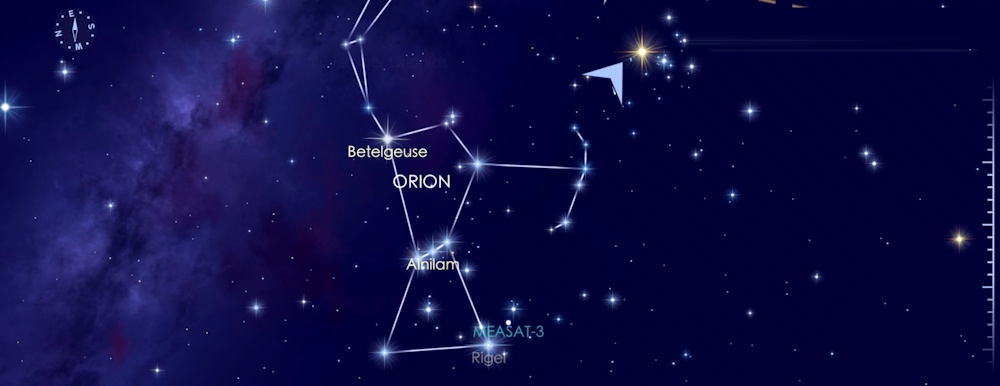
- Find Orion’s Belt, a straight line of three bright stars.
- If the constellation is upright, the belt points roughly east-west
- Orion rises in the east, moves across the southern sky, and sets in the west.
- The three stars in Orion’s belt run from east to west, though not perfectly east-west.
- Orion’s sword, which hangs from the belt, points towards the south when the constellation is in the southern part of its arc across the sky.
- In the Southern Hemisphere, it reaches its highest point when it is due north
- When Orion reaches its highest point in the sky in Australia, it is due north and appears inverted compared to the northern view. Betelgeuse (the red star) marks the hunter’s lower right, and Rigel (the blue-white star) marks the upper left.
When Orion is near due south in winter evenings, its sword hangs downward, giving you orientation even without tracking motion.
5. Use Sirius and Orion to confirm south (Northern Hemisphere)
Method:
- Find Orion’s Belt.
- Extend a line down and left from the Belt to reach Sirius, the brightest star in the night sky. This is also known as the Dog Star.
- When Orion is upright, Sirius appears south-south east early in the night, then due south later.
Orion crosses the meridian daily. When it does, Sirius sits in the southern sky.
Use this when Polaris is blocked by cloud or haze.
6. Use the Southern Cross to find south (Southern Hemisphere)

Method:
- Identify the Southern Cross, a compact kite-shaped constellation.
- Draw a line through the long axis of the Cross and extend it about 4.5 times its length.
- 2 pointer stars line-up towards the Southern Cross: Alpha Centauri and Beta Centauri
- If you bisect the stars and imagine a perpendicular line extending out, this crosses the long axis of the Southern Cross roughly at the South Pole.
- Drop a line straight down to the horizon to find south.
The Southern Cross rotates around the south celestial pole. Its long axis points at it.
If the Cross is distorted by horizon haze, use the Pointer Stars.
7. Use the Southern Celestial Pole rotation pattern
Method:
- Identify medium-bright stars near the southern sky if the Cross is not visible.
- Watch their movement for 30 to 40 minutes.
- In the Southern Hemisphere, stars rotate clockwise around the south celestial pole.
- The center of that rotation marks the pole. Drop downward to the horizon for south.
The south celestial pole has no bright marker, so rotation reveals its location.
8. Use the Crescent Moon
Method:
- If there’s a crescent moon high in the sky, draw an imaginary line connecting the tips of the crescent and continuing down to the horizon.
- That point is roughly south (north in the Southern Hemisphere).
This can be helpful on a cloudy night when stars are obscured but the crescent moon is visible.
8. Use star rising and setting points to determine east and west
Direct method:
- Pick a bright, identifiable star or a bright planet like Jupiter or Venus.
- Watch where it rises; that point is roughly east to south-east
- Later, note where it sets; that point is roughly west to south-west
Stars follow arcs parallel to the celestial equator. Their rise–set points are reliable orientation markers.
If the horizon is obscured, note the star’s drift across rigging or mast lines.
10. Use the Milky Way as a broad orientation band
Direct method:
- Look for the pale, cloud-like band of the Milky Way.
- Check where it arcs at your latitude. This is really only a “rough guide”
- In the Southern Hemisphere, the galactic core of the Milky Way often passes near the zenith (directly overhead).
- Use its general orientation when specific stars are difficult to identify.
The Milky Way is a fixed stellar backdrop and provides large-scale navigation cues. You are better off using the pointer stars to Polaris (or the Southern Cross) if you can. Cassiopeia sits in the Milky Way. The Swan (Cygnus or Norther Cross) flies away from her along the Milky Way.
Often visible even when bright stars are dimmed by moonlight.