

Code Sails on Catamarans
Understanding Code Sails: Code 0, 55, 65, 75, and Code D Explained
Cruising and performance sailors on yachts—especially those sailing catamarans—are increasingly turning to Code sails to fill the power gap between traditional headsails (genoas and especially self-tacking solents) and downwind spinnakers. These free-flying, furling sails combine versatility, ease of use, and performance across a range of wind angles.

But with names like Code 0, Code 65, Code D, and even “screecher” or “gennaker” floating around, what do these terms actually mean?
Let’s break it down by sail type, wind angle suitability, and best use cases—with clear guidance for all yachts: monohulls and multihulls alike.
What Are Code Sails?
Code sails are asymmetric, free-flying sails optimised for various reaching angles. They are categorised primarily by their mid-girth ratio (SMG)—the width halfway up the sail as a percentage of the foot. This determines how flat or full the sail is and, consequently, which wind angles it’s best suited for.
A useful rule of thumb is that a Code sail’s AWA sweet spot is roughly equal to it’s SMG. They will also work quite well around this number. Thanks to @jimmyh.se for sharing that nugget.
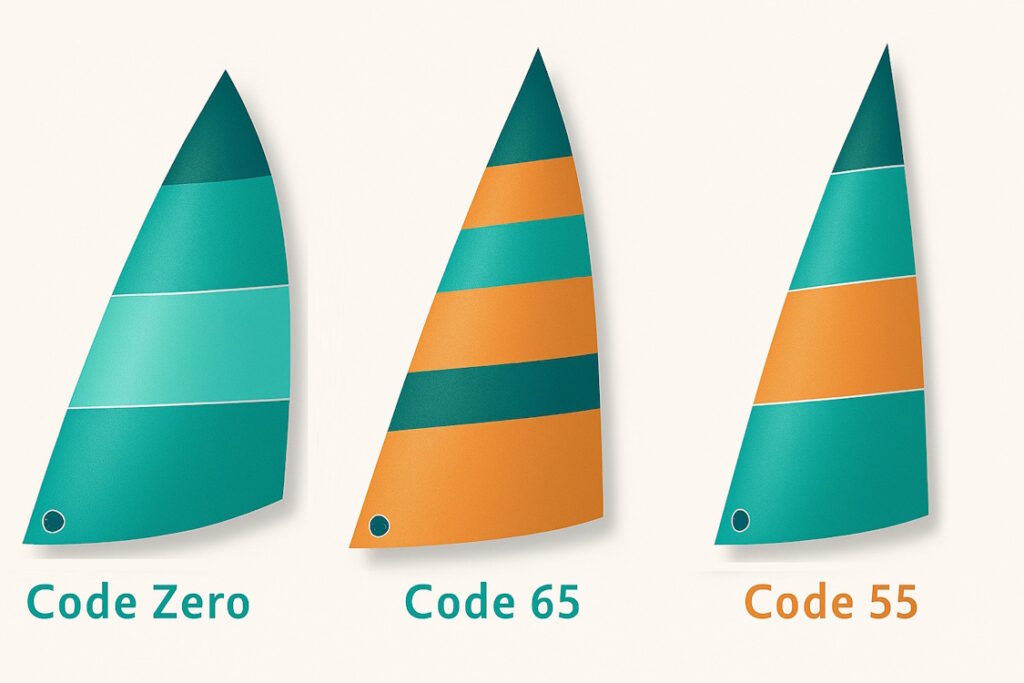
They’re often furling sails (vs. sock-deployed spinnakers), making them ideal for short-handed sailing and multihulls with forward deck space.
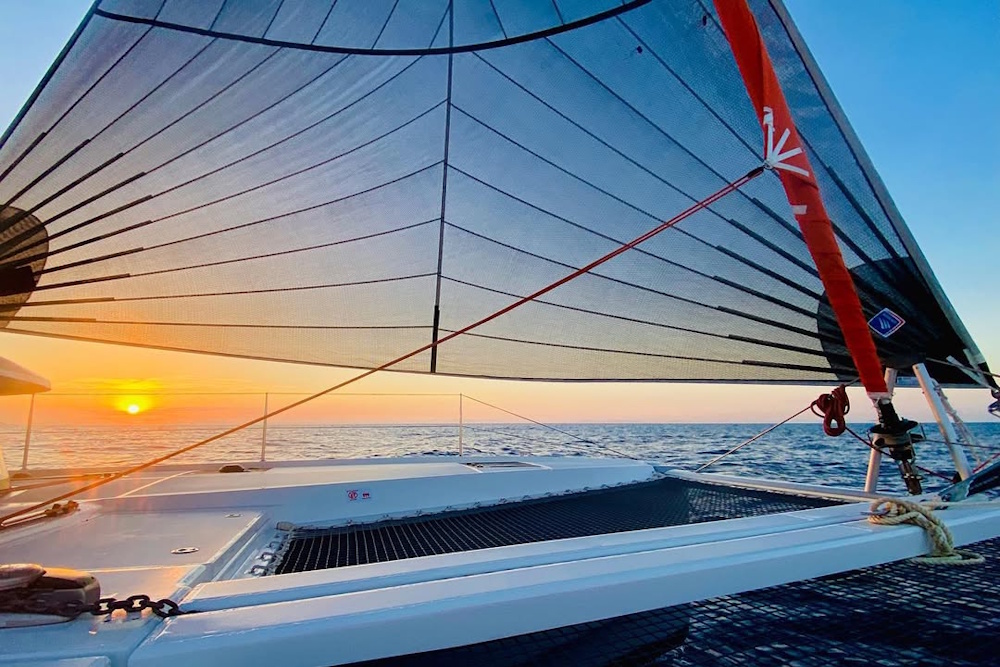
Code 0 on an Excess 11. Photo, Insta: @sailingbombarda
Here’s a comparative table for Code 0, Code 55, Code 65, and Code D (Gennaker) sails, focusing on multihulls. The figures are guidelines only, as they will depend on the sail manufacturer and indeed the yacht that is flying them.
Comparison of Code Sails
On mobile select the sail type to see the details.
| Sail Type | Usable Wind Angles (AWA) | Estimate of TWAs | Wind Speed Range Apparent | Wind Speed Upwind TWA | SMG% (Mid-Girth Ratio) | Common Alias |
|---|---|---|---|---|---|---|
| Code 0 | 50°–120° | 70°–130° | 3–20 knots | 3–13 knots | 65–75% | Screecher |
| Code 55 | 40°–100° | 55°–120° | 3–24 knots | 3–15 knots | 55% | Screecher |
| Code 65 | 45°–110° | 60°–125° | 3–22 knots | 3–14 knots | 65% | – |
| Code D (Gennaker) | 60°–150° | 90°–150° | 3–20 knots | 3–13 knots | >75% | Reacher |
Code 0
Usable Wind Angles (AWA): 45°–120°
Estimate of TWAs: 70°–130°
Wind Speed Range Apparent: 3–20 knots
Wind Speed Upwind TWA: 3–13 knots
SMG%: 65–75%
Alias: Screecher
Code 55
Usable Wind Angles (AWA): 40°–100°
Estimate of TWAs: 55°–120°
Wind Speed Range Apparent: 3–24 knots
Wind Speed Upwind TWA: 3–15 knots
SMG%: 55%
Alias: Screecher
Code 65
Usable Wind Angles (AWA): 45°–110°
Estimate of TWAs: 60°–125°
Wind Speed Range Apparent: 3–22 knots
Wind Speed Upwind TWA: 3–14 knots
SMG%: 65%
Alias: –
Code D (Gennaker)
Usable Wind Angles (AWA): 60°–150°
Estimate of TWAs: 90°–150°
Wind Speed Range Apparent: 3–20 knots
Wind Speed Upwind TWA: 3–13 knots
SMG%: >75%
Alias: Reacher
Key Points:
- AWA (Apparent Wind Angle) ranges reflect typical minimum and maximum performance. Code sails are more effective on a reach or close reach, while gennakers (Code D) can go deeper downwind.
- TWA (True Wind Angle) is larger than AWA due to multihull boats’ speed moving apparent wind forward. These are estimates, it will depend on the boat
- SMG% (Mid-Girth Ratio) distinguishes the sail’s shape: higher % = deeper, rounder sail (more like a spinnaker); lower % = flatter, more genoa-like sail.
- Apparent/TWA Wind Speed Ranges: Typical for light to moderate conditions; some specifications fill gaps if not listed for a particular code.
- Alias: Names may vary by region/sailmaker, but “Code Zero”, “Screecher”, “Reacher” and “Gennaker” are commonly recognised terms.
This table should make it easier to select the right sail based on desired angles, conditions, and performance profile
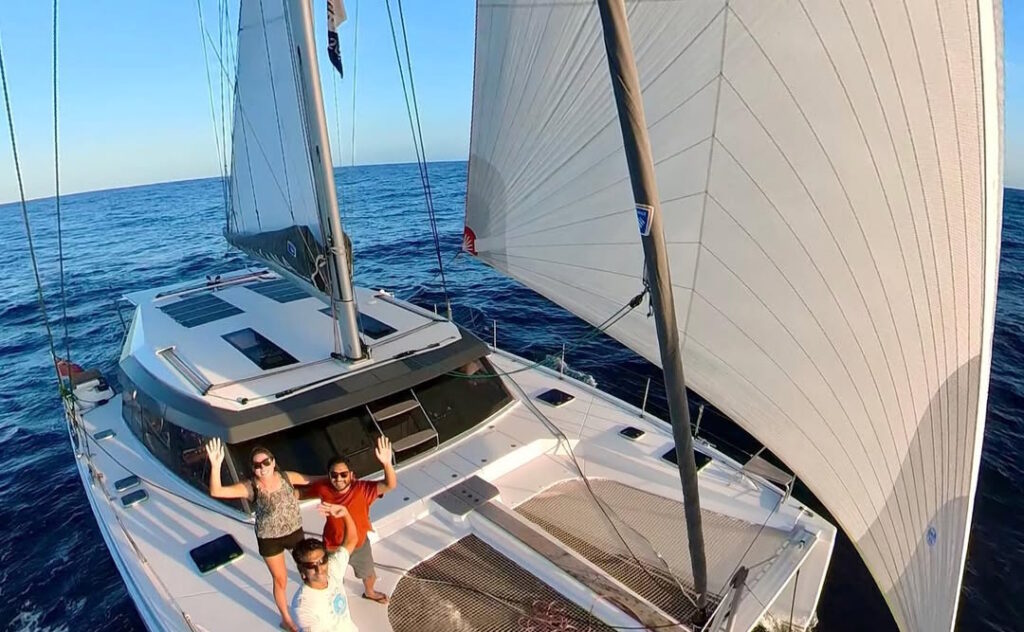
North Sails Code 65 on a Nautitech 46. Photo: Insta @sailingnavasana
Code Sail Breakdown
Code 0
- Shape: Flat profile, typically twice the size is a non-overlapping jib.
- SMG: Set at 75% for racing rules cut can be 65–75% for cruising (typically ~65%)
- AWA: 50–120°. Sweet spot 75°
- Use: Light-air upwind and close-reaching to reaching
- Aliases: Often loosely called a screecher on multihulls although this would more accurately be a Code 55
- Best For: Multihulls accelerating in light wind; fast furling; sailing close angles without a genoa. Easier to fuel than a gennaker.
Code 65
- Shape: In-between a Code 55 and Code 0
- SMG: ~65%
- AWA: 45–110°. Sweet spot 65°
- Use: All-purpose cruising and performance reaching
- Aliases: Often referred to as a screecher on multihulls although this more accurately this would be a Code 55
- Best For: One-sail solution for cruisers; reaches across a wide angle range and easy to furl. Easier to fuel than a Code 0.
Code 55
- Shape: Flat, narrower than a Code 0 or Code 65
- SMG: ~55%
- AWA: 40–100°. Sweet spot around 55°
- Use: Tight reaching in light-to-moderate wind
- Aliases: Sometimes referred to as a screecher
- Best For: Performance cats, fast monohulls looking for a tight-angle reaching sail with easy handling. Easier to furl than a Code 65 or Code 0.

Code 55 on an Outremer 5X. Photo Insta @sailing.nuvem.magica
Code D (aka Gennaker or Power Reacher)
- Shape: Deeper, rounded asymmetric profile
- SMG: Varies (generally 75%+)
- AWA: 60–150°
- Use: Deep-reaching/downwind in heavier breeze
- Aliases: Gennaker, Power Reacher. A reacher mostly refers to a large genoa hanked onto the forestay, but can blend into gennakkers.
- Deployment: Typically with a furler.
- Best For: Performance cats or short-handed crews needing an easy-to-trim downwind sail without a full spinnaker. Easier to get down than an assymetric spinnakers with a sock if the tension on the luff is optimal. Will start to collapse behind main at very deep angles.

Gennaker on Gecko, a Nautitech 40
Catamaran Focus: Which Code Sail Should You Choose?
Performance multihulls, especially those with non-overlapping jibs benefit immensely from Code sails. Here’s a quick guide:
| Sailing Goal | Ideal Sail |
|---|---|
| Upwind in light air | Code 0, Code 55 |
| Versatile all-around performance | Code 65, Code 0 |
| Reaching in moderate breeze | Code 65, Gennaker (D) |
| Deep-reaching/downwind | Gennaker (Code D) |
| High-performance closer angles | Code 55 |
Common Terms & Their Meanings
| Term | Meaning |
|---|---|
| Screecher | Multihull slang for flat Code sails (essentially a Code 55 or loosely Code 65, 0) |
| Reacher | Large foresail for reaching, Ann be hanked or furled on forestay, blend into gennakers |
| Gennaker | Generic asymmetric sail between genoa and assymetric spinnaker; includes Code D |
| SMG | Sail Mid-Girth (% of foot); defines sail width halfway up the sail. |
| Helix | North Sails’ structured-luff technology for Code sails |
Conclusion: One Size Doesn’t Fit All
Whether you’re racing offshore or cruising across a bay, selecting the right Code sail can improve your boat speed, VMG, fun and sail plan flexibility.
For catamarans, owning a Code 0 and a Code D offers broad wind angle coverage with minimal complexity. Add a Code 55 or 65 (screecher) if you’re chasing close angles in light breeze. Go for a 65 or 55 if ease of furling is more your priority or if you are likely to leave the sail out furled longer.
Sails are tools—choose the right one, and your sailing experience becomes smoother, faster, and more fun.