
McConaghy: One Yard, Five Catamarans
Over 50 Years of Expertise in Composites
Five catamarans: a 48ft carbon performance cruiser that is the lightest in its class. A hybrid electric 56. An 80ft luxury cat with a bespoke interior. A push-button 55. An 86ft grand tourer.
They all come out of the same yard: McConaghy, a brand that is on the move in the yachting world.

Adastra
It Started with Skiffs
John McConaghy founded the company in 1967, building 12, 16 and 18ft skiffs, Tornado and A-class catamarans, Moths and other high performance dinghies. From the beginning McConaghy was less interested in the type of boat than in what it could be made from.

Early hulls were plywood. Then came vacuum-formed foam sandwich in fibreglass and Kevlar. Then, in the mid 1970s, McConaghy became one of the first builders in the world to take prepreg carbon and put it into a sailing boat. The first 18ft prepreg carbon skiff reset the benchmark for the class.
In 1987 the yard built the first prepreg Nomex-cored maxi yacht, engineered by Giovanni Belgrano and SP Systems. At the time it was the largest composite structure in the world. Not the largest boat. The largest composite structure, full stop.
Everything McConaghy has done since is an evolution of this philosophy: how light can you make something and maintain its strength?
The Race Boats were the Lab
The results arrived in the regattas. Alfa Romeo took line honours at the Rolex Sydney Hobart in 2002. Wild Oats XI, launched in 2005, went on to take seven line honours wins in the same race (n 2025 MCB revisited WO XI to supply of a newly designed keel and foiling daggerboards). In 2005 the yard built the yacht for China Team, the first Chinese challenger in the America’s Cup.

Then things got even more interesting. In 2012 McConaghy helped James Cameron and engineer Ron Allum build DEEPSEA CHALLENGER, the submersible that took Cameron eleven kilometres down to the bottom of the Mariana Trench. In 2014 the Zhuhai yard delivered Adastra, a 42.5m power trimaran designed by Shuttleworth and still the largest vessel McConaghy has built. More recently the yard was chosen to build the AC40 for the 37th America’s Cup, designed by Emirates Team New Zealand, followed by a 13m hydrogen chase boat.
A submarine, a foiling one-design, a 42m trimaran and a maxi all contributed to McConaghy’s unique skillset : how to laminate and manage loads.
In their latest development in partnership with ZeroJet, the new MC-ZERO 450 combines McConaghy’s composite boatbuilding expertise with advanced electric jet propulsion to redefine the modern yacht tender. Powered by an advanced 48V electrical system, the MC-ZERO 450 delivers quiet, emission-free operation with innovative features such as push-button bow boarding steps.

The People
McConaghy has changed hands once in its history.
In 2000, John McConaghy and his long-time business partner Steve Moxham handed the company to two of their own employees, Jono Morris and Mark Evans. The pair went on to oversee some of the most successful maxi yachts ever built. In 2014 the Hong Kong-based Tiger Group Investments, led by yachtsman Graham Porter, took a stake and funded new facilities and equipment in both China and Sydney. Today the company is privately owned by Mark Evans and Tiger Group, employs more than 200 staff and operates across Australia, China and Hong Kong.
Evans is now Group Managing Director. In April 2026 he led the acquisition of Cure Marine, the Australian performance catamaran brand, bringing its designs and intellectual property fully into the McConaghy portfolio. Cure Marine has moved into McConaghy’s facilities. Ed Penn, a central figure in Cure’s early success, joined as Sales Manager for the Cure series.
“We saw a unique opportunity to bring a successful Australian design into the McConaghy fold,” Evans said at the time. Cure had the performance-driven IP, McConaghy had the production scale and the autoclave.
From Race Boats to Cruising Cats
McConaghy launched its first catamaran in February 2018. In seven years that has grown into a multihull operation with distinct ranges: MC-Multihulls, Panther, Sapphire, GT, Platinum and Chase Zero, alongside the Cure series.
That breadth is pretty unique. Most yards pick one market segment.
Here is how that looks today:
Cure 48GT, 55GT, 68GT
The sailor’s boat. With carbon used throughout the build. Carbon daggerboards, rudders, mast, longeron and crossbeam as standard. Designed around short-handed sailing, off-grid living and fast passages. This is the one you buy because you want to be on the helm, arriving at the anchorage first.

Cure 55
Panther 48, 56, 68
The Eco Panther series is McConaghy’s answer to electric cruising, and the 56 is the one drawing the attention. Full carbon vacuum-infused hull, deck and structure, electric drives with regeneration under sail, and solar integrated into the coachroof and side decks. The yard’s philosophy is clear here: electric only works if the boat is light, because weight is what kills range. It is a composites challenge before it is an energy problem.
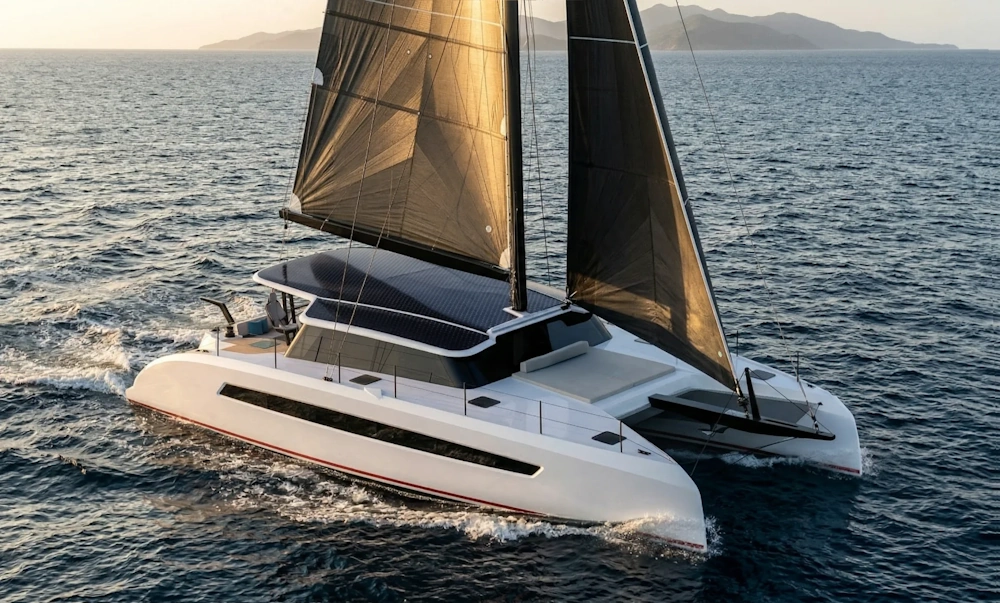
Panther 56
Sapphire 70, 80, 95
The bespoke, luxury end. Custome Interiors (choose your designer), furniture custom-built to order, and layout options that go well beyond picking a fabric. The pitch is volume without the usual weight penalty, built in vacuum-infused E-glass, carbon and Corecell. Also available as a 70 and 95.

Sapphire 80
MC55, 62, 68, 75
Luxury living with expansive entertaining spaces, advanced systems integration and elevated onboard refinement : thr MC range is the heart of the range.
Dual forward helms, push-button centreboards in place of daggerboards, and electric winches as standard. This is the boat for the owner who wants performance but does not want to work for it. Three or four cabin layouts.
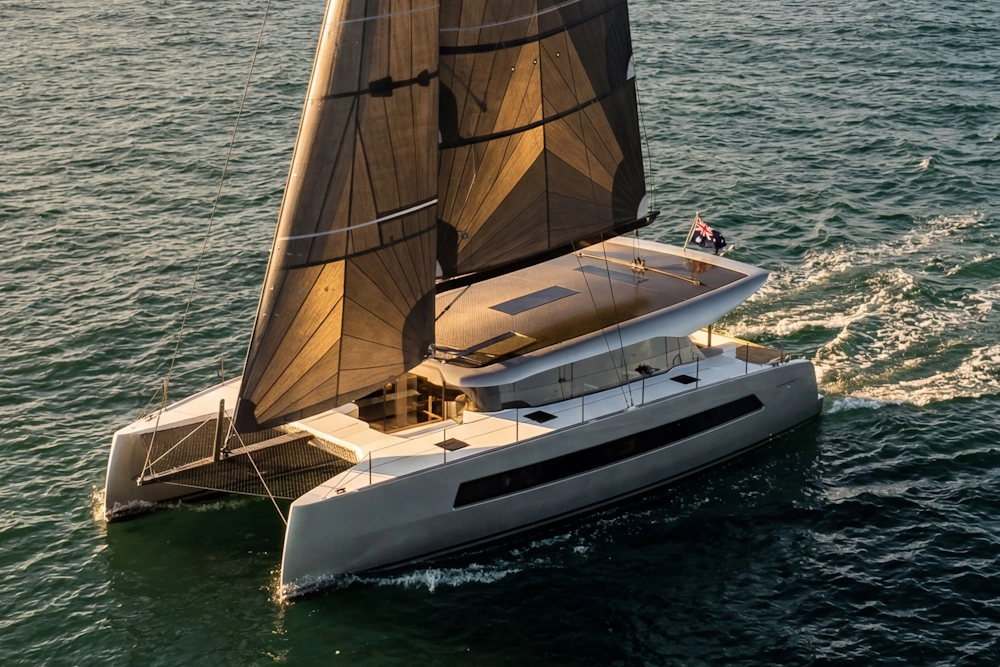
MC55
MC GT86
The grand tourer power cat. Narrower in the beam than most boats its size, with a sports coupe profile and a saloon left deliberately free of bulkheads. Built for covering ground quickly and entertaining when you stop.

What Links Them
What connects these yachts is McConaghy’s composite expertise. The reason the Panther can be electric is that it is light. The reason a Sapphire can carry that much volume and still sail well is that it is light. The reason a Cure 48GT feels so alive on the helm is that it is light.
McConaghy spent five decades perfecting their composites and have used that knowledge on their performance and luxury cruising catamarans.