

Catamaran Mainsail Reefing
Every System Explained
A monohull warns you it is overpowered by heeling. A catamaran does not. The platform stays flat while the loads climb, and the first signals are the leeward bow pressing down, the helm loading up and the speed surging in gusts. By then you are late. That is why reefing on a catamaran needs planning and discipline rather than reaction, and why it pays to know how your boat’s system works before you need it in 25 knots.
This guide covers the five mainsail reefing systems you will likely find on a catamaran where each one earns its place. Use the sequences as a pre-passage refresher or a cockpit reference.
The Five Systems at a Glance
| System | Worked from | Reef positions | Sail compatibility | Best suited to |
|---|---|---|---|---|
| Slab (hook or strap) | Mast, or mast and helm | Fixed (2 to 3) | Full battens, square top | Performance and traditional setups |
| Dual line | Cockpit | Fixed (2 to 3) | Full battens, square top | Shorthanded cruising and racing |
| Single line | Cockpit | Fixed (usually 2) | Full battens, square top | Charter and family cruising |
| In-mast furling | Cockpit | Infinite | No horizontal battens | Rare on catamarans |
| In-boom furling | Cockpit | Infinite | Full battens retained | Larger cats, bigger budgets |
Slab Reefing
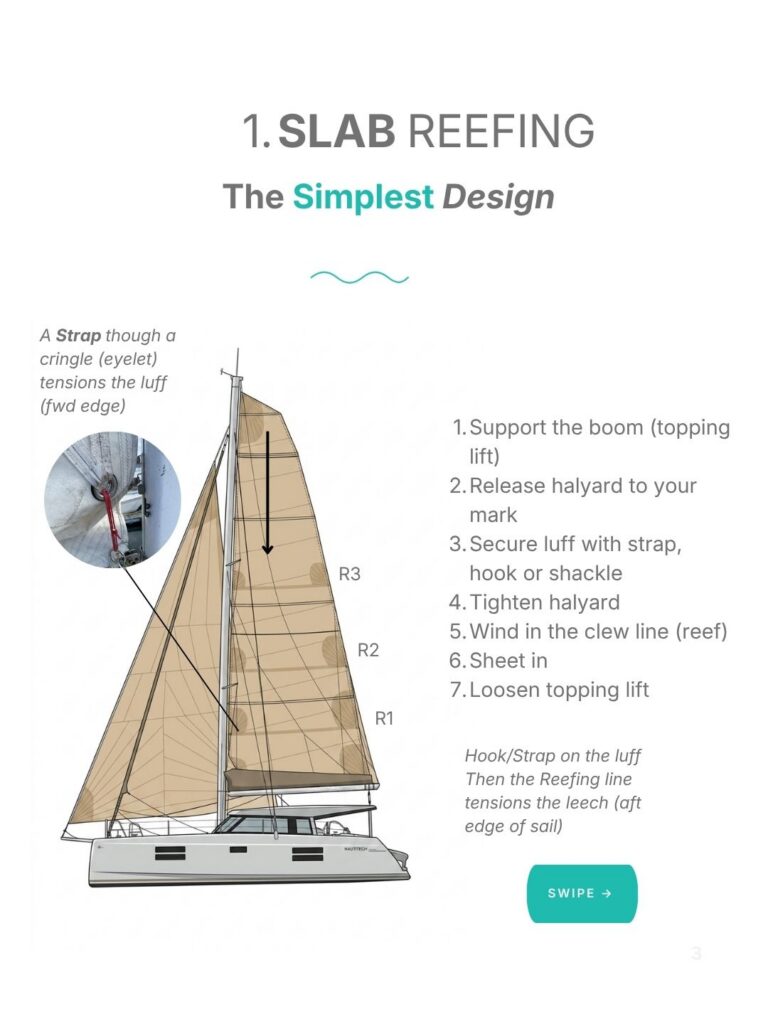
The benchmark against which everything else is judged. The sail is lowered to a fixed reef point and the luff cringle is secured at the gooseneck with a hook, a shackle or a strap fed through the cringle. The strap method is the most common arrangement on a cat and still the choice on boats such as the Nautitech 40 Open and the ORC 57, where reefing lines are at the mast. On most production cats the halyard lead aft, with only the luff secured at the mast.
Sequence
- Come into the wind to depower the mainsail
- Support the boom on the topping lift, ease the mainsheet and drop the traveller
- Ease the halyard to the pre-marked position, pulling the sail down against batten friction if needed
- Secure the luff: hook the cringle on, or feed the strap through and make it fast
- Re-tension the halyard until the luff is firm
- Wind on the clew reef line until the new foot is flat
- Sheet on, reset the traveller, ease the topping lift, tidy the bunt with ties through the sail only
Strengths
- Shortest line runs and the least friction of any system
- Best reefed sail shape: independent control of luff and foot tension
- Simple, inspectable and easy to fix at sea
Trade-offs
- On traditional setups someone leaves the cockpit and works at the mast
- Hooking a cringle on a pitching foredeck at night takes practice
Single Line Reefing

One line does both jobs. It runs from the cockpit, up to the luff cringle (eyelet), through blocks inside the boom, and up to the leech cringle, so winding it in brings tack and clew down together. This is the system on most production charter cats for a simple reason: nobody leaves the helm, and one winch does the work.
Sequence
- Boom supported, reef line loaded on the winch
- Halyard eased to the pre-marked position and locked
- Reef line wound in until tack and clew are home
- Halyard re-tensioned, sheet on
Strengths
- Fastest, simplest crew workload of the rope-based systems
- Safe: the whole job happens at the helm station
- Ideal for mixed-experience or family crews
Trade-offs
- The longest line runs and the most friction: expect to grind
- No independent foot tension, so the reefed shape is a compromise
- Usually limited to the first two reefs; reef three needs a separate arrangement, typically a luff pennant led aft
Dual Line Reefing
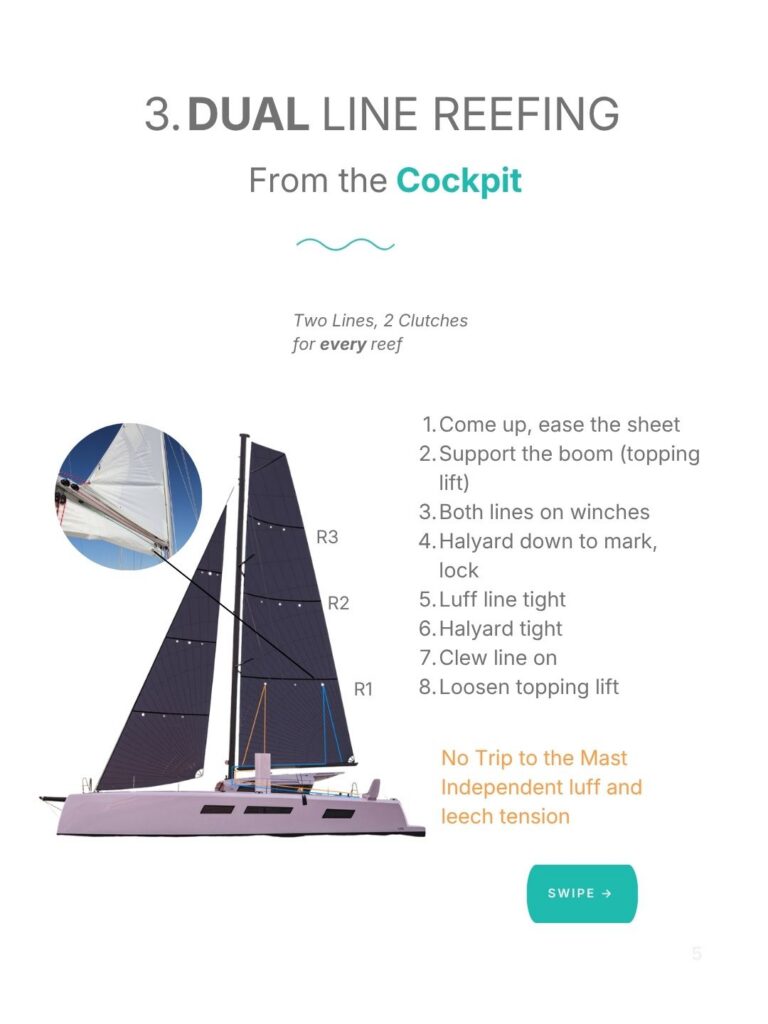
Like slab reefing but with the trip to the mast engineered out. A dedicated luff line replaces the hook at every reef, so both the tack and the clew are hauled down from the cockpit and locked in clutches. You keep slab reefing’s independent luff and foot tension and give up nothing but rope space.
Sequence
- Boom supported, both lines ready in their clutches
- Halyard down to the mark
- Luff line down and locked
- Halyard re-tensioned, then the clew line wound on
- Sheet on, trim, tidy
Strengths
- Everything from the cockpit, so it suits shorthanded crews
- Proper sail shape when reefed, close to slab standard
- Each reef is independent: a jam in one line does not disable the system
Trade-offs
- Two lines and two clutches per reef: six ropes for a three-reef main
- Cockpit clutter and more spaghetti to keep flaked and labelled
In-Mast Furling
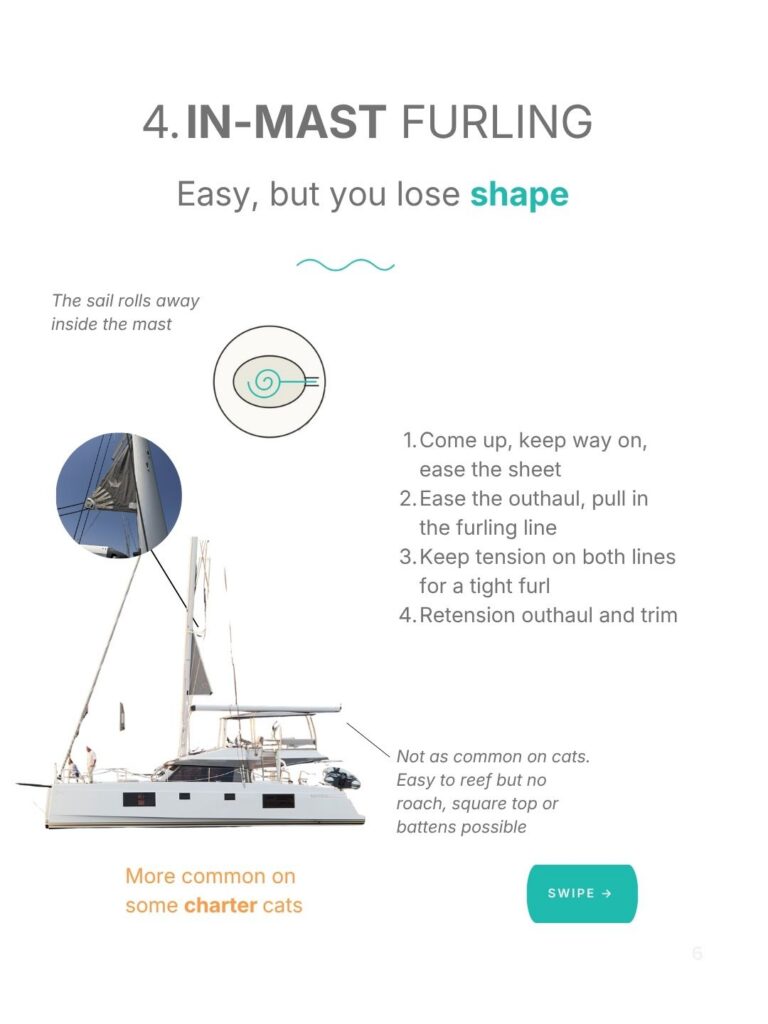
The sail rolls around a vertical foil inside the mast, so you can set exactly as much cloth as you want and strike it without ever hoisting. It is more common on cruising monohulls and rare on catamarans, and the reason is the sail itself. The modern cat mainsail is a fully battened, square-top sail, and horizontal battens cannot roll into a mast. An in-mast main gives up the battens, the square top and part of the roach, and its luff is shortened to accommodate the top swivel. The result is less area and a flatter compromise shape from a rig that depends on its mainsail for drive.
Sequence
- Come up towards a close reach, keeping way on for steerage
- Ease the sheet enough to unload the sail without letting it flog
- Ease the outhaul while winding in the furling line, keeping light back-tension so the sail rolls tightly
- Furl to the size you want, then re-tension the outhaul and trim
Strengths
- Effortless, infinitely variable reefing with no halyard work at all
- No sail to flake, cover or drop at the end of the day
Trade-offs
- Smaller sail with a compromised shape, on a boat that wants mainsail power
- Jam risk if furled under load or while flogging, though modern systems have reduced it
- Rarely fitted to modern cats, so parts and rigger familiarity can be thinner in multihull yards
In-Boom Furling
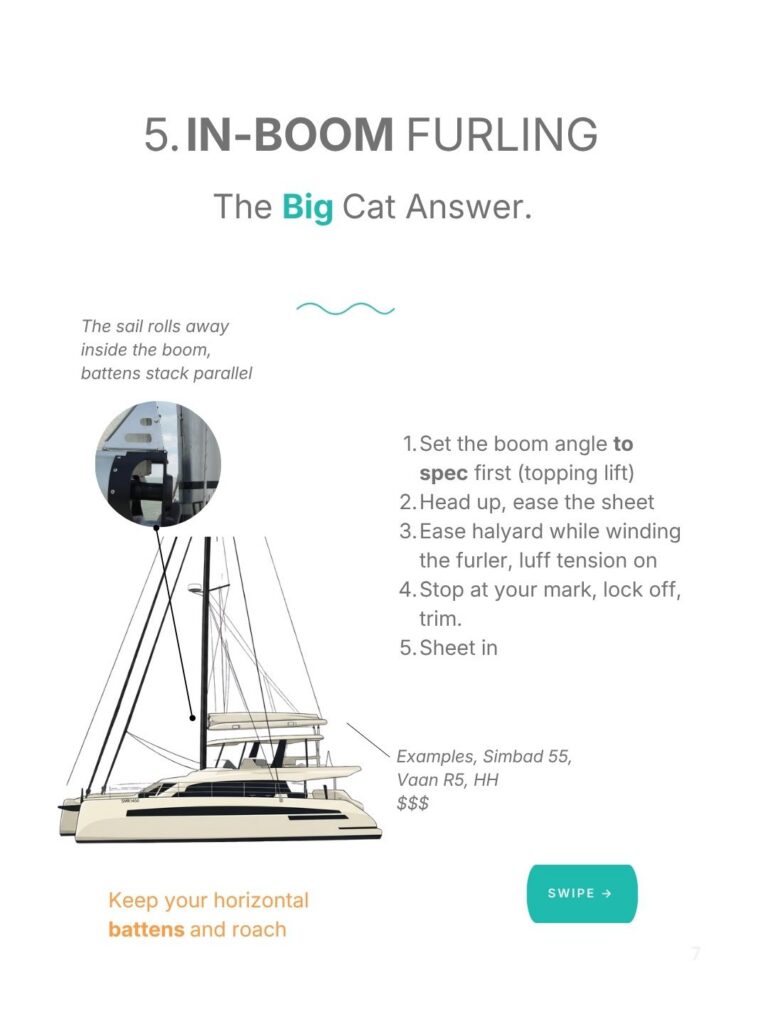
The sail rolls around a mandrel inside the boom, which resolves the in-mast compromise: you keep the full-length battens, the roach and most of the sail area, and still get variable reefing with a clean furl-away stack. It appears on larger cruising cats where slab loads get serious and budgets allow. The system has one absolute rule: the boom angle to the mast, set by the topping lift or rigid vang, must match the manufacturer’s specification, commonly around 87 degrees, or the sail creeps along the mandrel and jams.
Sequence
- Set the boom angle to specification before anything else
- Head up and ease the sheet
- Ease the halyard steadily while winding the furling line, keeping consistent luff tension so the battens stack parallel
- Stop at the reef mark, lock off, sheet on and trim
Strengths
- Keeps the fully battened, big-roach mainsail a catamaran wants
- Infinite reef positions and a fast, tidy strike
- If it fails, the sail can still be dropped conventionally
Trade-offs
- Boom angle discipline is non-negotiable; get it wrong and it jams
- Coordinating halyard and furling line takes practice
- Cost and weight in the boom, which sits high on a catamaran
When to Reef
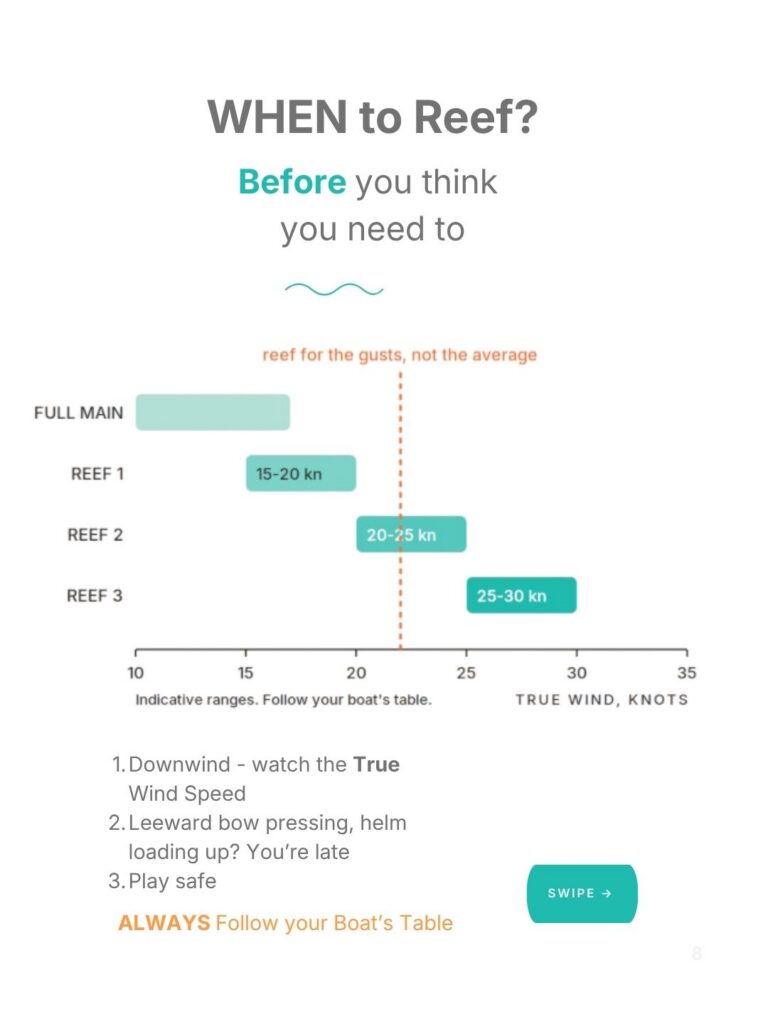
Reef before you need to. On a catamaran that is not a proverb, it is a sensible principle, because the boat gives you less warning as the load builds. Two numbers matter. Plan on true wind, because a fast cat sailing deep experiences much lower apparent wind and can flatter you into carrying full sail in 25 knots true. And reef for the gusts rather than the average, because a cat cannot spill power by heeling.
As indicative true wind ranges: first reef around 15 to 20 knots, second around 20 to 25, third around 25 to 30. Your boat’s own reefing table from the builder or sailmaker overrides any generic figure, so learn it and tape it at the helm.
Between the numbers, trust the cues: leeward bow pressing, spray building, helm loading, speed surging in the puffs. If you are asking whether it is time, it is.
Some Catamaran Rules
- Support the boom first. Most cats have no vang, so the topping lift carries the boom the moment the halyard is eased.
- Pull the sail down. A fully battened main on cars may not drop by gravity; batten compression sees to that. You may need to help it down. Make sure you keep the cars well lubricated.
- Mark the halyard for every reef. A whipping or a marker band per reef makes things easier, especially at night.
- Practise in 10 knots. The first time you tuck in reef two should not be the first time you need it.
Whichever system your boat carries, fluency is the objective. Learn the sequence until it is boring, then reef early, sail flat and arrive fast.