
Cardinal Marks Explained
How to Read Them Instantly at Sea

Out at sea, cardinal marks or buoys are some of the most important navigation aids you will come across. Unlike lateral marks, which guide you along a channel, cardinal marks tell you where the safe water lies in relation to a hazard.
This is part of our Kat School Series which includes articles like the Rules of the Sea and daggerboard designs.
They are precise, logical and very reliable once you understand how to read them.
There are four cardinal marks: North, East, South and West.
Each one uses a combination of black and yellow colouring, distinctive topmarks and specific light patterns to communicate its message.
Let’s break them down individually.
North Cardinal Mark
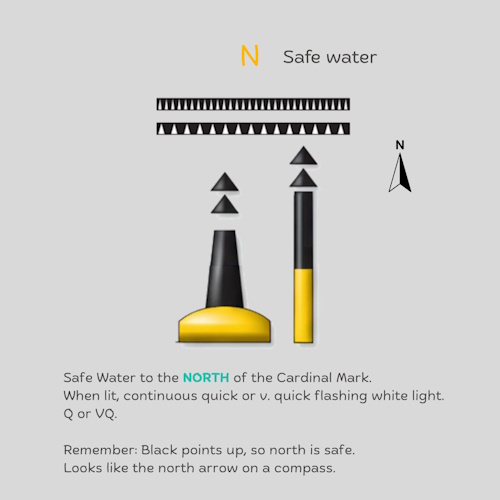
Safe water lies to the north of the mark. Pass to the north.
Colouring
Black on top, yellow on the bottom.
Think: the black band is at the top, like the top of a compass pointer.
Topmark
Two black cones pointing upwards.
The cones visually point north. Up equals north.
Light Configuration
White light flashing continuously or very quickly.
Either
Quick flashing (Q)
Very quick flashing (VQ)
No grouping, just rapid continuous flashes.
Where You See It
North of an isolated rock or wreck
- On the northern edge of a shoal
- At the northern limit of a reef system.
- At the northern limit of a marina wall.
East Cardinal Mark
Safe water lies to the east of the mark. Pass to the east.

Colouring
Black on top and bottom, yellow in the middle.
Think of the pattern as an “E” shape if you squint at the bands: dark, light, dark.
Or the yellow is Egg yolk (E for egg, E for East). The yolk is in the middle.
Topmark
Two black cones pointing away from each other, base to base.
They look a bit like an Egg.
Light Configuration
White light flashing in groups of three.
Q(3) 10s or VQ(3) 5s.
Quick or very quick flashes in a group of 3, followed by a pause.
Why three? Because East is at 3 o’clock on a clock face.
Where You See It
- East side of a shoal patch
- Marking the eastern edge of a sandbank
- Around complex reef systems
- Eastern limit of a marina wall
South Cardinal Mark
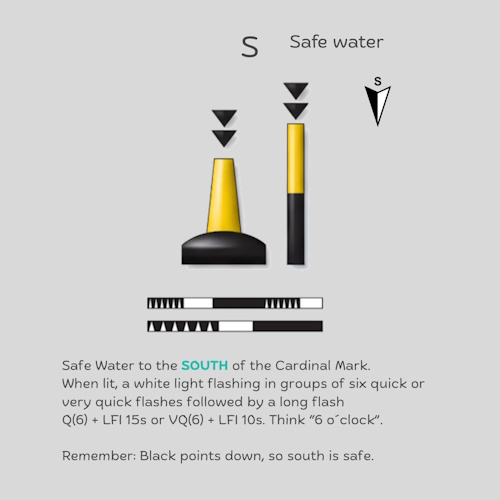
Safe water lies to the south of the mark. Pass to the south.
Colouring
Yellow on top, black at the bottom.
Think: the black band is at the bottom, like ta compass pointer pointing south.
Topmark
Two black cones pointing downwards.
Down equals south.
Light Configuration
White light flashing in groups of six, followed by one long flash.
Pattern: 6 quick flashes + 1 long flash.
Q(6) + LFI 15s or VQ(6) + LFI 10s.
Why six? Because South is at 6 o’clock on a clock face.
Where You See It
- South of submerged rocks
- South edge of a wreck
- Southern edge of a marina sea wall.
West Cardinal Mark
Safe water lies to the west of the mark. Pass to the west.

Colouring
Yellow on top and bottom, black in the middle.
Think Black Waistband. W for Waistband, W for West.
Topmark
Two cones pointing towards each other, tip to tip.
They resemble a Wineglass Shape shape when viewed. W for Wine. W for West.
Light Configuration
White light flashing in groups of nine.
Q(9) 15s or VQ(9) 10s. Think “9 o´clock”.
Why nine? Because West is at 9 o’clock on a clock face.
Where You See It
- Western edge of shoals
- West of rocky outcrops
- Westlimit of offshore wind farms
- Western end of a martina wall.
A Brief History
Cardinal marks are part of the IALA buoyage system (International Association of Marine Aids to Navigation and Lighthouse Authorities).
Before international standardisation, buoyage systems differed between countries, which caused confusion and accidents.
IALA, founded in 1957, created two buoyage regions, A and B, mainly affecting lateral marks. Cardinal marks, however, are consistent worldwide. That is what makes them so useful. Whether you are sailing in the Mediterranean, Caribbean or Pacific, cardinal marks work the same way.
They became widely adopted in the late 20th century as maritime trade expanded and the need for standardised safety systems increased.
Different Shapes You May See
Cardinal marks are often:
- Large pillar buoys offshore
- Spar buoys in shallower water
- Fixed posts in tidal estuaries
- Beacons mounted on rock outcrops
The shape of the buoy body is not the important thing. The key identifiers are:
- Colour bands
- Topmarks
- Light patterns
Never rely on the buoy shape alone.
How to Memorise Them Easily
Use three simple memory systems:
Cones Show Direction
Cones up = North
Cones down = South
Cones like an Egg = East
Cones like a Wine Glass = West
Clock Face for Light Flashes
North = continuous rapid flashing
East = 3 flashes
South = 6 flashes
West = 9 flashes
Black Markers Show Direction.
North: black at top like a compass pointer
South: black at bottom like a compass pointer
East: black top and bottom, yellow Egg yolk in the middle
West: black in middle like a Waistband
Where You Are Most Likely to See Them
You will typically see cardinal marks:
- Around isolated dangers offshore
- On approaches to harbours
- Near rocky headlands
- Surrounding wrecks
- Around reef systems
- Marking safe passages through shoal areas
- At the ends of marina sea walls
They are common in coastal cruising grounds with complex seabeds, such as the Mediterranean, UK coastlines, Scandinavia and coral reef areas.
Examples
East

This show was take in Pollença, Mallorca.
West

North

South

Thoughts
Cardinal marks are not complicated once you see the system behind them. They are logical, geometric and consistent worldwide.
Learn:
- The cones
- The colour bands
- The clock face light system
Then you will be easily able to identify any cardinal mark instantly, day or night.