

Wind Speed Calculator. True, Apparent.
TWS/TWA vs AWS/AWA
True Wind, Apparent Wind Calculator
Try this tool if you would like to convert true wind speed (TWS) and true wind angle (TWA) to apparent (AWS, AWA) and vice-versa.
Normally you know your boat speed (STW) and you are either inputing the TWS and TWA to find the Apparent values or the AWS and AWA to find the true values. You can also find your boat speed from the other values of course. See our Points of Sail article for another angle on this.
Wind Calculator
Enter three or four values to calculate the missing one or two.
For example TWS, TWA and Boat Speed to calculate AWS, AWA.
Or AWS, AWA and Boat Speed to calculate TWS, TWA.
This tool is a sailing wind calculator designed to help you determine the relationship between True Wind and Apparent Wind.
What’s the Difference Between True Wind and Apparent Wind?
In sailing, the True Wind is the actual speed and direction of the wind over the water, while the Apparent Wind is the wind speed and direction you feel on the boat, which is a combination of the true wind and the wind created by the boat’s movement.
If you have ever stuck your head out of the window of a car when the wind is blowing from the side, you will feel it coming from the side of the car when you have stopped at the traffic lights, and it will move progressively forward as you accelerate. That’s the apparent wind.
How the Tool Works
The tool works by treating wind and boat speed as vectors. A vector is a quantity with both magnitude (speed) and direction. The fundamental principle is that the Apparent Wind vector is the sum of the True Wind vector and the Boat Speed vector.

- Vector Decomposition: The tool takes the speed and angle you enter for each value (True Wind Speed, True Wind Angle, and Boat Speed) and breaks them down into their horizontal (X) and vertical (Y) components. This is done using trigonometry:
- X=speed×cos(angle)
- Y=speed×sin(angle)
- Vector Addition: To find the missing value(s), the tool adds or subtracts the known vectors’ components. For example, to find the Apparent Wind, it adds the X and Y components of the True Wind and Boat Speed vectors.
- Vector Composition: Once the combined X and Y components are found for the missing value, the tool uses the Pythagorean theorem to calculate the new speed (the vector’s magnitude) and the
atan2function to calculate the new angle (the vector’s direction). This process is repeated to solve for any missing values.
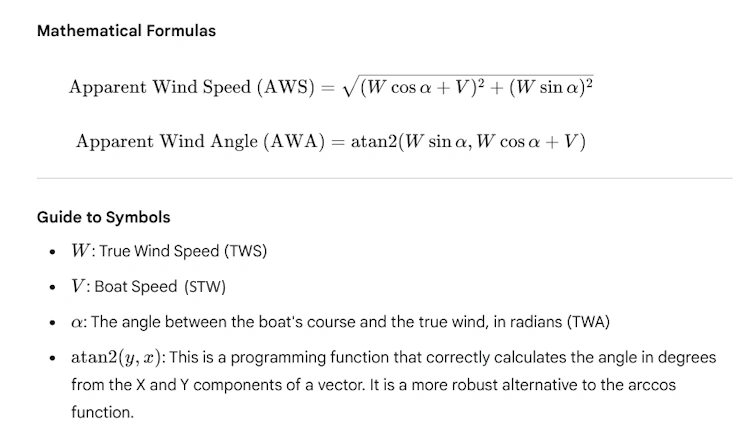
Here are the mathematical formulas used by the wind calculator, presented with a guide to the symbols. These equations are a direct representation of the vector calculations performed in the code.
Mathematical Formulae
Guide to Symbols
- W: True Wind Speed (TWS)
- V: Boat Speed (STW)
- α: The angle between the boat’s course and the true wind, in radians (TWA)
- atan2(y,x): This is a programming function that correctly calculates the angle in degrees from the X and Y components of a vector. It is a more robust alternative to the arccos function.
These formulae are what the tool uses to solve for the missing values. The code converts angles to radians for calculation and then back to degrees for display.
A Note About Boat Speed and SOG
There are two ways of measuring the speed of your vessel.
– Speed Through the Water (STW) usually measured by a paddlewheel on a boat. This takes into account any current effects. If your SOG is 5 knots and you are heading directly into a 2 knot current, your boat speed will be 7 knots.
– Speed Over Ground (SOG). This is the speed of the boat over the seabed, usually measured by GPS.
Boat instruments use speed through the water (STW) instead of speed over ground (SOG) because true wind is defined relative to the water, not the seabed. Using SOG would contaminate the calculation with current.
In practice, unless you are in a very strong current, SOG will also give you a good idea of True Wind Speed and True Wind Angle. If you haven’t correctly calibrated your paddlewheel, it may be more accurate, or you can use it as a substitute if your paddle wheel is not working. Most nav systems allow you to set your boat speed to match SOG as a workaround, but the best thing to do is correctly callibrate your paddlewheel and make sure that it is clean after long stays in the marina.
For this calculation, we are assuming that your paddle-wheel is working and correctly callibrated.