

VYBE 43 Review:
Italy’s New Power Catamaran Enters a Crowded Field
A new name has surfaced on the Tuscan coast, and it is not shy about its ambitions. Cantiere del Vybe, the shipyard behind the VYBE 43, has built a boat with the philosophy that yacht owners no longer need to choose between space, speed and style.
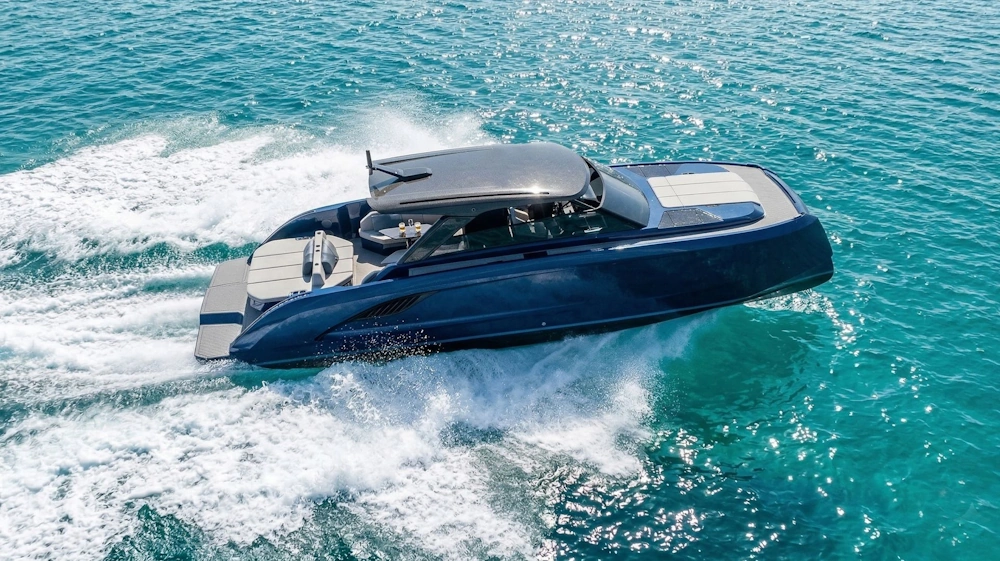
Born on Italy’s boatbuilding coast
Cantiere del Vybe is in Carrara, in the Massa-Carrara province of Tuscany, a stone’s throw from Viareggio, the town many regard as the engine room of Italian yacht construction. This stretch of coastline, sometimes called the Riviera della Nautica, is home to composite specialists, upholsterers, and marine businesses that supply much of the world’s superyacht industry. Vybe positions itself as an insider rather than a newcomer to that world, using the same craftsmen trusted with some of the most demanding customers around.
Vybe is a young, low-volume builder. It produces only a handful of boats a year and operates by appointment, with client meetings held in Viareggio or Ibiza: a boutique approach more common to custom sailing yacht builders than to production power cat brands.

The Vybe Philosophy
Vybe focuses heavilty in on area: that its hull design delivers monohull-like handling and a reduction in fuel burn without using foils. They argue that foil-assisted designs lose effectiveness as marine growth builds up and depend on ideal conditions, whereas Vybe’s performance is engineered into the hull shape itself.
It’s an interesting positioning in the power cat world, where foil-assisted designs have become increasingly common, and it gives Vybe a clear point of difference.

Meet the VYBE 43
The VYBE 43 is a 12.67 metre power catamaran with a 3.97 metre beam and a 1 metre draft, small enough to sit in a standard monohull marina berth despite its twin-hull layout. The hull itself is the headline feature: twin asymmetric deep-V hulls with a triple-step configuration, designed to cut hydrodynamic drag, paired with an aerodynamically shaped tunnel that generates a lifting air-cushion effect at speed.
Two engine packages are offered. The standard is a pair of Volvo Penta D6 units at 480hp each, with an estimated top speed of 46 knots at light load. The performance option swaps in twin Mercury V12 engines at 600hp each, taking the estimated top speed to 53 knots under the same light-load conditions.
Fuel capacity is 1,900 litres, with 350 litres of fresh water and a 112 litre black water tank. The boat is rated for 14 passengers in Category B.
Vybe publishes theoretical fuel consumption figures of 3.4 litres per nautical mile at cruising speed and 3.9 litres per nautical mile at maximum speed, up to a 22 per cent saving against boats of comparable size. These are the shipyard’s own figures rather than independently verified test results.
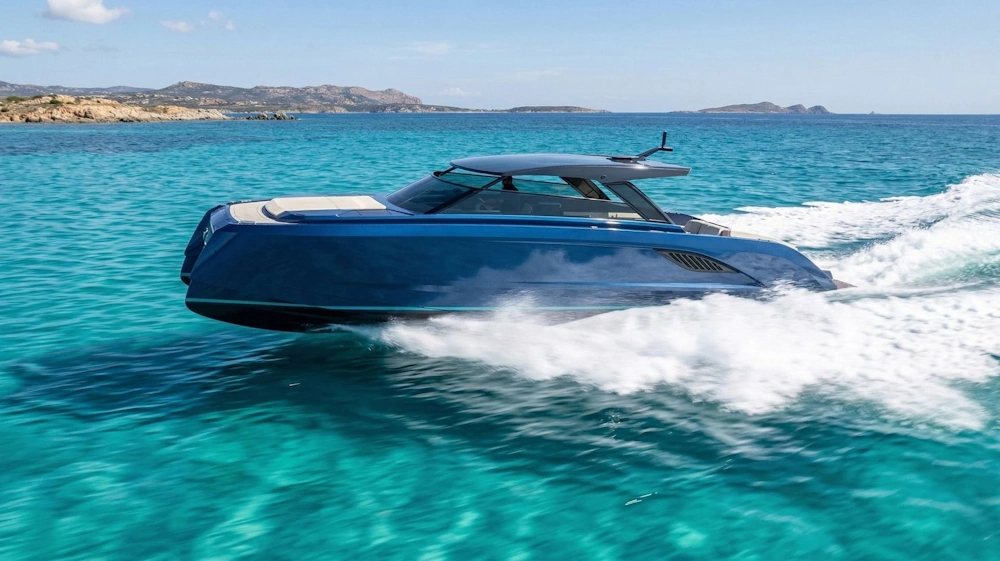
Construction and design credentials
Structurally, the VYBE 43 is built from a vinylester-infused composite sandwich, reinforced with carbon fibre in key structural areas and stiffened with longitudinal and transverse framing.
The hardtop is infused carbon fibre, as is the flooring and interior partitioning, keeping weight down where it matters most.
The naval architecture is credited to Adam Younger, with exterior and interior design by Abbasli Design.
Standard equipment includes a Mase 6.5kVa generator, air conditioning rated at 32,000 BTU, an Opacmare hydraulic gangway, Garmin navigation, a VOID sound system, a Quick double bow thruster, and Starlink satellite internet as standard.
Living aboard
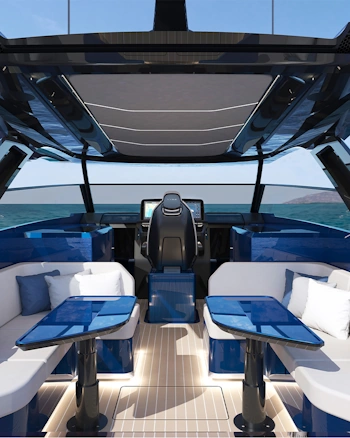
Below deck, the VYBE 43 breaks from typical 43-foot power cat convention by offering two full master cabins, each with its own ensuite bathroom. Interior finishes lean firmly toward the superyacht end of the market: Loro Piana and Foglizzo 1921 fabrics, marble-effect stone surfaces, and Gessi brassware. The cockpit runs to two separate dining and seating areas beneath the carbon hardtop, and the transom folds down to a swim platform with steps, turning the stern into a beach club when at anchor.
How it compares to the competition
The VYBE 43 is entering a segment that has grown quickly over the past two years.
YOT Power Catamarans, launched by the Catana Group at a dedicated facility in Aveiro, Portugal, is the closest match in spirit. The YOT 41 can be specified with twin Mercury V12 600hp engines, the same engine choice Vybe offers, and independent sea trials have recorded speeds in excess of 40 knots.
YOT’s cockpit also folds down into a beach club arrangement, and pricing for the V12 specification runs to around 850,000 euros. Where the two diverge is scale and positioning: YOT is backed by an established production group with an ambition to build hundreds of boats a year, while Vybe frames itself as a small, boutique producer.
Aquila’s 45 Sport, targeting the US and European market, takes a different route with similar performance numbers, using a double-stepped hull with a claimed top speed in the region of 43 knots, and fold-down terraces that echo the beach club theme found on both the VYBE 43 and the YOT models.
Aquila’s approach is more overtly a production dayboat, with a single cabin and head, against the VYBE 43’s two full ensuites.
Set against both, VYBE highlights the 43’s cabin count, finish level, and its no-foil hull arrangement.
What comes next for Vybe
The VYBE 43 is the first model in a planned four-boat range. Three further sizes are in development: the VYBE 53, VYBE 66, and VYBE 77, all following the same twin asymmetric hull philosophy at increasing scale.
None of the larger models have been launched yet, and Vybe has not published detailed specifications, pricing, or delivery timelines for them.
The Verdict
The VYBE 43 is a confident debut with the Italina looks to go with it. Two full ensuite master cabins on a 43-foot power catamaran is a real draw. The no-foil hull design and the finish level matches its Tuscan boatbuilding pedigree.
For the moment, it lacks the track record of more established rivals like YOT and Aquila, but independent performance and efficiency figures will give even more weight to the design.
A great looking power catamarans from a new shipyard betting on craftsmanship and low volume rather than scale.