
VMG 53 Trimaran Interiors
Layout, Materials and Cabins
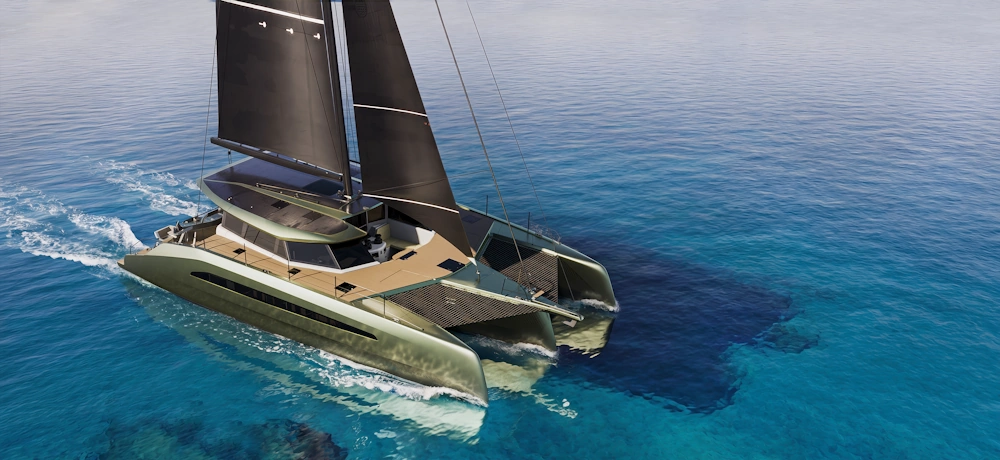
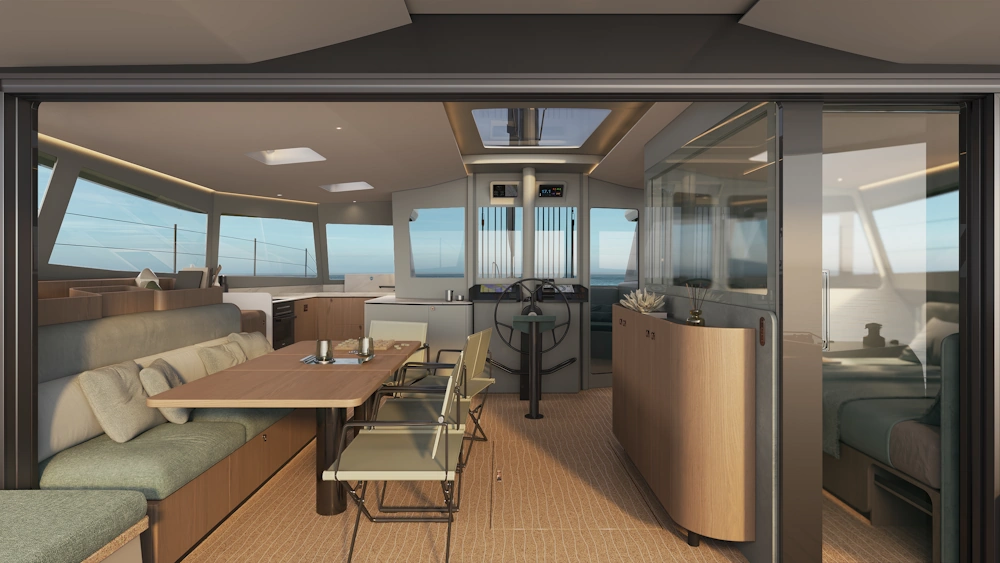
VMG, the recently shipyard building high-performance luxury trimarans, has released the first details of the VMG 53 interior. The design is by Christophe Chedal Anglay of CCA, and the first boat is due for delivery in January 2027.
The brief was a performance-first interior with no trade-off between style and practicality. The result is a layout that changes role depending on how the boat is being used, finished in cork, eucalyptus and vegan suede. The design has a Japanese infleunce to it – the simplicity and modular use of the spaces.
At a glance
- Brand: VMG (Velocity Made Good), New York
- Naval architecture: VPLP Design, France
- Interior design: Christophe Chedal Anglay, CCA
- Build: Evolution Marine Manufacturing, Cape Town
- Engineering: Thorne Yacht Design, UK
- Length overall: 17.22 m (56.49 ft)
- Waterline length: 15.79 m (52.95 ft)
- Beam: 8.80 m (28.87 ft)
- Cabins: four in VMG’s specification (on-deck suite, port hull, starboard forward, central hull)
- Key materials: cork, eucalyptus, vegan suede, bronze hardware
- First delivery: January 2027
Design approach
Anglay describes the VMG 53 as a boat for performance-orientated sailing rather than an entertainment platform. He draws on his own background in extreme mountain sports and sailing, and says functionality and the constraints it brings “generate the style of the vessel”.
One layout, several uses
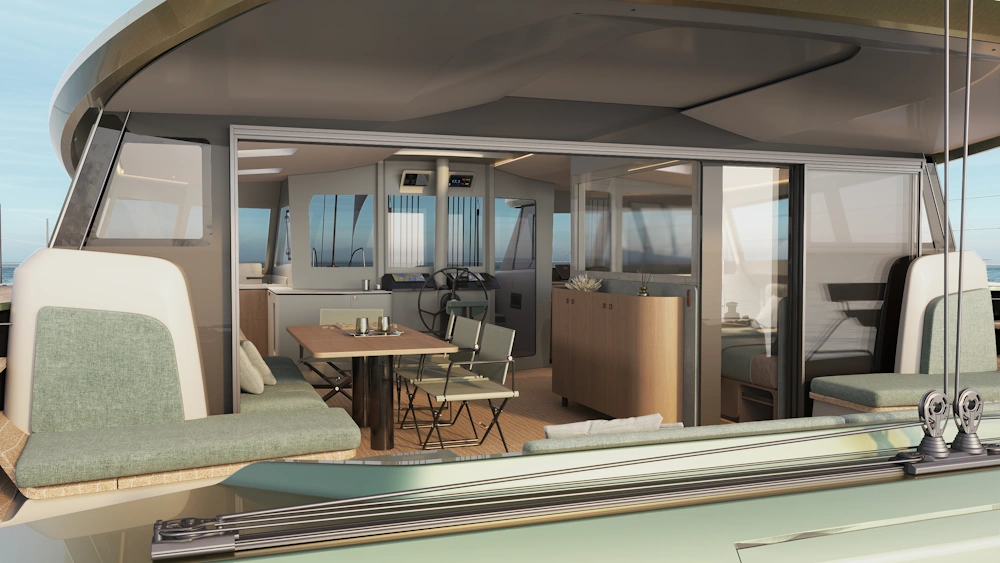
The interior is designed around use scenarios rather than a single fixed arrangement.
- On passage: the owner uses the main cabin near the helm, close to the controls.
- At anchor with guests: the owner can move to a private cabin in one of the side hulls (amas), which frees the main cabin as a social space.
The main cabin changes role through four features:
- Bi-fold doors and disappearing bulkheads open it into a larger saloon.
- A projector uses one of the bulkheads as a screen.
- Switchable glass provides privacy when it is used for sleeping.
- Together these let one space work as a bedroom, saloon or entertainment area.
VMG’s specification lists this space as the on-deck suite. Anglay credits Japanese architecture for the idea of a living space that is reconfigured from one day or week to the next.
Smart glass
VMG uses PDLC smart glass, which switches from fully transparent to fully opaque at the touch of a button. VMG states it blocks up to 99% of UV radiation and cuts heat from infrared light by more than 78%. In its opaque state the glass works as a projection surface for films, charts or video calls. An emergency clear override at each helm station returns the on-deck cabin to full transparency. In the lower hulls, smart glass replaces traditional blinds.

Cabin guide
- On-deck suite: queen berth wrapped in switchable glass, with a private stair to a starboard-hull en-suite with rainfall shower.
- Port hull suite: full-hull cabin with a queen berth and generous stowage. The en-suite has a floor-size shower, and a watertight door leads into the Adventure Locker, which holds sails, boards, bikes and dive tanks.
- Starboard forward (VIP) cabin: designed to come close to the owner’s suite for comfort. The berth converts between single and double configurations (VMG’s specification lists it as a twin-to-queen convertible). Storage and furniture can be adjusted in minutes for friends, couples or children. It has under-step stowage and a private en-suite with rainfall shower.
- Central hull cabin: a Murphy-style queen berth over an integrated workstation and 8 kg Miele washer-dryer, with an en-suite. It is accessed via the sail pit, so crew or a professional captain can reach it without crossing the guest areas.

Colours and materials
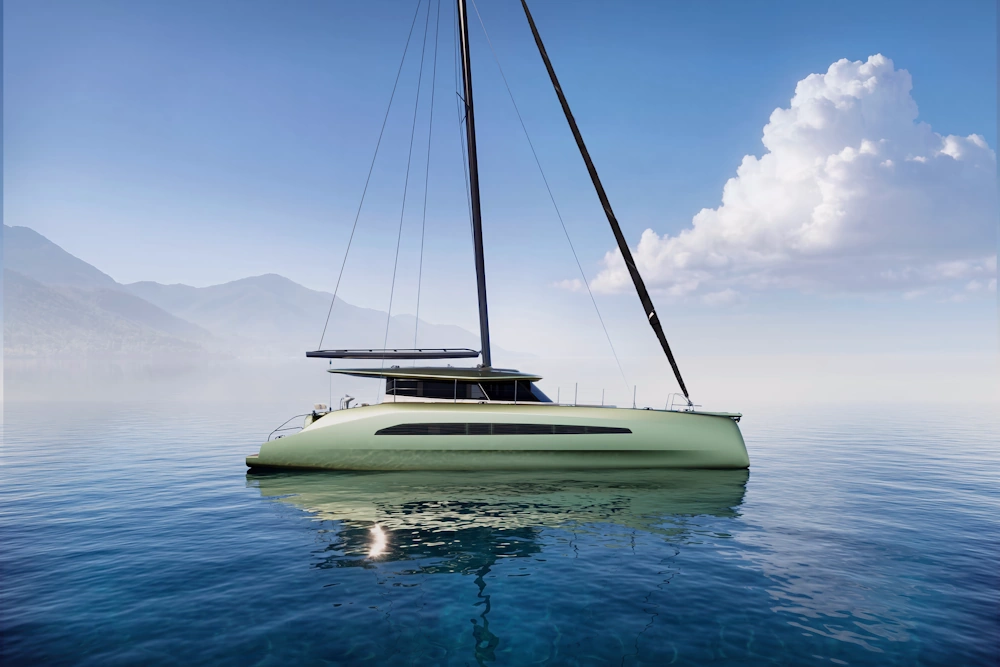
VMG’s brand green was the starting point for the palette. Anglay developed it into a nature theme: green for an island rainforest and blue for a lagoon. On deck, a slightly darker tone gives a better view outside. Inside the hulls, lighter paint suits the more streamlined spaces.
The key materials are sustainable cork, eucalyptus and vegan suede. Anglay says durability came first and that each material is the best available on the market for it. Hull number one has a finish that shifts from deep green to golden bronze with the light, echoing the cork, eucalyptus and bronze hardware inside.
The same cork flooring is used inside and out, running continuously from the aft cockpit across the deck to the bow. VMG’s specification lists SeaCork CCA x VMG decking as an option, and joinery in custom veneer with a water-based open-pore finish.
Personalisation
The architecture of the hulls and decks stays fixed. Flooring, base colours, woods and textiles can be adjusted with the designer to suit each owner. Anglay says every new project must differ from the one before, so each VMG 53 interior should look related to the others but individual.
About the VMG 53 project
VMG was founded by Mike Schwartz and Karl Reed with the aim of bringing advanced multihull technology into serial production. VPLP leads hull and sail plan design, CCA handles the interior, Thorne Yacht Design manages structural and systems engineering, and Evolution Marine Manufacturing builds the boat in Cape Town. VMG positions the 53 as combining trimaran stability, monohull upwind ability and catamaran resilience.
Where the VMG 53 is designed and built
The project spans four countries: design work is done in France, engineering in the UK, manufacture in South Africa, and VMG itself is headquartered in the US.
- VMG, New York, USA: the HQ behind the project, founded by Mike Schwartz and Karl Reed. VMG’s lists its presence as USA, France and South Africa.
- VPLP Design, France: naval architects responsible for the hull and sail plan. The studio was founded in 1983 and has worked on both racing trimarans and cruising catamarans.
- CCA, France: Christophe Chedal Anglay’s studio, which designs the interior.
- Thorne Yacht Design, Lymington, Hampshire, UK: structural engineering and systems design. The studio was founded by Eliot Thorne.
- Evolution Marine Manufacturing, Cape Town, South Africa: VMG’s manufacturing partner, specialising in composite construction for performance sailing yachts. It is led by Oliver Dawson.
Other headline features listed by VMG:
- Twin motors in each outer ama
- A powered, lockable tender garage behind a watertight bulkhead, holding a 3.3 m carbon tender with 30 kW ZeroJet propulsion
- Three helm positions: one forward and two aft
- A central sail pit with lounge seating and powered winches
Editions and timing
- VMG 53 Regatta: hybrid E-glass and carbon construction, listed by VMG as available now.
- VMG 53 GP: full carbon construction, about 500 kg lighter than the Regatta at lightship, due spring 2027.
- VMG 53: same hull as the Regatta, due autumn 2027.
VMG’s website has a virtual tour and a configurator.