

Seakeeping on the Vision Yachts Range
A Design Priority: The Vision Yachts Difference.
When you do your research across the modern market, you will hear many claims about the stability of the boats at sea with performance often reduced to headline numbers such as bridge deck clearance or displacement.
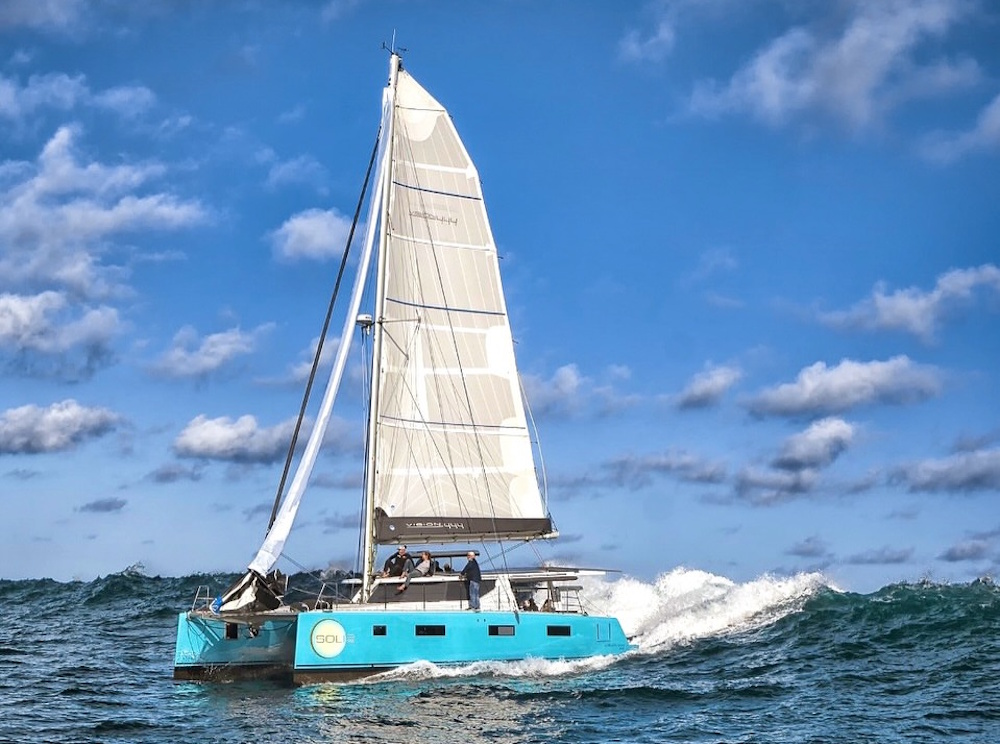
Vision Yachts are built near the Knysna Heads, two towering sandstone cliffs, the Eastern Head and Western Head, that frame the mouth of the Knysna River Estuary where it meets the Indian Ocean on South Africa’s Garden Route.

They form a narrow, often turbulent channel that’s a gateway to the lagoon from the power of the ocean. The ocean waves can surge and crash dramatically through the passage, providing a perfect testing ground for yacht designers.
It has allowed Vision to build their learning on top of their naval architectural tools such as MaxSurf and other Computational Fluid Dynamics (CFD) Software.
Holistic Approach
On the Vision 444, 444ES and 484, good seakeeping is the fruit of development of the boat as a complete system rather than its individual parts. Geometry, buoyancy, underhull shape, weight distribution and structural stiffness are integrated to deliver a steady, quiet motion offshore that sets these boats apart from the competition.
And the proximity to Knysna has allowed Vision to develop solutions iteratively in conditions that mimic those found offshore.
You’ll notice this difference most clearly when conditions deteriorate. Where many catamarans suffer from bridge deck slamming, excessive pitching and structural noise, Vision yachts remain predictable and comfortable. This is the result of deliberate design choices refined through offshore use.
Bridge Deck Clearance is a System and a Number
The Vision 444 carries a bridge deck clearance of 750 mm, while the Vision 484 increases this to around 950 mm. These are strong figures, but the real story lies beneath the deck.

Vision Yachts build their boats with sculpted transition panels between the inboard hull sides and the underside of the bridge deck. When a wave rises between the hulls, it meets these angled surfaces first. The water is deflected sideways and dissipated before it can build enough energy to strike the flat underside of the deck.
This shape, perfected through trial, error and modelling elps to minimise bridge deck slamming.
The Vision 484 builds on this philosophy with even more clearance, refined underdeck shaping and carefully tuned weight distribution. The longer platform allows Vision to take performance at sea to the next level.
Proven at Sea
Design modelling only matters if it works at sea, and that’s where the Knysna Heads has proven such a fruitful testing ground. Refracted swell bounces off steep cliffs and waves arrive simultaneously from multiple directions, creating a confused, high energy sea state that exposes weaknesses quickly.

Many catamarans slam aggressively as vertical wave energy is trapped between the hulls and driven upward. Vision Yachts are designed to break the wave, shed water laterally and prevent pressure from building beneath the deck.
Lightweight Construction and Buoyancy
Another key contributor to Vision’s seakeeping is their pursuit of a lightweight, stiff construction combined with efficient, buoyant hull forms.
A heavy, high displacement catamaran will smash its way into oncoming waves. This increases vertical acceleration, amplifies slamming loads and transfers shock into the structure. A lighter boat with positive buoyancy rises with the wave rather than punching through it.
Reduced vertical loads mean less impact, less noise and less fatigue for both the structure and the crew. This helps to improves average passage speeds, and reduces stresses on the rig in a blow, as the boats maintain momentum instead of being repeatedly checked by the waves.
Central Weight is Good Weight
Seakeeping is also influenced by where weight is placed, so Vision Yachts places strong emphasis on longitudinal and vertical weight distribution across the entire platform, ensuring that mass is kept low, central and balanced wherever possible.
Engines are positioned further forward in the hulls which reduces the pitching moment by shortening the “lever arm” between the weight the boat’s center of buoyancy. The result is a calmer motion, particularly noticeable when sailing into a head sea or when motoring in short chop.
Fuel and water tanks are also centralised. As tank levels change during a passage, the platform remains balanced rather than becoming bow or stern heavy.
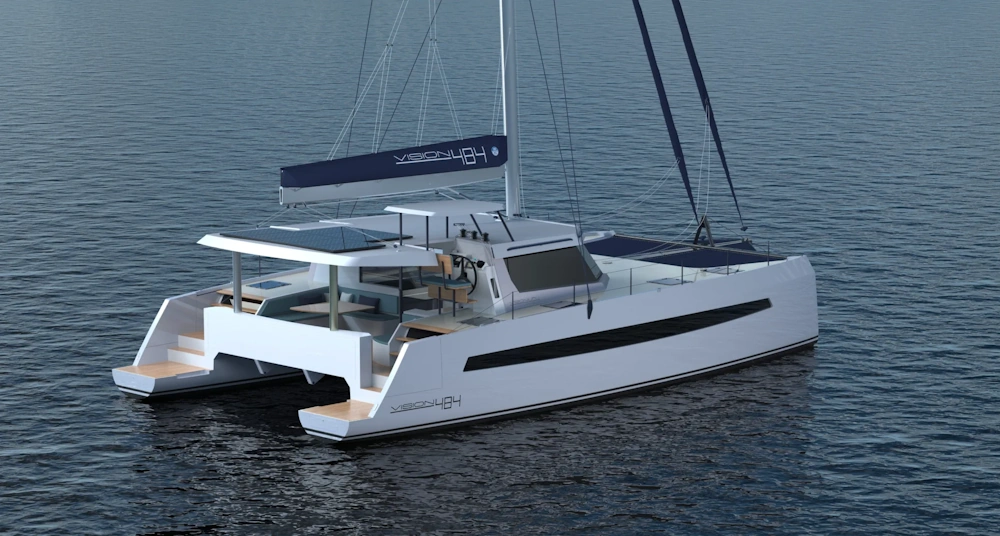
Comfort Thanks to the Shape
Good seakeeping means less fatigue, and higher confidence and enjoyment on long passages.
If a catamaran performs cleanly through the Knysna Heads, it’s an excellent indication that it will perform well anywhere.
Vision’s comprehensive, integrated approach helps achieve that.
Head to Visionyachts.com for more information on the range.
| Specifications | Vision 444 | Vision 484 |
|---|---|---|
| LOA | 13.12 m | 14.75 m |
| LWL | 13.12 m | 14.72 m |
| Beam (BOA) | 7.60 m | 8.00 m |
| Draft | 1.17 m | 1.25 m |
| Air draft | 19.47 m | 21.7 m |
| Bridge deck clearance |
Approx. 750 mmVision’s offshore comfort comes from the whole under-bridge package, not clearance alone. The sculpted, angled underdeck surfaces help shed water sideways, reducing the chance of hard bridge deck impacts in a seaway. |
950 mmMore clearance plus refined underdeck shaping further reduces susceptibility to bridge deck slamming, especially in short, confused seas. |
| Displacement |
11.32 T (light)Vision prioritises a light, stiff platform with buoyant hulls and disciplined weight placement. This supports a smoother ride by helping the boat lift with waves rather than punching through them. |
12.7 T (light) / 17 T (max load)A higher platform, tuned weight distribution, and buoyant hull forms work together to keep motion calm and reduce impact loads offshore, even when loaded for passagemaking. |
| Engines |
Nanni 37 hpEngines are positioned further forward than many cruising cats to improve fore-aft balance, reduce pitching, and support a steadier motion into chop. |
2 x Nanni 50 hpPower is paired with careful mass placement. Keeping heavy machinery from the extremes helps reduce hobby horsing and maintains a more consistent trim as sea state changes. |
| Cabins | 3 | 3/4 |
| Main sail area | 76.54 sq.m | 87.1 sq.m |
| Self-tacking jib area | 32.3 sq.m | 42.9 sq.m |
| Total sail area (Main + Jib) |
109 sq.mThe 444’s sailplan is designed around simple, efficient short-handed handling (self-tacking headsail, balanced helm), which reduces workload when conditions build. |
130 sq.m |
| Certification |
CE Category AOffshore |
CE Category A |