
Parlay Revival Joins the Dash to Aluminium
As multihull fans, we have watched the production catamaran market lean toward mass-production over rugged utility. For years, major brands have favoured fiberglass molds and construction optimised on GRP.
However, a shift is happening in the custom blue-water community. Sailors who push their boats to the limit are abandoning composite plastics for marine-grade aluminium. Check out our article on the Best Aluminium Catamarans with a video explainer. There are advantages and disadvantages to this boat buiding material of course.

Few understand the pros and cons of production fiberglass better than Colin MacRae, the mechanical engineer and former superyacht chief engineer behind the YouTube channel Sailing Parlay Revival. For eight and a half years and over 45,000 nautical miles, Colin and his crew have sailed Parlay, a Lagoon 450 badly damaged by Hurricane Irma.
Their journey became an engineering masterclass – and a lesson in composite structural upgrades. From rebuilding internal bulkheads to repairing osmosis blisters in Malaysia, Colin has lived through plenty of challenges of production boat building.
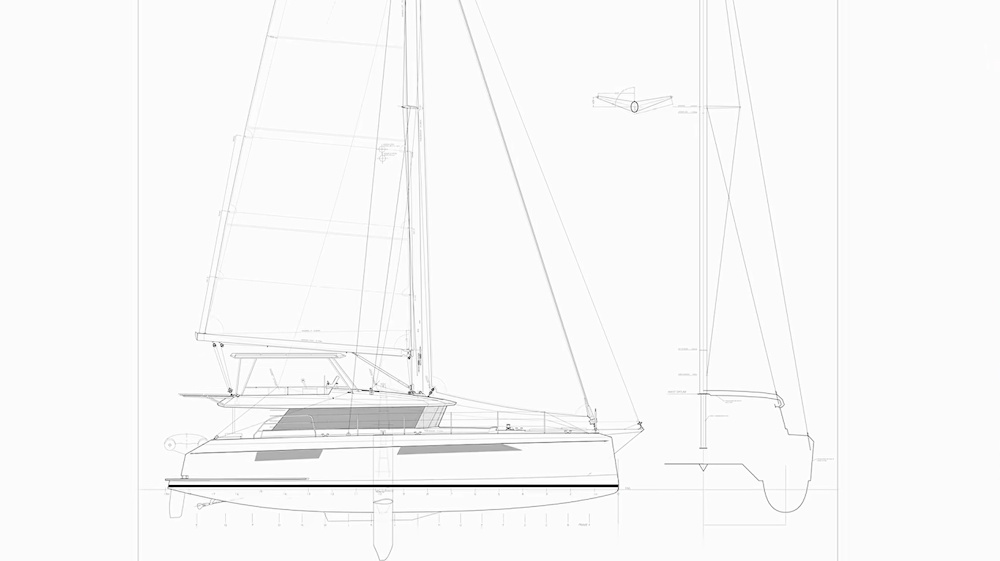
These lessons have culminated in their latest announcement: Parlay Revival is building a custom 60-foot aluminium catamaran from scratch.
To be fair, their boat has carried them 45,000 miles after being tossed around by a Category 5 hurricane and it has built Colin’s channel to what it is today. He’s now in a position to put more money on the table and build his dream boat. Will the new boat be more structurally robust than his current catamaran? Undoubtedly, but it’s in a different price league. There’s always a trade-off to be made on a boat, this new yacht will be no different.
The Switch to Aluminium: Built for the Extremes
From a structural engineering standpoint, the decision to pivot to aluminium gives you structural peace of mind. While fiberglass is an excellent boat-building material, it is prone to fatigue, delamination, and failure upon impact.
Aluminium possesses good tensile strength and ductility; rather than shattering or piercing when striking a shipping container or an ice floe, aluminium deforms.
For a yacht intended to sail into high-latitude environments, aluminium is unmatched. It eliminates the threat of core rot, osmotic blistering, and structural bulkhead issues, the very issues that plagued Colin’s first Category 5 hurricane-damaged boat.
But it’s not all roses. They are going to need to minimise galvanic corrosion, eliminate stray currents and optimise the aluminium thickness across the boat to ensure the best balance of strength, weight and safety across the design. One thing is for sure, they will have plenty of content for their YouTube channel with the challenges that lie ahead on their first aluminium build.
The Design Brief and World-Class Partners
To bring this vision to life, Colin has partnered with New Zealand multihull naval architect Roger Hill. For decades, Hill has designed premier power and sailing multihulls, making him the perfect match to translate Colin’s superyacht-inspired brief into a functional blueprint for a cruising cat.
One of the key directives of the design brief was uncompromising: the boat must be capable of navigating Antarctica and the Northwest Passage.
To achieve this, the vessel features a robust safety layout consisting of four watertight compartments in each hull. Even in the event of a severe bow impact that floods the collision bilge or a midships breach, the calculated buoyancy in the bridge deck clearance, engine rooms, and forepeaks ensures the boat remains afloat.
Standout Features
Thanks to Colin’s background as a marine engineer, the design prioritises system accessibility and redundancy.
Walk-In Engine Rooms
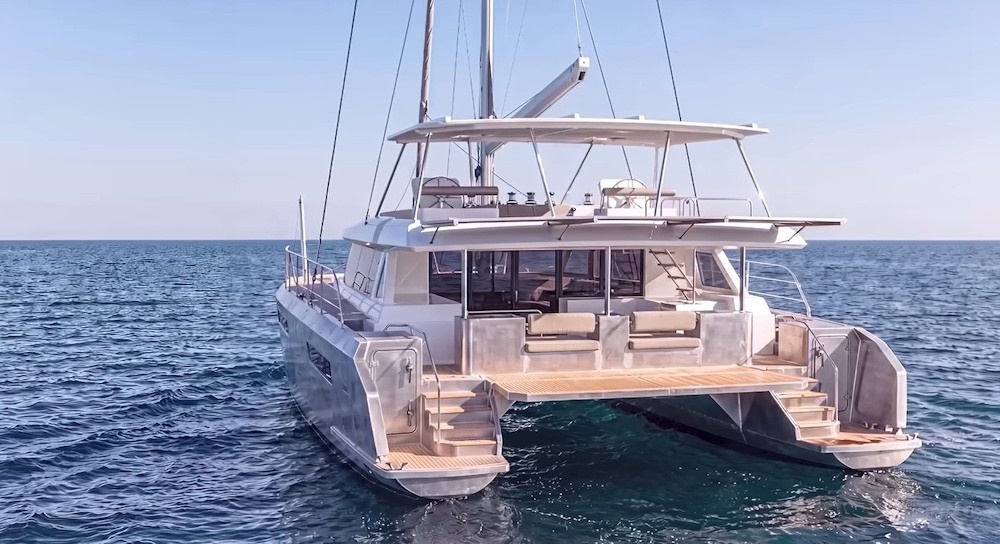
Unheard of on most 60-foot catamarans, the hulls have full standing-height engine rooms with dedicated workshop spaces, organized tool areas, and storage for dive gear.
Daggerboards
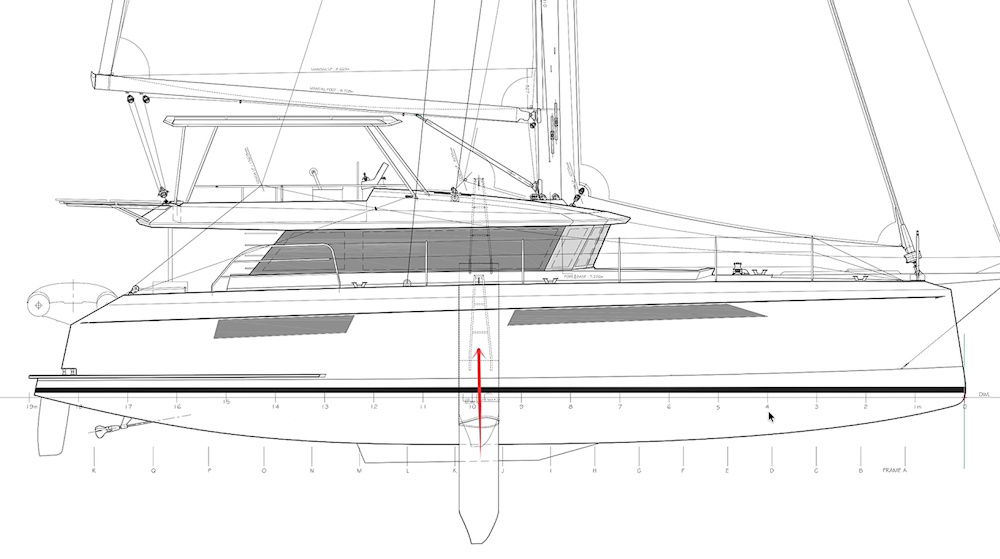
Rather than fixed mini-keels, the design incorporates deep daggerboards with sacrificial breakaway tips. This allows the crew to pull the boards up when sailing downwind to minimise drag, or drop one down when going upwind.
Dual Flybridge & Inside Helm
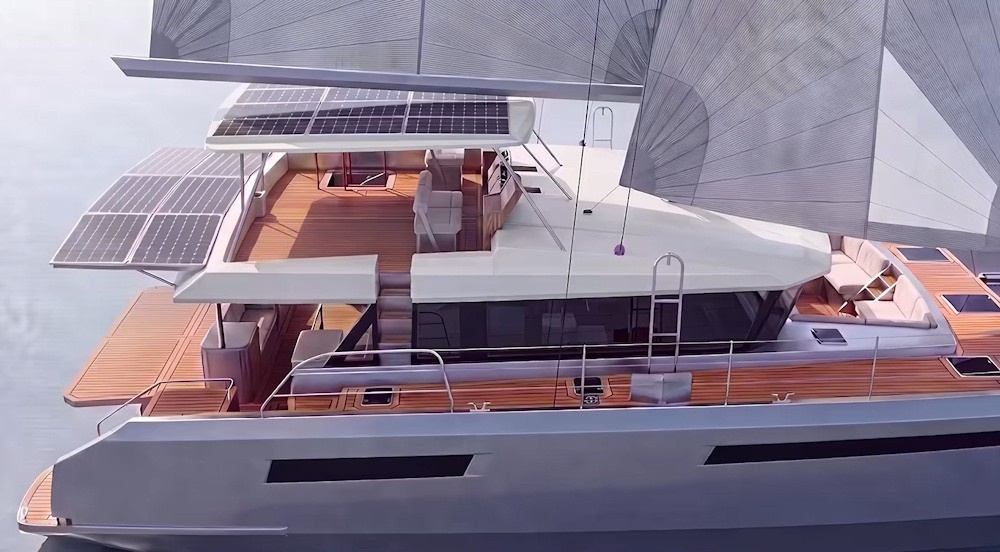
The flybridge provides maximum visibility when navigating tight coral passes, with a central pod where all five winches sit for easy single-handed sailing. Conversely, a fully protected internal helm station with forward-raked windows offers a safe haven during storms.
The interior layout should help Colin’s signature social cruising style. The saloon boasts a big galley with a breakfast island, alongside a large dining table for twelve people. Airflow is optimised throughout, with forward-facing cabin hatches and big sliding saloon doors that tuck cleanly into hidden pockets.
Process, Timing, and the Next Steps
With the digital naval design finalized and the precision CNC cut-files almost ready to slice the aluminum sheets, the project is moving from the screen to the shipyard floor.
The first hurdle for the Parlay team is securing a big enough shed. Colin is searching for a coastal shed measuring at least 22 meters long, 12 meters wide, and 7 meters high, ideally near an active surfing community to keep the team morale up during the build.
Colin and his first mate Jamie plan to be on the tools from day one, working alongside structural aluminum welders. As a build of this scope typically takes two to three years, the crew plans to document every single step on the Parlay Revival YouTube channel.
Production will rely on technical sponsors to integrate cutting-edge solar, lithium battery storage, and high-efficiency DC climate control systems.
This project is a personal milestone for Colin, but it’s also a long-term commercial blueprint to launch a custom blue-water catamaran building business. For offshore traditionalists and multihull enthusiasts, this 60-foot aluminium yacht may redefine the standard for global exploration in comfort.
Comparing YouTuber Aluminium Catamarans
Comparison
Three YouTube Crews, Three Aluminium Catamarans
How the new Parlay Revival design stacks up against Delos 2.0 and the Nahoa M. Tap a section to expand. Scroll sideways on mobile.
The Basics
| Parlay Revival 60 | Delos 2.0 | Nahoa M | |
|---|---|---|---|
| Channel | Sailing Parlay Revival Colin MacRae | Sailing SV Delos Brian & Karin Trautman | Sailing Nahoa Ben Brehmer & Ashley Stobbart |
| Project name | Unnamed custom 60ft | Delos 2.0 (Delos Explorer 53) | Nahoa M (also billed as Nahoa 55) |
| Length overall | 18.3 m / 60 ft | 16.0 m / 52 ft 7 in | 17.4 m / 57 ft 1 in |
| Beam | Not yet disclosed | 7.7 m / 25 ft 3 in | 8.3 m / 27 ft 3 in |
| Draft | Not yet disclosed (daggerboards) | 1.2 m / 3 ft 11 in | 1.55 m / 5 ft 1 in (fixed) |
| Displacement | Not yet disclosed | 16,340 kg light | 21,050 kg light 27,660 kg max load |
| Naval architect | Roger Hill (NZ) | David de Villiers (NZ), adapted from an existing design | Pierre Delion (FR), architect of the Explocat 52 |
| Who builds it | Owner-led self build with pro welders; location being sought | Stradbroke Yachts, near Brisbane, with the owners on the tools | Circa Marine, New Zealand; initial production run of four hulls |
Hull & Structure
| Parlay Revival 60 | Delos 2.0 | Nahoa M | |
|---|---|---|---|
| Material | Marine-grade aluminium | Marine-grade aluminium, 6 mm plate below the waterline | Fully welded marine-grade aluminium |
| Appendages | Daggerboards with sacrificial breakaway tips | Mini keels; designed to be beached | Skegged rudders; fixed shallow draft |
| Drive protection | Not yet disclosed | Shaft drives with skeg-protected props and rudders | Shaft drive with V-drive |
| Watertight subdivision | Four compartments per hull | Watertight bulkheads (count not published) | Six watertight bulkheads |
| Mission brief | Antarctica and the Northwest Passage | Global expedition; engineered to surpass ISO CE Category A | Long-range expedition; ISO Category A target for up to 10 persons |
Helm & Deck
| Parlay Revival 60 | Delos 2.0 | Nahoa M | |
|---|---|---|---|
| Sailing station | Flybridge with a central pod housing all five winches for single-handed work | Not yet disclosed | Forward cockpit for line handling, in the aluminium expedition tradition |
| Protected steering | Fully enclosed internal helm with forward-raked windows | Watch-keeping station with a wheel at the front of the saloon | Watch station connected directly to the aft cockpit |
| Deck concept | Dual-level: flybridge visibility for coral passes, inside helm for storms | Walk-around aft platform doubles as dinghy mount and dive deck | Saloon and galley flow into the forward cockpit as one open living area |
Systems & Performance
| Parlay Revival 60 | Delos 2.0 | Nahoa M | |
|---|---|---|---|
| Propulsion | Not yet announced | Parallel hybrid: one 80 hp diesel plus twin 25 kW electric motors with hydrogeneration | Twin 80 hp diesels |
| Fuel capacity | Not yet disclosed | Not published | 1,800 L |
| Solar | Planned via technical sponsors; capacity TBC | Large roof array plus integrated rainwater catchment | 5 kW+ peak (some material states 3 kW+) |
| Sail plan | Not yet disclosed | Not published | Main 94 m², genoa 78 m², staysail 39 m², gennaker 190 m² |
| Performance target | Not yet disclosed | Not published | 10 to 12 knot averages, 200+ nm days |
| Engine access | Walk-in engine rooms with workshop space in each hull | Not published | Compact, accessible systems by design |
Status, July 2026
| Parlay Revival 60 | Delos 2.0 | Nahoa M | |
|---|---|---|---|
| Where it stands | Design finalised, CNC cut files in preparation, searching for a build shed of at least 22 x 12 x 7 m | In build at Stradbroke Yachts since 2024 | Hull one scheduled to begin at Circa Marine |
| Timeline | Estimated two to three year build | Launch date not confirmed | Launch date not confirmed |
| Business model | Personal boat plus blueprint for a custom bluewater catamaran building business | One-off owner build | Production brand; further models (Nahoa L, Nahoa S) planned |
Parlay Revival figures from the project announcement (Episode 370, June 2026); detailed specifications have not yet been published. Delos 2.0 figures from SV Delos and Yachting World. Nahoa M figures from Nahoa Yachts, Multihulls World and Yachting World. Specifications for all three projects are subject to change during build.