
Outremer: Four Decades
Four Decades of Building Fast Boats That Cross Oceans
Outremer launched their first model back in 1984 with a conviction: that a cruising multihull should be light, narrow and fast. For this Franch manufacturer, speed is not a luxury offshore but a safety margin. Forty years of boats have followed that philosophy. The shapes have changed, the build has modernised and the interiors have grown more comfortable, but the logic running from the first 40-footer to the new 48 remains remarkably consistent. This is the story of how the yard got from their first model to the last.
1984: A Light Boat in a Fledgling Market
In June 1984, at La Grande-Motte on the French Mediterranean coast, naval architect Gérard Danson teamed up with Daniel Cailloux, a technician from the Conati yard, to build a 40-foot cruising catamaran. The timing was telling. The same town and the same year produced Catana, and the wider market still assumed that serious ocean cruising meant sailing a monohull. The best-selling cruising cats of the era were heavier, boxier boats such as the Prout range from the UK. Danson went the other way.
His first boat was stripped to the essentials: slender hulls, low displacement, a modest sail plan and low windage, finished with the aluminium toe rail that became something of a signature. The thinking was simple. Fine hulls cut drag, light weight needs less sail to drive, and low windage keeps the boat from being pushed around. A second boat was ordered before the first had even launched, which told the partners they had found a niche. They registered the business as Atelier Outremer, the name meaning “overseas,” and built to order, adapting each hull to its owner with different coachroof sizes, open or closed cockpits and outboard or inboard engines. Early boats started winning offshore races, which did more for the reputation than any brochure.
The 40 and 43: The Original Danson Blueprint
The 40 set the template, and the variants that followed refined it rather than replaced it. A narrower-beamed version was sold as the 38, sometimes badged the 40 Light. The 43 used the same hull moulds with factory-extended transoms, which lengthened the waterline, lifted load-carrying ability and made boarding from the water easier. Together the 40 and 43 defined what owners now call the Danson style: passage-making speed and sailing feel placed ahead of volume.
These were uncompromising boats. Lightship weights sat around 4.3 tonnes on the early examples, hulls were narrow enough to keep the saloon modest, and earlier examples had hull access from the side decks rather than through a walk-through bridgedeck. A tiller, not a wheel, was the ghelm. They reward owners who keep them light and sail them wel, and they punish anyone who loads them with too much gear.
The Outremer 45: The Boat That Made the Name
If one boat carried Outremer from niche brand to recognised name, it was the Danson 45. Built from around 2000, with 39 hulls produced over its life, it took everything the yard had learned and put it into a 13.7-metre boat that could cross oceans at high average speeds with a family aboard. Light displacement, cruising weights in the order of 6.5 tonnes, a high sail-area-to-displacement ratiowith an upwind sail area of around 108 square metres gave it the legs. Daggerboards helped this catamaran point close to 30 degrees off the apparent wind, far tighter than a fixed-keel cat, while lifting the boards reduced lateral resistance in heavy weather so the hull could slide rather than trip. Some owners specified fixed performance keels for simplicity and the ability to dry out, but the daggerboard version was the main theme.
The 45 also gave Outremer some trophies. The boat Bagnoles de l’Orne won the OSTAR, the singlehanded transatlantic, in 2000 with Didier Levillain at the helm. For a cruising catamaran to win a shorthanded ocean race told owners exactly what the brand stood for. The interior was spartan by modern standards and the saloon compact, but that was the trade off, and the people who wanted this boat understood that.
Grand Large Yachting and the Modern Era
Gérard Danson died in 2005, which closed the founding chapter. In 2007 the Grand Large Yachting group took over and relaunched production, bringing the resources of a group already specialised in blue water boats and a willingness to hire the best multihull architects around.
The first statement of intent was the Outremer 49 in 2009: full structural infusion, dynamic hull balance, flush-decked living areas and 360-degree sightlines from the saloon. It kept the seaworthiness and the speed but moved the comfort closer to what buyers expected. The formula worked. The 49 grew into the 51 by 2013, selling more than fifty boats, and the yard added the VPLP-designed 5X as a near-sixty-foot flagship that weighed only about fifteen tonnes light.
The New 45: Barreau-Neuman Masterpiece
The 45 was relaunched in 2014, and the boat was new from the keel up. Architecture came from Barreau-Neuman, exterior styling from Patrick Le Quément, the former Renault design chief, and interior design from Darnet Design. Positioned as the smaller sister to the 51, the new 45 took the modern Outremer concept and shrank it into a boat a couple could handle, with a self-tacking solent for trade-wind work, a single raised helm, an optional tiller and the daggerboards that had become part of the success story.
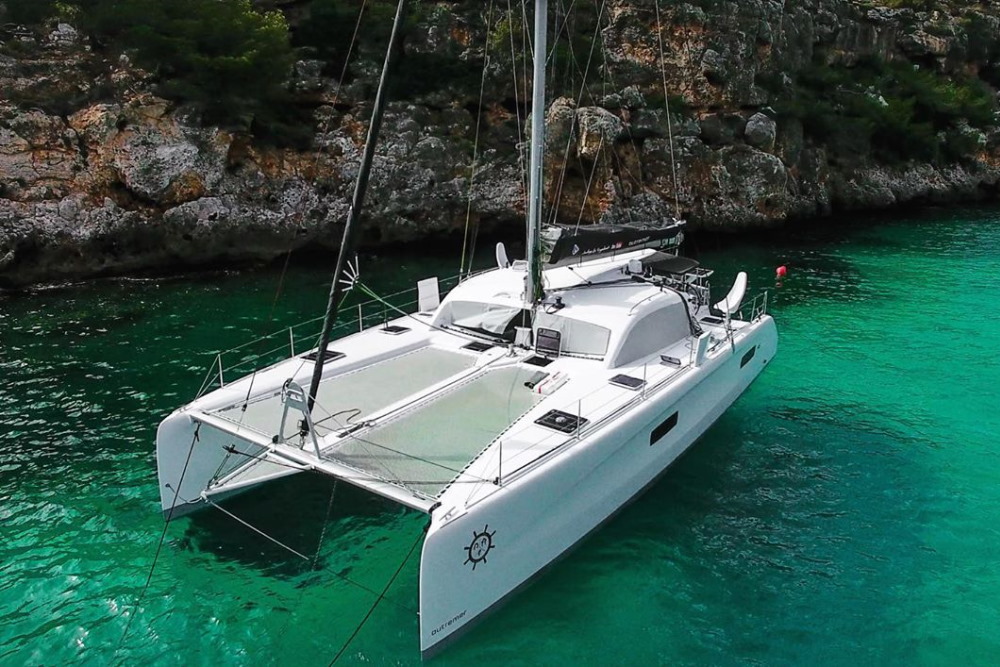
Thongs evolved quickly. Alongside the 45 ran the 4X, a stretched, lighter, carbon-rigged version aimed at owners chasing more performance, which took European Yacht of the Year honours for multihulls in 2017. The new 45 became the most visible Outremer of its generation, thanks to Riley Whitelum and Elayna Carausu sailing one across the world’s oceans on Sailing La Vagabonde. It was the Danson 45’s idea translated into an infused, modern, more comfortable boat , without losing the underlying philosophy.
The 48: The Story Continues
The latest chapter is the Outremer 48, presented at the La Grande-Motte show in 2026. VPLP drew it, with Mathias Maurios leading a project that began in spring 2024, with the strength of the relationship solidified by the design of the 5X, 55 and 52. Le Quément and Darnet Design returned for styling and interior.
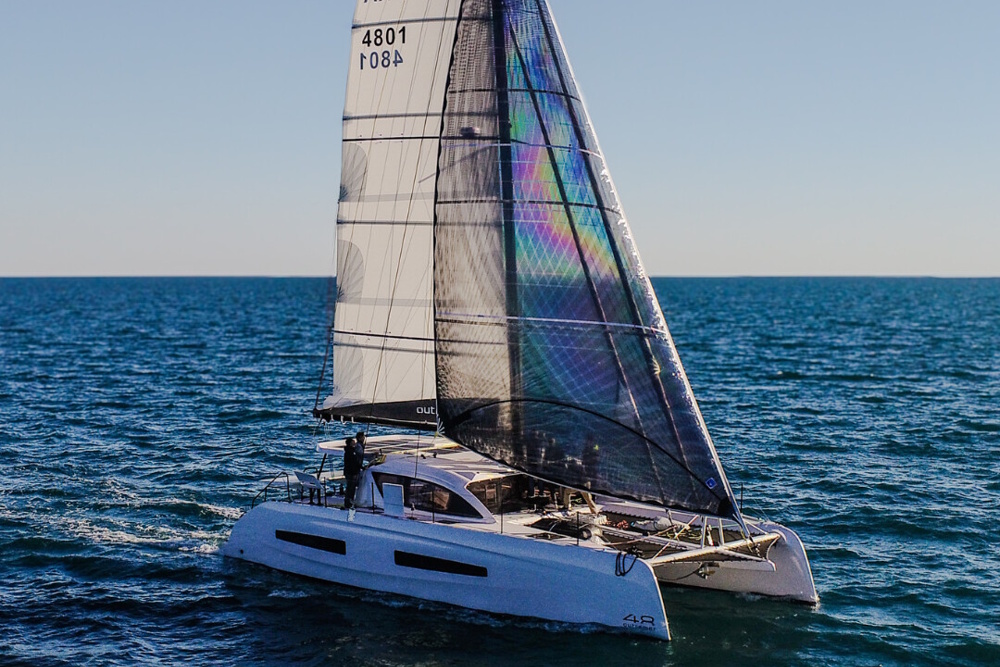
On paper the 48 shares its 14.63-metre length with the extended 45 but adds almost half a metre of beam, at 7.56 metres, and has all of the cockpit ergonomics and adaptable helm developed on the 52 and 55. The wheel tilts through three positions, from a fully sheltered cockpit station to an exposed outboard one, with a starboard tiller retained for feel. The roof is wider with more glass, the interior comes in roughly ten configurations, and payload jumps.
Owner feedback, drawn from a fleet that has now logged something like ten million miles, pushed the design away from peak speed and toward a high average maintained over days. A boat that holds eight to ten knots without constant trimming is less tiring on a long passage than a more extreme machine that demands attention, and on a circumnavigation that comfort compounds. The slim hulls, inverted bows and restrained forward volume stay, because they reduce drag, but the brief has matured to “fast over the averages, for longer, with less effort.” The 48 is for now a completion of the range rather than a replacement for the 45. Let’s see.
Outremer vs the Competetion
Catana was the clear competito in the early days, born in the same town in the same year and built on similar logic. The Catana Group has enjoyed huge success with its high-production Bali brand, while keeping a toe in the performance cruising water with the Catana Ocean Class in 2022. The OC50 sits between Bali and Outremer: more interior volume and payload, carbon in the structure and roof, an internal cockpit-and-saloon layout closer to Bali’s thinking at the expense of perfromance in lighter conditions. Barreau and Neuman drew for Catana before they drew for Outremer, so the connections are close.
Gunboat now belongs to the same Grand Large Yachting group, which makes it a stablemate aimed higher up the price and performance ladder, with full carbon construction and a more extreme brief. One spin-off from this is technology transfer across the group which has helped Outremer maintain an edge.
HH Catamarans is a sharp competitor at the top end: all-carbon, award-winning, offered with daggerboards or mini-keels and flexible helm station set-ups, pitched at buyers who want pace wrapped in a luxury interior. Balance Catamarans, built in South Africa, takes a similar carbon-and-performance route with its VersaHelm and an owner-operator focus across the 442 to 580 range.
One notable point is construction. HH, Balance and Gunboat lean heavily on carbon throughout, while Outremer keeps solid glassfibre below the waterline, designed to survive a grounding or an impact, and uses carbon and foam sandwich selectively above it. That choice has drawn scepticism about how the yard’s quoted weights compare with full-carbon rivals, but it reflects a priority: a boat built to last 20 to 30 years or even more. And that can be seen with the second hand values of Outremer’s earlier boats which continue to hold their value.
What Next?
The evolution from the 40 to the 48 is pretty straight for a builder that has changed ownership, designers and construction methods along the way. Danson’s original bet, that a light, narrow, low-windage hull with lifting boards is the right tool for crossing oceans quickly and safely, has been refined rather than rewritten.
The 40/43 proved the concept, the Danson 45 made it famous, the Barreau-Neuman 45 modernised it, and the 48 adapts it to how many people want to cruise today: shorthanded, over long distances, with their gear at a high average speeeds. The market has plenty of good rivals, several of them excellent, but Outremer’s claim is still the one it staked in 1984, and four decades of boats sailing the world’s oceans make it hard to argue with.