
Kinetic KC54
Kinetic KC54 Owner’s Review
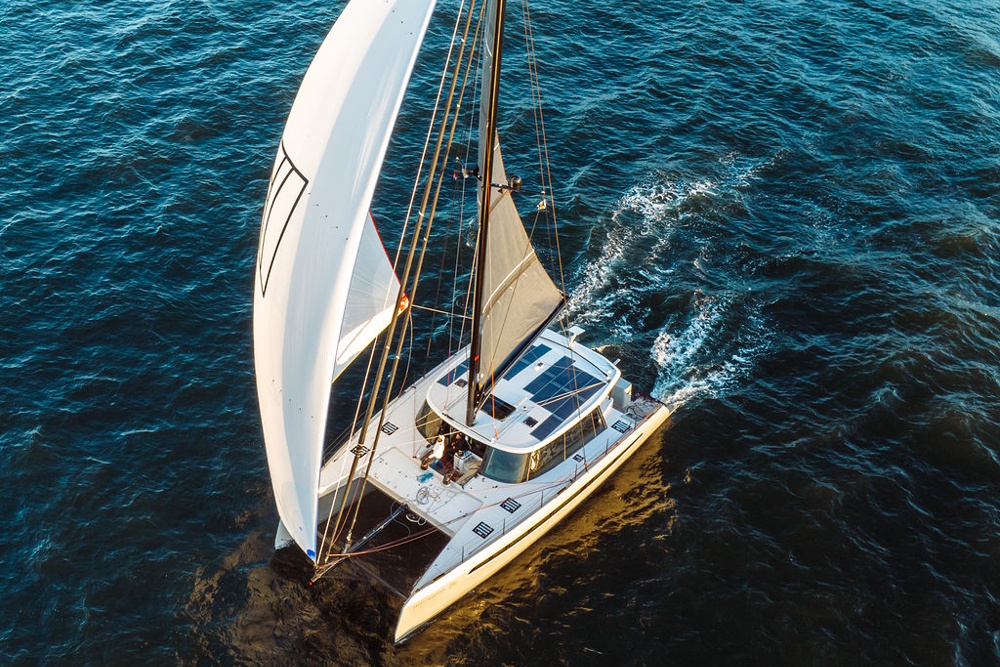
- 1Performance rig and push-button centreboards are the standout factory choices. Both are standard rather than optional add-ons.
- 2Averaged 9 knots crossing the Pacific and passed around 25 boats along the way.
- 3Best day’s run: 266 nm. Average passage day: around 220 nm.
- 4Close-hauled pointing angle: 30 degrees apparent wind angle with the leeward centreboard down.
- 5Carbon construction means zero flex between the hulls in a seaway. The owners describe 20 ft seas without concern.
- 6Weight discipline matters. They loaded around 5,000 lbs of a 10,000 lb capacity and stay 2,000 lbs under maximum cruising weight even fully fuelled.
- 7On passage she sails 85% of the time. Their previous Leopard motored 65% of the time.
- 8Everything electric has a manual backup, including the mainsheet. The backup was tested in need and worked.
- 9Zero electrical problems in three years of full-time liveaboard sailing.
- 10After-sales support is live and direct: a WhatsApp video call connects you to the factory floor, where a boat in build can be used to demonstrate the fix.
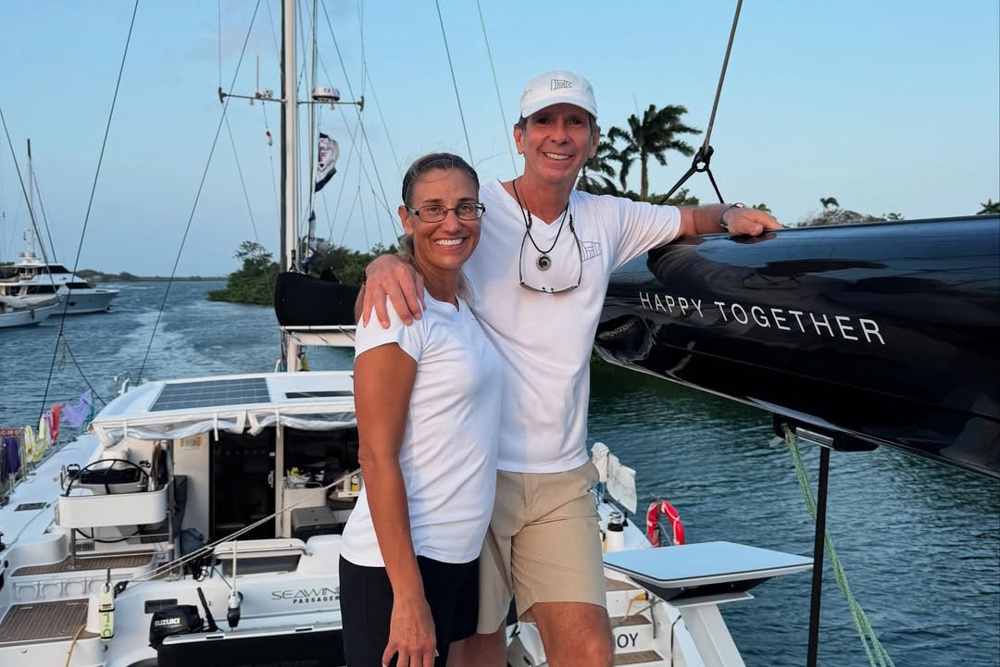
Lennie and I have been sailing since our youngest left for college in 2012. We had a monohull and then two Leopard catamarans, a 48 and 50. We sailed the 48 about 20,000 miles from Florida to California and back via the Panama Canal twice.
When we wanted to do our world cruise, we decided it was time to trade up to a performance cat, but we really enjoyed the design work of Simonis-Voge Architecture since they had designed our previous two Leopards. Once you have a forward cockpit door, you can’t go back.
The Kinetic was an easy choice on all fronts because it is truly a luxury boat that happens to be lightweight carbon construction, so she sails fast. We have now finished our 14,000-mile journey from Grenada to New Zealand via the Caribbean, Panama Canal, Galapagos, Marquesas, Tuamotus, Tahiti, Tonga, Fiji, and then New Zealand. The boat is currently on a ship headed for Europe, where we will pick it up in Palma in June and begin a two-year Mediterranean tour.
Going from a cruising cat to a performance cat had some challenges, actually. The rig, although easy to manipulate, took some getting used to. It’s tall, almost 88 ft on my boat, and it’s a lot of horsepower in the sails. I would equate it to driving a regular car or a high-performance sports car. That’s what it feels like.
At first, we thought we’d jump the shark when we were sailing her in Cape Town. After the first season in the Caribbean, we started to learn apparent wind sailing, which is a whole different ball game.
We placed our order at the Annapolis Boat Show in October of 2021 and took delivery in July of 2023, pretty fast for a custom boat. I know they call it semi-custom, but when you can choose just about anything, I call it custom. The build was fun.
The factory gave us monthly reports with pictures and details as everything was coming together. We even traveled to South Africa twice during construction to see milestones. Having the relationship with the designers for all these years made it easy as well, and the factory service was top-notch. Most importantly, after the sale, it’s like we’ll be together forever.
The boat comes fully loaded, so there’s not a lot of options you need, but I would say the designer’s choice here, on doing a performance rig and centerboards rather than daggerboards, which are amazingly convenient and deployed and retrieved at the push of a button, are two of my favorite options.
Of course, Lennie and I like to live in luxury, so we’re not glamping here. We have a washer and dryer, a scuba compressor, an ice maker, and a wine fridge. Are you getting my drift? We loaded this boat with all the comforts of home, and those are some of the things that we selected, but as far as the boat, the sail away package is exceptional.
It always surprised us when we would see people buying their production catamaran and selling the house and showing up with a U-Haul and putting 10 or 15,000 pounds of gear on their boats. People don’t understand that weight robs performance on a catamaran. Our Leopard sailed exceptionally well because it was so light. We always did whatever it took to minimize weight on the boat. For instance, no books, etc. People don’t take this seriously enough.
The fact that Happy Together can carry 10,000 pounds of full cruising gear is great, but we actually only loaded her with about five. Even when she’s fully loaded with fuel and water, we are 2,000 pounds under the maximum cruising weight.
If there’s one thing I want your readers to take away, it is that catamarans should be sailed light and you should pack them light and minimalist. We keep lots of stuff in our garage at home and bring it or take it back with us when we’re going and coming. Also, don’t fall into the trap of having things add up over time. It’s almost like every time we bring something new on the boat, I take something away.
This isn’t mandatory, but this is essential for fast sailing, and after all, it is one of the reasons you bought a catamaran? To sail fast.
We have a YouTube channel since 2015 that has about 50,000 subscribers who’ve been following our journeys. We have three seasons (7, 8, and 9) dedicated to this boat and our crossing of the Pacific, and I call out our miles daily in these videos.
I would say our average daily rate is about 220 mi. If the boat was professionally crewed, it would be easy to do 240. Our biggest day was 266. Even though the boat has the horsepower and ability to make 10 knots in most trade wind conditions, at nighttime we are conservative and reef the main and switch to a smaller sail plan. Of course, we never fly the chute at night. We power up in the morning, and then we power down at dusk.
We averaged nine knots crossing the Pacific, which was fantastic. We passed around 25 boats during the crossing. One thing that people don’t realize about Performance Cats: it’s not just that they sail fast, but you spend all your time trying to make them sail fast, which is like adding a new level of excitement to the sport of sailing. We just can’t help it.
We’re constantly trimming for boat speed, and we get a thrill from it. I think our highest speed on the crossing of the Pacific was about 20 knots with surfing, of course. In flat water, our fastest speeds were about 16 with the A2 and the BVI. I think it could go faster with a professional crew. Keep in mind I talked about weight earlier. This boat carries 7,000 lb of fluids, so we keep our gray water tanks near empty, our water tanks at about 30%, and we never fill more than 50% of fuel. You don’t have to, because you don’t have to motor in a boat like this. In our Leopard, we motored probably 65% of the time on all of our passages. On this boat, we sail 85% of the time.
When a performance manufacturer tells you their boat will sail at wind speed, they’re really talking about wind under ten knots. When it’s blowing twenty, you’re not going twenty, but when it’s blowing six, you’re going six. Figure that one out.
With the lee board down and with the blade and my mainsail sheeted appropriately, I can sail 30° apparent. Yes, you read that right.
Depending on distance, as I mentioned before, if we’re on a 100-mile tack, we usually will fly the parasailer. If we’re sailing around the Caribbean on 15- and 20-mile tacks, we use the A2 and do apparent wind sailing, so we might be steering 140 max. And yes, we get there faster than the boats sailing 180.
The sail plan was fun. We spent a good bit of time with the designers at NorthSails in Toronto, who were helping us with our selection.
The jib on this boat sails amazingly well, and anything above 15 knots of wind, it’s all you need. My go-to sail would be the jib. The J-Zero, which is like a bigger genoa, is exceptional from 85 to 120 degrees. As far as my favorite sail, it would have to be the A2. She’s over 3,000 sq ft on my boat and pulls us easily at 13 or 14 knots.
I also have a parasailor, and I know the guys at the factory scratch their heads on that choice. When you’re on a long trade wind passage, sometimes you don’t want to sail to the apparent wind. Sometimes you just want to set up a sail and forget it, and the parasailor does that nicely. We also have a staysail for extra square footage when racing, and a storm jib, which I hope I will never unpack.
The boat sails effortlessly with no weather helm. When we are performance sailing, which is most of the time, and in good weather, it’s great to be at the aft helm so you can look up at your sails and the waves and the wind gusts ahead of you. I’m not saying it’s like sailing a Hobie Cat, but it certainly is fun.
The forward sailing cockpit is where the action happens. Lennie is usually at the center helm so that we can talk through our maneuvers. She’s constantly reading me boat speed, wind speed, and angle, and I do most of the sail trimming and deployment. It’s a fun place to be. When at the aft helm, we have push-button sail trim, so no problem there.
If you are going hard to weather in a bumpy sea, the forward cockpit will get wet. There is nothing wrong with this setup, but you have to be careful opening the forward door in those conditions. Sometimes I just walk around from behind to make sure I don’t get salt water inside the Boat.
We spend most of our time sailing from the center helm position because it’s just so convenient. We have a huge moonroof that opens up so you can look at the telltales on both sails from that position. With Lennie at the helm and me running the lines in the forward cockpit, it’s a dream setup.
One of my favorite things in my Leopard catamarans was the raised aft helm, and I was nervous about how I was going to feel about this center helm, or as my kids call it, “steering from the kitchen” 🙂 but we truly love it and are so glad to be in the center of the boat for all maneuvers. Visibility: outstanding, of course.
Sail handling is a breeze. We can reef or furl headsails at the push of a button. You never have to be overly concerned about sail handling. I can sail the boat single-handed anytime and easily. Frankly, on passage, that’s how we do it, since we’re taking turns through the night being on watch and handling all the sail trimming.
The centerboards go up and down at the push of a button with line drivers. Everything that’s electric has a manual backup, including if you lost the main sheet, and guess what? I did, and the backup system worked perfectly. The designer and the builder have tweaked the boat just right so that if anything fails, you’re not out of business.
Carbon boats are no joke. They’re lightweight, so I always thought I would feel like they were less secure, but in fact this boat feels like a tank. There is no flex between the hulls when going over waves, so everything feels rock solid.
We’ve been in 20 ft seas and haven’t had a care in the world. We feel absolutely secure in this boat. Once we started sailing at high speeds and in rough weather, Lennie realized just how rock solid this boat is, and that gives her an incredible level of confidence, which is really important when you’re sailing as a couple.
I love the three helm setup, but I always dock from the center position. I also have a dock mate, which is very convenient. I can stand anywhere and manipulate the engines and the bow thruster.
Well, this took a bit of practice. On my old, heavy fiberglass boats, I had 4-bladed folding max props, and they bit the water hard. The boat had very little windage due to its weight. A carbon boat with a big freeboard and three-bladed folding props is not the same thing. It took a while getting used to marina maneuvering. If the wind is blowing 10 knots or more, you really feel it and you have to anticipate.
I have an 88 lb Rockna stainless steel anchor that I just love. It’s the Vulcan Series without the roll bar, as the roll bar wouldn’t fit in my setup. I’ve got 300 ft of chain and no rode. I have a chain counter and a Maxwell windlass. I’m really happy with the setup.
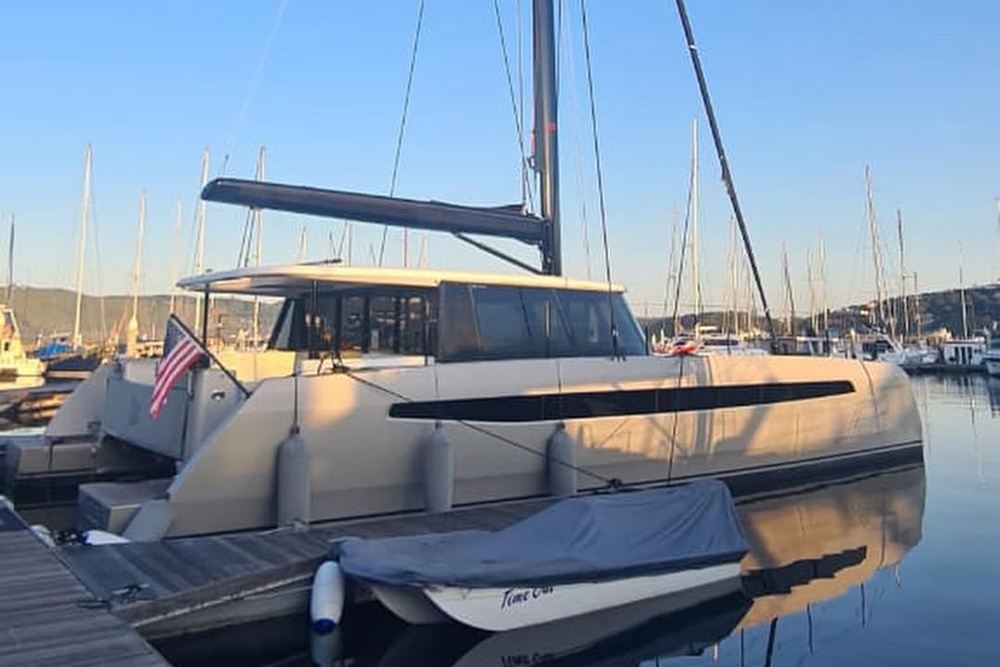
All safety systems are in great locations, and we have drilled on everything. Escape hatches are easy access and easy to open. The bottom of the boat is painted orange, which is required in South African construction regulations, but I hope to never see it.
The best thing is hard to nail down. Lennie will tell you the separate washer and dryer. I would tell you the rig, but really it’s because Happy Together has become our home. We know her inside and out, and we really love this yacht.
That’s the best part about custom building. There’s nothing we would change. We got everything we wanted and then some. She’s beautiful to look at, fast and easy to sail, and the fit and finish is like a Yacht.
The boat is exceptionally comfortable. You can see in the pictures we elected to have the inside and cockpit table on the same line so we could seat 12 for dinner. The hulls are very comfortable.
We elected to have a port side master stateroom running from bow to stern. We’ve got a head that’s 13 ft long with double sinks and a massive bed all the way aft in the back.
I’m generally surprised that so many manufacturers of performance cats have the owner’s bunk forward and transverse. We have one of these on our starboard hull, and it is not comfortable to sleep in a seaway. The most comfortable place on your boat is low and in the back, and I’m surprised more people don’t realize this.
As I said before, the boat is yacht-like. It’s the nicest interior we’ve seen for fit and finish.
There’s so much storage on our boat. We haven’t filled 30% of it. Including storage for 40 gas cans, all the sails, scuba gear, everything. Even our closets aren’t full.
My favorite spot is the forward cockpit. It’s where we work and play and drink our rosé at sundown.
Exceptional. Two guest cabins with private heads and private showers. No sharing on this boat.
The dinghy drops down with a push of a button, and it’s a high-speed deployment, so the dinghy’s in the water in three or four seconds. We take the dinghy up every night for all the obvious reasons, but it’s really a breeze. It goes up in three or four seconds, and it comes down in three or four seconds. It’s just that easy.
The folding platform adds to the real estate on the back of the boat, and we put it down every day when we’re at anchor.
I built a custom dinghy out of carbon fiber and painted it the color of the hull. It’s also got a seat with a backrest and a console because my wife and I are too old to sit sideways. This is pure luxury. We’ve got a 20 hp Honda on the back.
We’ve done no modifications because we custom built everything to our needs. There’s been no reason for changes.
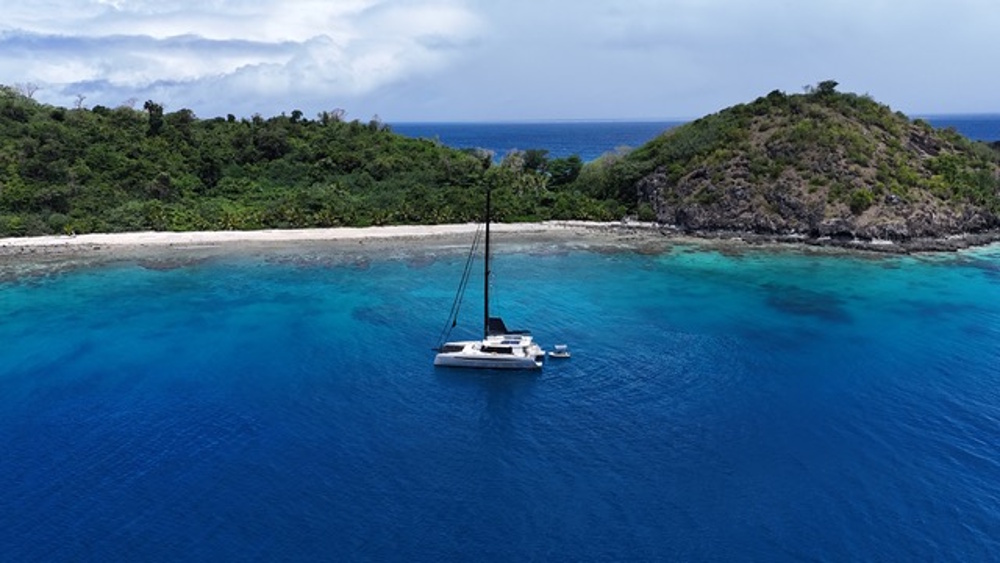
Favorite anchorage so far is a tough one, and we get asked all the time. We have crossed half the world on the trade wind routes and gone through some of the most amazing places on the planet. We would have to say Fiji Namena island. We anchored there for a couple of nights. We had a dive operator from Jacques Cousteau’s Sons Resort come and pick us up off the boat and take us to the most amazing soft coral dive of our lives.
We hiked to the top of the hill, flew the drone, and did a drift snorkel which lasted two miles and was the best snorkel of our life. The anchorage was flat calm, and the island is surrounded by a coral reef, sort of like the Tuamotus. We were the only boat there. It was magical.

The setup on Happy Together is my dream, but it’s not for everyone because Lennie and I are power hogs. We sleep with air conditioning. Yes, every night. Yes, every anchorage, and yes, even on passage. Although the boat has 1200 Ah of Lithium at 24 V and two 160 A battery chargers on my Yanmars and 2500 W of solar, I still have a 6 kW direct DC generator from Fischer Panda wired into my battery system.
The boat is fully inverted. No shore power touches any systems. All it does is charge the batteries. So because of our intense power needs, power generation comes from our generator a lot of the time. We can run our air conditioning all night long in the master stateroom easily on battery power, but you have to replace that energy anyway.
We set up the boat so the generator turns on and off at 100% and 40% so we don’t even think about power. It’s just every now and then this little generator is humming away in the corner quietly.
A lot of boats are going with the integral system, and although I know that’s the future, I’m really happy that my boat is set up the way it is. It’s bulletproof. We have had zero problems with our electrical system in three years of sailing.
She motors easily at 9 knots with 80 hp Yanmars, and remember, my boat does not have an integral system. I specifically did not add that as I wanted a separate generator. A lot of people set up the boat whereby if you want to power up your batteries, you have to start the engines, one or both. That’s a lot of vibration and noise, having an 80 hp engine charging your batteries.
My little Fischer Panda generator sits away thumping quietly in the corner, and we really like it.
Maintenance is about the same as every other boat I’ve owned. You have to keep track of all on-board systems and follow the manufacturer’s regular checks, service intervals, and overhauls.
The after-sales service is exceptional. They have several boats in production at the yard at all times. Whenever I’m having a problem, I simply video call them on WhatsApp, and they can go into a boat and describe how something’s done or how to fix something. It’s just amazing. I feel like I’m in the Kinetic family.
In my opinion, there is no competitor for this boat. All the other boats are awesome. We love Balances, we love Outremer, and the Gunboat is in a different league, so let’s leave them off for this list.
This boat is the only one built without a budget and with luxury in mind, not just performance. The hulls are a bit wider on this boat for livability. It does cost speed, but due to carbon construction, she’s fast as heck. There are no shortcuts on this boat. She’s expensive and worth every penny.
YouTube: @SailingSVHappyTogether — Seasons 7, 8, and 9 cover the KC54 and the Pacific crossing
Instagram: @svhappytogether