
Nahoa Yachts
Background
Nahoa M is the first model in the new Nahoa Yachts range, designed to set the benchmark for future sister models, the Nahoa L and Nahoa S. All of these yachts will be built around a similar “offshore-ready” brief.
The goal is not to be the fastest boat in the water in flat-water trials, but to achieve consistently high average speeds when the boat is fully loaded, conditions are messy, and the crew is short-handed and tired.
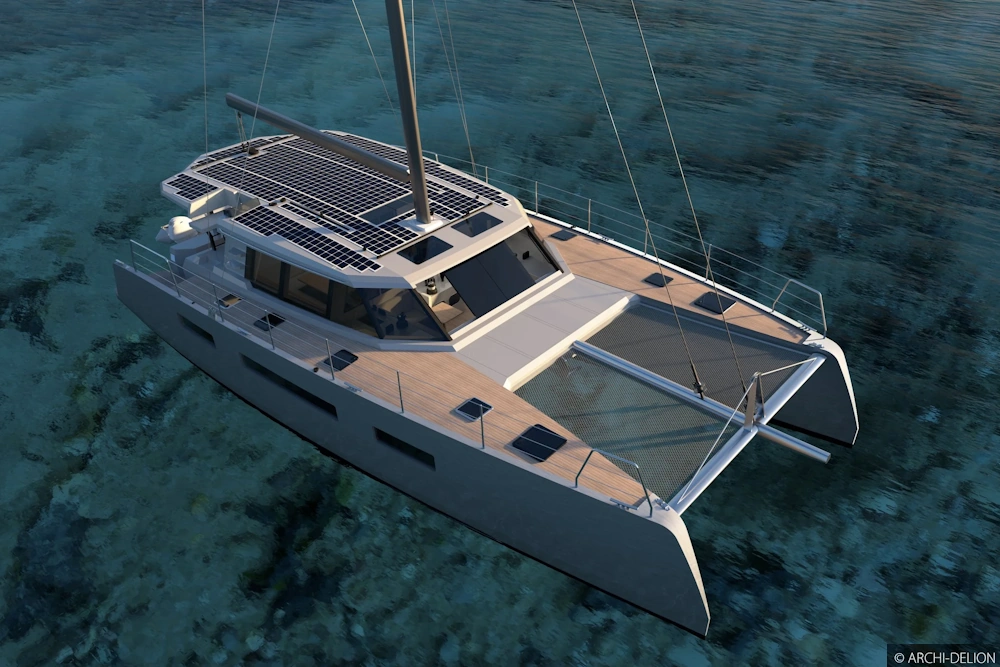
A core part of that brief is proportion: Nahoa is keeping the interior volume closer to that of a typical cruising 48-footer, while the waterline length and passage-speed target are closer to what you’d expect from a bigger platform.
The Nahoa Team
The project is beinfg driven by the Sailing Nahoa YouTubers and media team, Ben and Ashley, who document their cruising life and boat projects online. They boast a decade of global sailing and content creation, and are experienced hands-on operators: Ben is a self-taught fixer and Ashley is the logistics “glue” of the program.
On the design side, Nahoa Yachts has named Pierre Delion, the brains behind the Explocat 52 as the naval architect for the Nahoa M. He has specified construction in marine-grade aluminium and an ISO Category A target for up to 10 persons.
Summary of the Boat
The Nahoa M is an aluminium expedition sailing catamaran that blends:
- Load-carrying ability while remianing nimble
- Manageable sail loads for short-handed sailing
- Systems simplicity for remote cruising
- Robustness and repairability (a big part of the aluminium argument)
The Nahoa M clocks in at 17.4 m (57 ft) LOA, 8.3 m beam, and 1.55 m draft.
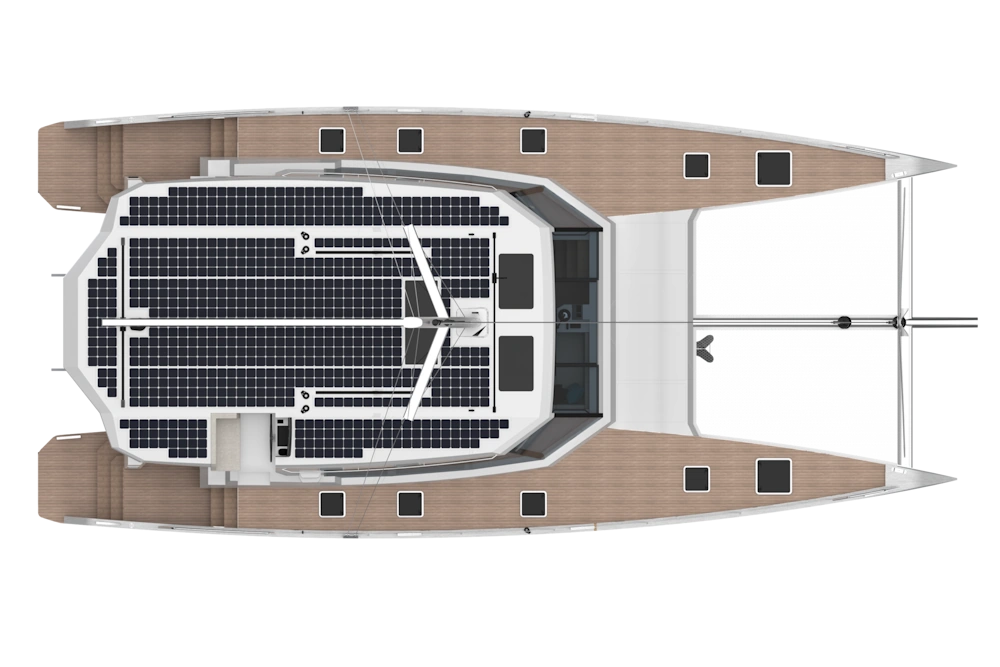
Propulsion is twin 80 hp diesels on shaft drive with V-drive, paired with “5 kW+” solar and 1,800 L fuel capacity.
The Build Philosophy
Simplicity, strength, and safety.
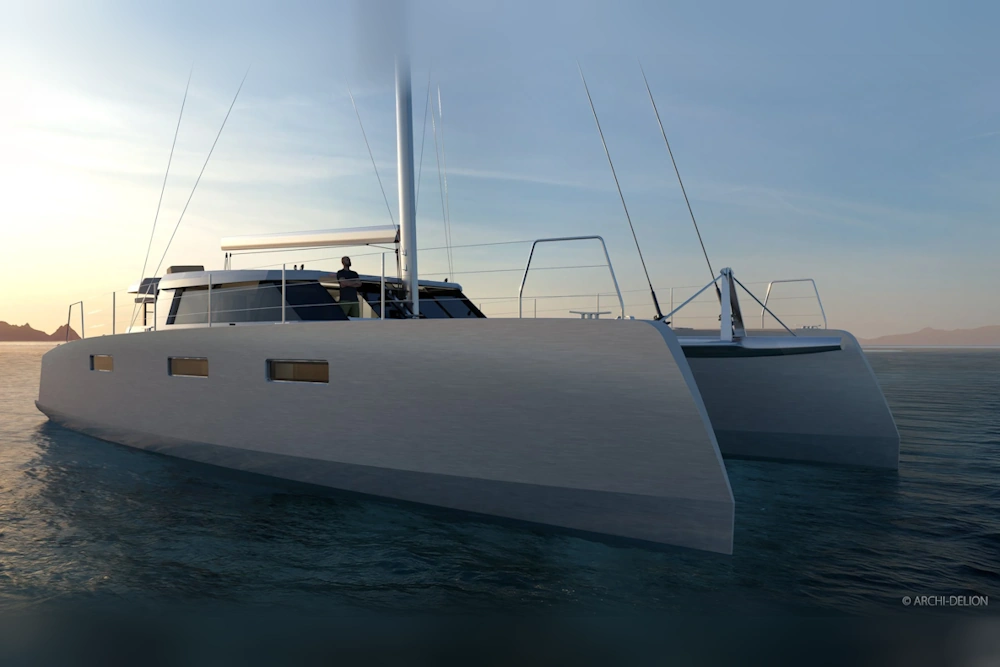
The use of aluminium is practical rather than fashionable: aluminium is ductile (it deforms rather than cracking), repairable in more places worldwide, and well-suited to welded-on deck hardware to reduce potential water ingress. The design will meet ISO and CE stability/buoyancy/watertight requirements, and exceed minimum certification standards for its expedition role.
Living Space
This will be a comfortable boat, but interior volume will be moderated to keep systems compact, accessible, and easier to live with long-term, rather than chasing maximum volume per foot.
They are aiming for clearer machinery access, less systems sprawl, and storage and service routes that work at sea.

 Aluminium expedition boat: impact tolerance, repairability, welded hardware reducing deck leaks.
Conservative handling brief: rig loads targeted at short-handed control, not racing.
Strong systems design: shaft drives, large fuel capacity, and 5 kW+ solar will build self-reliance.
Aluminium expedition boat: impact tolerance, repairability, welded hardware reducing deck leaks.
Conservative handling brief: rig loads targeted at short-handed control, not racing.
Strong systems design: shaft drives, large fuel capacity, and 5 kW+ solar will build self-reliance.
 “Restrained interior volume” is a deliberate choice, but there is a trade off there.
A new production series carries delivery, finish-quality, and aftersales risk until multiple boats are in service.
“Restrained interior volume” is a deliberate choice, but there is a trade off there.
A new production series carries delivery, finish-quality, and aftersales risk until multiple boats are in service.
Sailing and Deck details
The rig is “sized and loaded like a 52,” aiming for conservative, predictable handling in squalls and easier management for a short-handed crew.
On the passage-making side, the aim is trade-wind performance of 10 to 12 knots boat speed, enabling 200+ nautical mile days.
Propulsion will be through reliable twin 80 HP diesels, shaft drive with V-drive, and a high solar array(5 kW+).

| Model | Nahoa M |
| Type | Aluminium sailing catamaran (expedition-style) |
| Naval architect | Pierre Delion |
| Construction | Marine grade aluminium |
| Certification target | ISO Category A (10 persons) |
| LOA | 17.4 m (57 ft) |
| Beam | 8.3 m |
| Draft | 1.55 m |
| Engines | Twin 80 hp diesel |
| Drive | Shaft with V-drive |
| Fuel capacity | 1,800 L |
| Solar capacity | 5 kW+ |
| Stated passage performance | 10 to 12 knots in typical trade-wind passages (200+ nm days) |
Summary
The Nahoa M is shaping up as a purposeful, offshore aluminium catamaran with conservative rig loads, robust construction logic, and systems aimed at long-range autonomy.
The published numbers (57 ft LOA, 8.3 m beam, 1.55 m draft, 1,800 L fuel, 5 kW+ solar, twin 80 hp shaft drives) support that positioning, and the design brief is refreshingly direct about “average speed with load” rather than many marketing-led projects.
The Competition
Garcia Explocat 52
Closest “mainstream” competitor in intent: an aluminium, go-anywhere cruising cat from an established expedition builder. Explocat 52 is pitched around autonomy (large tankage, offshore focus, expedition options).
Nahoa M vs Explocat: Nahoa is positioning for conservative loads and long-range autonomy too, but at a longer LOA (17.4m) and with very large fuel capacity published (1,800L).
Delos Explorer 53 and Stradbroke 52 (Devilliers Marine Design family)
Part of the same design lineage (De Villiers Marine Design) with published numbers for beam, draft options, displacement, tankage.
Nahoa M vs Delos. Delos/Stradbroke are strongly “expedition build + content-led project” (Delos in particular), and Stradbroke highlights a “go anywhere” proposition with welded aluminium and watertight bulkheads.
If a buyer likes the Delos/Stradbroke idea, Nahoa is in the same ballpark: offshore-first, repairable material, and owner-operated. One big difference is the forward cockpit on the Delos.
Odisea 48 (Wama Yachts)
More performance-leaning at 48ft, with a lightweight positioning.
Nahoa M vs Odisea: Nahoa is positioned more as a “fast load-carrying passage machine” than “light-air performance cruiser”.
Mumby 48
Mumby is a proven bluewater/performance aluminium design with a long owner-builder and offshore culture around it. You’ll see claims of strong daily runs from owners.
Nahoa M angle vs Mumby: Mumby attracts performance-minded cruisers and practical builders. If your budget is tighter, these yachts are an excelleny option.
Vaan R5
Sustainability-led aluminium cat, with recycled-aluminium, electric propulsion, etc
Nahoa M vs Vaan: Vaan is “eco-modern lifestyle + electric” at 49ft; Nahoa is “expedition autonomy + offshore ruggedness” at 57ft with twin diesels.