
Monohulls vs Catamarans: A Catamaran Sailor’s Week on a Mono
We spent a week on a monohull in the Ionian Islands in Greece on a Beneteau 51.1 with Istion Yachting. Purely for research purposes of course!
Here are our thoughts on monos vs cats with 5 people on board who all wanted separate cabins. What’s the key takeaway? Sailing with friends is great fun whatever the vessel.

Short on Time? Bookmark & Later? Here’s the Quick Take
Catamarans win on: Space & privacy, shallow draft access, downwind speed, reduced seasickness, lower fatigue on passages, the tender.
Monohulls win on: Upwind performance, cosy atmosphere, marina availability, self-righting capability, charter costs (also purchase & operating of course).
The real winner? Whichever matches your cruising style. After sailing all sorts of different catamarans over the years (including Prouts), a week on a Beneteau 51.1 in the Ionian revealed some surprising insights about both.
Read time: Quick read: 2 min (summary + table) | Full article: 5 mins

The 26-Knot Revelation
Let’s see the scene: the wind was gusting to 26 knots in the Ionian islands on day 2 of our trip, with the Beneteau 51.1 on a broad reach with full canvas flying. For a catamaran sailor, alarm bells would be ringing. Reef, NOW! But the monohull simply heels, spills the excess power, and charges on with a steady, pendulum-like rhythm that the keel and ballast create.
Exhilarating? Absolutely!
Then you head below deck. That’s when reality hits – literally. You’re bracing against bulkheads, timing movements with the heel and pitch of the boat, suddenly aware of how much you take that flat, stable catamaran platform for granted.
After a week comparing this experience to the Nautitechs, Lagoons, Lagoons, Dazcats, Seawinds and even vintage Prouts I’ve sailed, here’s what unites and divides both camps of sailors: this is catamarans versus monohulls.
The Sailing: Feel vs. Stability
The first thing catamaran sailors will notice is the heeling. It’s no drama at first, but enough that your inner ear resets what “normal” feels like. It’s exhilarating in gusts, sailing the boat on the foot braces and feeling every puff through the helm. It’s comfort versus adrenaline: a trade-off.
That said, the “cats have no feel” myth is way off. Modern designs like Nautitech, Excess and Outremer deliver genuine helm feedback with direct connection to the rudders. When you are hanging off the side of an ORC 57, you’ll be feeling the wind in your hair. The difference is subtler than monohull purists claim. Granted, crusing designs such as the Lagoons, Fountaine Pajots and Balis offer a different experience: more protection or better views all round.
Visibility and sail trim present interesting contrasts. On the Beneteau with the bimini up, spotting tell-tales required neck craning – which not ideal. That surprised me, as I was expecting better visibility of the sails. In most cases, you are going to have the bimini up.
And the high boom, a must for safety in case of accidental gybes, makes dealing with reefing line issues and flaking the main a workout. Some cats flip this script entirely: Seawind, Nautitech, Excess, and Outremer mount their booms low so that the centre of effort of the mainsail is low and all the kit is accessible at chest height or lower. So you can make quick fixes without the drama.

Performance profiles depend on the point of sail. Upwind, the monohull points higher and punches through chop with a pendulum motion thanks to the ballast in the keel (cast iron for the Beneteau). This is arguably more comfortable than a cat’s pitching. The deeper keel grips better so that there is less leeway at tighter angles, unless you are sailing a catamaran with daggerboards
But crack off to a beam reach and the catamaran starts to pull ahead She accelerates, lifts slightly, and suddenly you’re doing 12+ knots. On a beam to broad reach, cats are faster, more stable and thrilling.
And that means that the apparent wind speed comes down meaning you can fly your big sails off the bowsprit for longer. And that also makes downwind reefing feasible on a cat; you’ve got boat speed to maintain control, manoeuvrability and keep the AWS down.
But the monohull has a trick up her sleeve: ease of reefing under way. You can let out the main and lose the power without worrying about it catching on the shrouds – the geometry just works better. Just watch you don’t gybe by accident, keep the wind angle tighter.
Space & Liveability: the Cat’s Got the Cream.
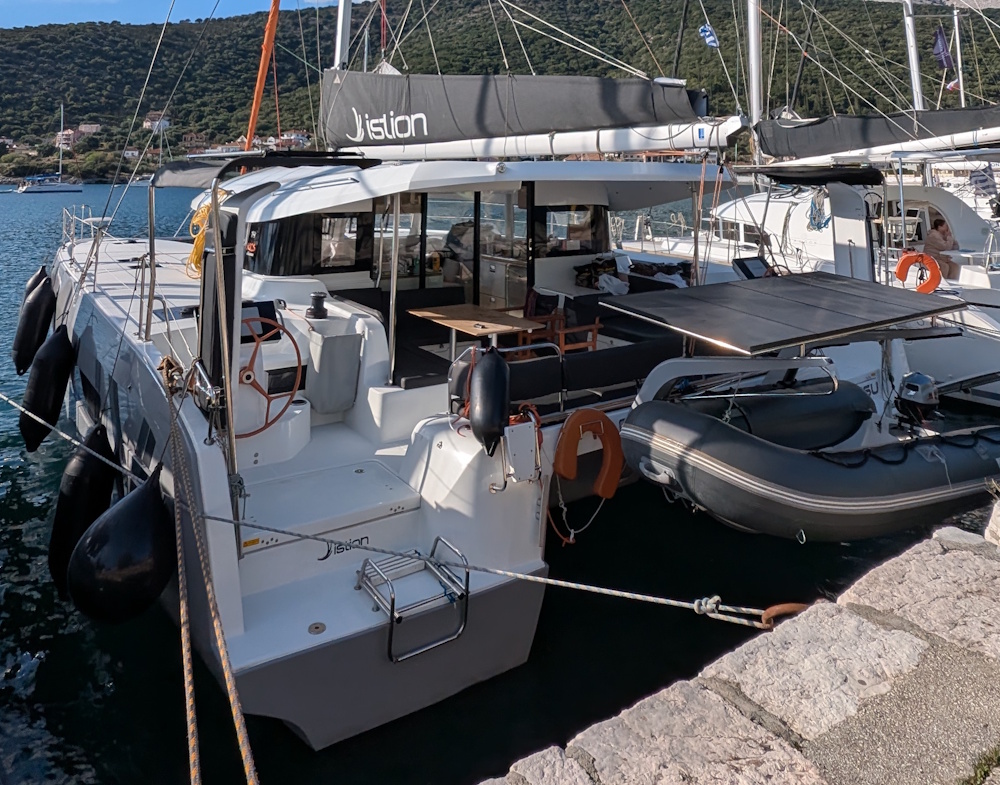
There’s no surprise on this one – catamarans win on liveability. Two hulls mean privacy, with cabins separated by the width of a saloon. You’ve got multiple social zones: cockpit, saloon, forward nets (which I genuinely missed on the mono) and flybridges on many models. The bigger beam translates into elbow room. One of the things I love about sailing is watching the stars on the nets. You can’s do that on a mono.
The Beneteau 51.1 did surprise us though- five private cabins, and everyone had their own space. The 2 cabins forward had ensuites. If you try that on a comparable cat, someone will be in a forepeak cabin that’s really a sail locker with delusions of grandeur. Or you have to go large with a big flybridge cat.
But here’s another area where monohulls claw back points: when the Ionian weather turned cooler, that cosy single-level living space felt inviting. Everything’s within arm’s reach, the saloon wraps around you and it’s very cosy. Cats, for all their volume, can feel sprawling and less intimate in cooler climates.
The galley-up versus galley-down debate is a fierce one. Anyone prone to seasickness will prefer the saloon-level galley with horizon views that most catamarans have. Some brands like Seawind and Dazcat are galley down, but I would argue that they are “half-galley-down”.
And when the monohull heels? Moving around down below, you are bracing against counters, timing your movement – it’s fine, but it can be tiring on longer passages, especially for less experienced crew.
Winner: Cats, but monohulls aren’t without charm when conditions suit them.
At the End of the Sail: it’s Close
Anchoring has its nuances. Monohulls keep it simple – you drop, set, and you are done. There is no bridle to rig, no worrying about the load distribution between two bows, or swinging differently to the monos. But you’re also a long way from the action, ideally wanting crew up front giving hand signals. We didn’t have a chain counter or remote windlass control, so you need your crew to be on the ball.
Catamarans can be easier depending on helm position. Mid-cockpit and flybridge Lagoons? Your visibility and communication forward is better. Forward helm designs like Windelo put you very close to the anchor roller – you can see the chain laying out, read the angle and make adjustments accordingly. Aft helm cats are in the same boat as a mono, possibly more so as you have the coach-roof in the way. Invest in some bluetooth headsets.
Manoeuvring in tight quarters was a surprise for me on the monohull. The single engine and prop, especially going astern, felt predictable. Add a bow thruster and you’ve got comparable control to twin engines. We didn’t have any prop walk on the Beneteau but most monos do. That gives you another tool in your box to play with. Cats win on the ability to spin on their axis – invaluable in tight marinas – but it’s closer than I anticipated.
Engine redundancy versus simplicity: two engines mean getting home if one fails, but also double the maintenance, double the expense, double the things that can go wrong. The monohull’s single engine is elegantly simple.
Draft is clearly more shallow on cats, especially daggerboard models. You’ll be sneaking into anchorages monohulls can’t touch. Beach the boat? Only on a cat. But windage is another story – monohulls sit lower, catch less breeze, especially compared to flybridge catamarans that act like big sails in 25-knot anchorages.
Tender Size and Convenience. Catamarans win hands down versus most monohulls here. You will likely have a small tender strapped to the roof behind the mast on a monohull.
Ours had a 2.5 HP engine, even though we were sailing a 50 foot boat. On a cat, you’ll be buzzing around on a 3m tender as a minimum, with a 10HP engine. Some monohulls like the Amels have davits for a bigger tender of course, but they are the exception rather than the rule.
Overall, we give the edge to catamarans for the twin engines, though monohulls deliver less stress when the wind pipes up at anchor.
Money Talks: Budget Matters
Let’s talk about what nobody mentions in the glossy brochures: catamarans cost more. Quite a bit more.
The price? Expect to pay 30-50% premium for a comparable-length catamaran versus a monohull. A Beneteau 52 might run to €600k depending on your options. A similarly equipped Lagoon 46 is more like €900k.
Then the ongoing costs multiply. Marina fees often charge by the beam – that 25-foot-wide cat pays from 1.5x to 2x what a 15-foot-wide mono does for the same length berth. Haul-outs? You’ll need a travel lift rated for wider beams and not every yard can accommodate you, and those that can charge accordingly.
Two engines, two saildrives, two props, two fuel filters, two impellers… you see where this goes. Maintenance costs aren’t double – but budget 60-70% more annually. Insurance premiums reflect this reality too.
Monohulls win on simplicity and cost efficiency. With one engine to service, a narrower beam with more marina options at lower prices and haul-outs that are straightforward anywhere.
But catamaran resale values hold well, especially for popular brands and even more so for performance cats like Outremers. The market has a healthy demand for these yachts. Monohulls can be harder to move unless they’re performance models or blue-water proven designs.
Winner: Monohulls for operating economics, though cats may recoup more at resale.
Safety & Offshore Capability: Different Philosophies
This is where perspectives diverge sharply – and physics doesn’t care about opinions.
Monohulls have self-righting capability. Knock them down to 90 degrees, even beyond, and that deep keel and ballast will pull them upright. It’s been proven many times in storm conditions. Uncomfortable? Terrifying? Absolutely. But the boat wants to come back up.
Catamarans, once inverted, stay inverted. If you flip one past a certain point, it’s not flipping back. Having said that, modern cats are extremely difficult to capsize with their wide beam and lower center of gravity. If you do your research, you’ll see that this is a very rare occurrence, even among blue-water cats.
If you reef sensibly and stay within the limits, this is a very low risk. Monos can lose their keels to the bottom of the ocean, so they are not without their risks either.
And catamarans offer a compelling counter-argument: speed as a safety factor. Performance cats can sail out of danger – outrunning weather systems, reaching safe harbour before conditions deteriorate. That 200-mile overnight passage? A cat might do it in 15- 20 hours while the mono takes 30, meaning less fatigue, and less exposure.
Speaking of fatigue: reduced heeling means less physical strain in fresh conditions. The crew aren’t bracing constantly, cooking is manageable, and sleeping is easier. Over multi-day passages, this reduced tiredness is a big safety factor. Add the twin engine redundancy and cats build in a healthy safety margin.
Motion comfort at sea tells a different story. That monohull pendulum motion – rolling predictably – can be more restful on long passages than a catamaran’s quicker movement especially upwind. Some crew sleep better on monos; others prefer the cat’s reduced heeling. It’s personal.
Structural strength: monohulls are single, robust hulls with decades of proven ocean-crossing design evolution. Catamarans have bridgedeck structures connecting two hulls – with potential stress points, although modern engineering has largely addressed this. Both can be built to cross oceans; both have circumnavigated successfully.
Windage offshore matters more than at anchor. In survival storm conditions, that low-profile monohull presents less surface area to wind, making heaving-to or running off more manageable. In a cat you are more likely to be running with the weather with a drogue, or warps out of the back to slow your speed down. That is not going to be so easy off a lee shore.
Winner: this one’s tied. Speed, reduced fatigue, and redundancy are compelling safety arguments, though monohulls have that ultimate self-righting ace card and are easier to heave to meaning you can sit the storm out.
The Honest Verdict
So which wins? For us – admittedly a multihull-focused site – catamarans edge it overall. The space, the shallow draft access, the speed, the reduced fatigue on longer passages, that stability at anchor. These are big advantages; they reshape how you experience cruising.
But here’s the honest truth from that week in the Ionian: the Beneteau 51.1 was the best boat for that trip. Five people wanting private cabins, mixed experience levels, island hopping in protected waters, lots of marina and anchoring work – the monohull delivered a great sailing experience.
The real answer isn’t which is “better” – it’s which suits your priorities:
Choose a Catamaran If:
- Space and comfort top your list
- You’ve got crew prone to seasickness
- You love shallow anchorages and beach access
- You’re chartering with multiple couples wanting privacy
- You’re planning extended liveaboard cruising where that extra room compounds daily
Choose a Monohull If:
- You prioritize the pure sailing experience
- Budget matters significantly (both purchase and operating costs)
- You’re sailing short-handed
- You value that cosy below-deck atmosphere
- You’re drawn to traditional seamanship and that self-righting peace of mind
Both will get you across oceans. Both will deliver memorable sailing. The question isn’t which is superior – it’s which matches how you actually want to use the boat.
And sometimes, like that week in the Ionian, the “different” choice turns out to be the right choice.
Over to You
What’s been your experience crossing over between monohulls and cats? Did anything surprise you? What would you add to this comparison? Contact us and send us your thoughts.
Considering the switch? Check out our detailed catamaran buyer’s guide or browse charter options to test before you invest.