Max Cruise 48 SC: Flexible Layouts, Custom Options and Hybrid Power
The Max Cruise Marine 48 SC is a 14.6 m (47 ft 11 in) semi-custom performance catamaran that lets customers choose the helm, keels, deck layout and power system before the build starts. Three things set it apart: a layout that can be reshaped to how you will live aboard, a build process that encourages input, and a proven hybrid power system with ocean passages behind it.

That power system is one of the key highlights of the range. The same parallel hybrid architecture is offered on the 45 SC and 55 SC, and carries over to the new ALU-EXP 15, a 15 m aluminium expedition catamaran built on the 48 platform. The power section below covers all four.
Max Cruise 48 SC at a glance
| Specification | Max Cruise 48 SC |
|---|---|
| Length overall | 14.6 m / 47 ft 11 in |
| Waterline length | 14.5 m / 47 ft 7 in |
| Beam | 8.0 m / 26 ft 3 in |
| Draft, mini keels | 1.35 m / 4 ft 5 in |
| Draft, daggerboards | 1.2 m up, 2.4 m down |
| Light displacement | 10.6 t |
| Mast above water | 19 m |
| Mainsail | 76 m² |
| Genoa | 52 m² |
| Self-tacking staysail | 28 m² |
| Bridge deck clearance | 0.9 m |
| Fuel | 610 L |
| Fresh water | 540 L |
| Diesels | Twin Beta Marine or Yanmar 40 hp, shaft drive |
Flexible design
The 48 SC is a vinylester resin-infused foam sandwich build with CNC-cut components and asymmetric hulls. Light displacement is 10.6 t. The owners of Ditto, who chartered production catamarans before buying, estimate 12.5 to 13 T afloat with full tanks and a heavy cruising kit, and report that she moves well in light air and points higher than the crusing catamarans they sailed previously.
The flexibility comes from a list of structural options.
- Helm position. The popular choice is a mid-raised helm to starboard. Twin aft helms and a forward working cockpit are alternatives on the larger designs. Sheets, halyards, reefing lines and furlers are led to the raised helm in the first case, and the Code 55 is deployed by electric furler from there.
- Keels. Fixed mini keels draw 1.35 m and allow the boat to dry out on her own keels. Daggerboards draw 1.2 m up and 2.4 m down and improve pointing upwind.
- Deck layout. A standard layout and a forward cockpit layout are on the option list.
- Saloon. A dining table sits between the galley and a forward-facing nav station. The saloon opens to the aft cockpit, with an optional bar at the aft end to separate the two zones.
- Cabins. The guest hull has a queen aft and a double forward, with an option for a foldaway berth that turns the space into an office. The owner’s hull has the queen aft, with a large shower room and head forward.
One build detail affects how the interior feels at sea. Max Cruise glasses, tapes and ties interior fittings into the hulls, rather than dropping in separate furniture units. So no creaking from this stiff boat.
Customisation
Ditto is hull 2, owned by a British couple who signed the build contract at the 2023 Annapolis show and took delivery in Pattaya in June 2025. They were involved in most decisions, with options presented as CAD drawings, two three-day factory visits to handle materials and finishes, and payments tied to build milestones.

Their specification shows how far the options go:
- Systems. Hybrid propulsion, fresh water heads, watermaker, engine remote control and air conditioning in the two aft cabins, with diverter vents to push cooled air into the saloon.
- Interior. A workshop in place of the second guest head, an all-electric galley with a three-burner induction hob and no oven, and a gelcoat galley finish instead of veneer.
- Deck. EVA foam covering in place of teak, davits developed with the builder to carry a tender and SUP boards, a 33 kg Rocna anchor and 90 m of 10 mm chain.
- Sails. A 76 m² main and 52 m² genoa in black laminate on the builder’s advice, a 28 m² self-tacking staysail, a 90 m² Code 55 on an electric furler and a 150 m² asymmetric spinnaker.
The builds have evolved. Later boats gained extra storage units along the outboard side of the owner’s hull, and Ditto is having one retrofitted. The owners also say they would specify a height-adjustable cockpit table that converts to a lounging area.
On the water, Ditto reports passage averages of 7 to 8 knots, a best 24-hour run of 165 nautical miles and a top speed of 19.4 knots.
Power options across the range
Max Cruise offers a diesel-only boat on every model, and a parallel hybrid as an option package. The hybrid is one of the technology highlights of the range. Power is shaft-drive.
How the system works
Each shaft carries a diesel engine and a Hybrid Marine electric motor. Beta Marine or Yanmar diesels are fitted, both on shaft drives, and the power management sits between two battery banks. That gives four working modes:
- Electric. The twin 15 kW motors drive the boat for manoeuvring and quiet anchorage exits. The motors are air-cooled, so there are no raw-water pumps.
- Diesel. The engines drive the shafts as they would on any shaft-drive cat.
- Diesel generation. A clutch lets each diesel drive its electric motor as a DC generator, rated at 10 kW per side, charging the 48 V lithium bank without a separate generator.
- Hydro regeneration. Under sail, feathering Hydralign props spin the motors as generators. Hybrid Marine International’s AI-Regen controller adjusts drag against speed, sea state and electrical load, balancing energy capture against sailing performance.
The builder’s fact sheet puts the headline numbers as twin 15 kW electric drives, 10 kW hybrid generation per side and hydro regeneration averaging 1 kW per propeller at 8 knots.
Hybrid packages by model
The three Max Cruise packages share a 48 V bank with CAN bus, a 48 V windlass and deck sailing winch, a 48/12 V DC/DC converter, an induction hob and a convection microwave. Victron inverters and a Cerbo GX handle monitoring and control. Generation is quoted per side, so a twin installation is 20 kW in total.
Hydro regeneration
The fact sheet gives a regeneration curve for each propeller:
| Boat speed | Regeneration per propeller |
|---|---|
| 6 knots | 0.7 kW |
| 8 knots | 1.0 kW |
| About 10.5 knots | 1.5 kW |
| 14 knots | 2.0 kW |
The figures represent the best case, and the result depends on propeller size, load and sea state.
To put the sheet in context, two propellers at 1 kW each for 24 hours would return 48 kWh, which is more than the 35 kWh bank on a 48 SC package. Ditto’s owners call regeneration a game changer for ocean crossings.
In use aboard SV Ditto
Ditto’s owners carry a 30 kWh LiFePO4 bank, about 4 kW of solar on three panel banks and no generator. Their reported routines show how the modes are used in practice:
- Docking and anchorages are done on twin electric power, with remote control from the deck.
- Cruising under power is usually one diesel at 1,800 rpm for 6.5 knots. That engine also generates about 100 A at 48 V, which can drive the other hull’s electric motor at 100 A or less, so consumption can be neutral or negative.
- Pointing assist. Under sail the leeward electric motor can run at low amps to point th boat closer to the wind.
- Autonomy. A couple can go 3 to 4 days before running the diesels, with air conditioning on overnight in eco mode. Guests, watermaking and more cooling shorten that.
The control software has guardrails. The electric motor will not engage for propulsion while the diesel is running, and generation ramps down as the batteries approach full. The electric motors need only periodic drive belt changes.
Two longer passages give an indication of fuel use. SV Kea, a 44 SC with a 38 hp diesel on one side and a 10 kW electric drive on the other, sailed 10,000 nautical miles from Vietnam to France on 656 litres of diesel, logging 1,200 hours on the diesel and 1,600 on electric. A 55 SC was delivered from Vietnam to California on about one and a quarter tanks of fuel.
The same systems on the ALU-EXP 15
The ALU-EXP 15 is a 15 m (about 49 ft) aluminium expedition catamaran from ALU-EXP and Max Cruise Marine. It is drawn from the 48 platform and uses the 48’s propulsion, battery management, solar and monitoring systems.
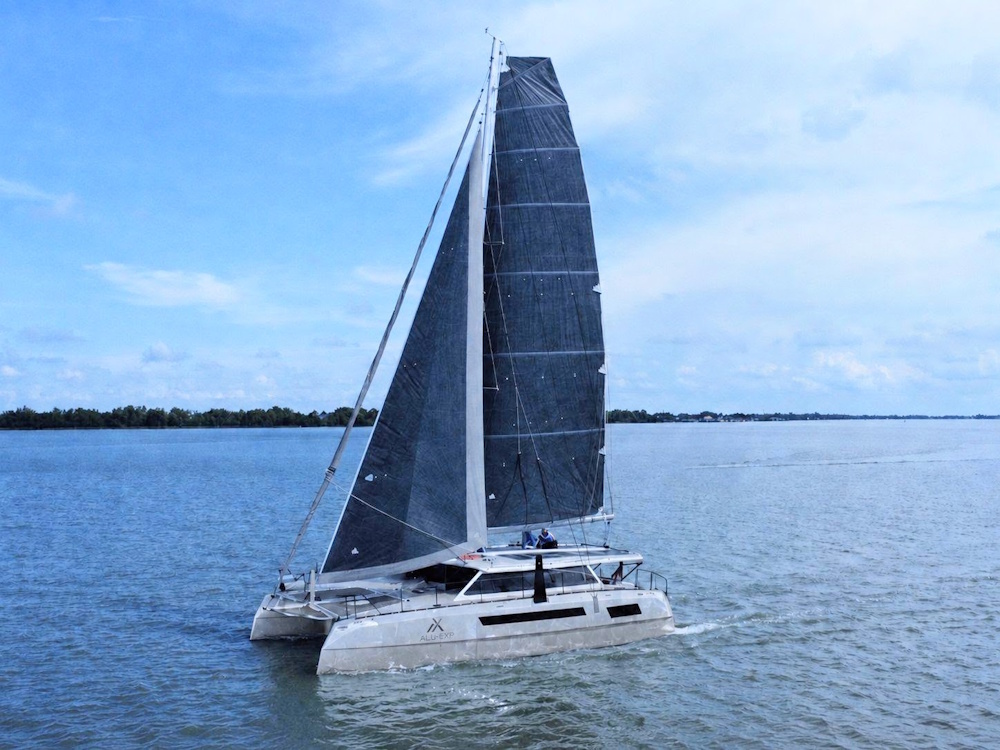
The hull is a mix of materials. Hulls, main deck, bridge deck, sugar scoops and mast compression posts are aluminium. Above the window line, the coachroof, mullions and upper structure are carbon-reinforced vinylester over foam. Impact protection includes sacrificial mini keels and rudders, crash bows and watertight engine room bulkheads, and the boat also has shaft drives rather than saildrives.
Power is a parallel hybrid: twin 40 hp Yanmar diesels, twin 15 kW air-cooled Hybrid Marine electric motors, up to 10 kW of generation per side through a dog-leg clutch and a 35 kWh 48 V lithium bank. Regeneration uses the same approach as the Max range. Because the aluminium hull carries the structural loads, interior joinery is not structural and can be semi-customised, and the standard and forward cockpit layouts of the 48 are both offered.
Hull 1 was scheduled to start building in October 2026, with a launch aimed at December 2027 and a price of under €1,000,000 fully equipped. Beam, draft, displacement and tankage have not been published, so the comparison tool lists them as not published.
Compare the Range
The comparison tool sets the 45 SC, 48 SC, 55 SC and ALU-EXP 15 side by side across dimensions, rig, layout options and hybrid power. Models can be switched on or off, and a differences-only view strips out the rows they share.
Verdict
The 48 SC is built for owners who know how they want to live aboard. The helm, keels, deck layout, interior and power system are all choices, and Ditto shows how the builder will work through them together.
The hybrid package is one of the strongest options in the spec. It uses established components, has ocean passages behind it and is shared with the rest of the range and the ALU-EXP 15.