Earthling E40 Hybrid Power Catamaran
Quiet with a decent range, clever systems, and real-world proof.
When we met the Earthling team in Barcelona, the E40 Hybrid Power Catamaran felt like a good answer to a familiar problem: how do you cruise efficiently on electric motors, comfortably, and quietly without the range anxiety?
The designer, John McGettigan had just motored the boat single handed from Genoa to Barcelona, roughly 650 nautical miles,. That tells you much about the E40’s design intent: dependable hybrid propulsion in a hullform that turns modest energy into meaningful mileage.
The Low Down
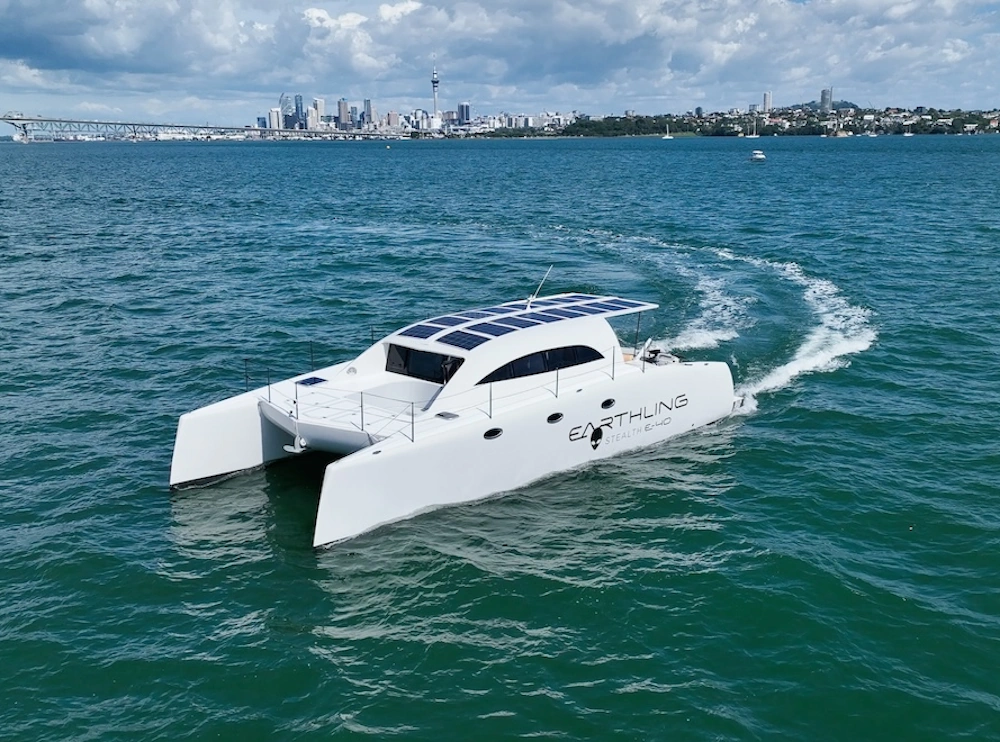
The E40 is a 40-foot power cat engineered around electric propulsion with a hybrid backbone. Twin electric motors deliver the primary power, fed by a sizable battery bank that supports both propulsion and service loads.
A compact, efficient generator serves as a range extender, automatically topping up when needed and allowing longer passages at steady, frugal speeds. Solar contributes to the daily energy budget, trimming generator hours and keeping the boat “quiet-ready” when you arrive in an anchorage.
The architecture is the stand-out feature. The catamaran hull (a Stealth Power Cat design) reduces drag, lowering power demand across the cruising range. Electric motors give you instant torque for close-quarters control and silent running for hours. The genset is your safety net and your distance maker. You choose when to be whisper-quiet and when to resort to diesel at between 1.5 to 3 L per hour consumption.
What stood out onboard
Systems that think for you. The E40’s power management is cleanly designed. State of charge, predicted range at current speed, solar yield, and generator strategy are presented so you don’t have to be an engineer to make good decisions. Set a target speed or arrival state of charge and let the system optimise. It’s a great way to set up a hybrid boat.
Acoustic comfort. Under pure electric drive, the E40 is very quiet. Even with the generator running, noise and vibration are minimised, so the helm feels more like a modern EV than a diesel trawler. Less fatigue means longer, easier days and better watchkeeping when you’re on your own or with a short handed crew.
Maneuverability and redundancy. Twin electrics give precise control. Docking is responsive and exact. Redundancy is inherent: two motors, independent drivetrains, and an energy system with multiple charging paths. For coastal roaming or day sails, that builds confidence.
Space used intelligently. Catamaran platforms earn their keep at anchor, and the E40 leans into that: a stable, wide salon, ample cockpit, and easy flow between living and working zones. Because the powertrain is compact, volume that might be lost to big diesels and tanks is reclaimed for storage and systems access. Maintenance is simplified by clear labelling and thoughtful conduit runs. There is plenty of space for solar up top.
Low, steady consumption. The hybrid sweet spot is a sensible cruise speed where the hull’s low drag and the motors’ efficiency intersect. Hold that number and the boat is very efficient. You don’t need to sprint because the boat makes miles cheaply at its designed pace.
Well Positioned in the Market
Hybrid power cats aren’t new as an idea; what’s been missing is proof and polish in the 40-foot class. Many buyers see a binary choice: go electric and accept tight range bands, or stay with straight diesel and accept noise, smell, and more maintenance. The E40 is trying to hit the sweet spot: hours of silent running to reach those nice bays, the reach of a compact range extender for longer legs, and day-to-day operating costs that trend down because the generator works at efficient, steady loads instead of a diesel working stop-start.
Dive Deeper!

Some of the features that stand out on this design include the following:
- The two small compact 48VDC variable speed Gensets (redundancy for safety) are barely audible, as opposed to one large genset which is more difficult to place and comes with a higher noise/vibration profile. This also allows the option of halving the diesel use running slower on passages.
- The boat has mirror imaged systems and can run at the target passage speed of 10 knots regardless of whether one or 2 hulls are propelling.
- Large slow-moving props optimise efficiency turning at only 400RPM at the 10 knot sweet spot. No cavitation with solid traction.
- The 48V DC platform is safe and serviceable and plugs into standard 16A x 2 or 32A shore plug. It uses the same onboard DC charges used for the Gensets.
- Price point (Nov 2025).A starting price of €685k which includes the full E-Propulsion system. Options are:
– The full SCADA system
– Removal of the forward cockpit to give the traditional 2 x doubles port/starb
– Additional pull-out Queen bed starboard (as standard on Port)
– High end laminates to service areas above and below
– Colour schemes and finishes
Bottom line
The Earthling E40 isn’t trying to win a speed contest. It’s optimizing the hours you actually spend boating: the early-morning departures, the afternoons ghosting into a cove on battery, the quiet overnight watch, and the following-morning passage when you need to eat miles efficiently. This is a hybrid with an elegantly managed system and a hull made for efficient motion.
The interior feels utilitarian and minimalist, but this will change on the production units which will aim for a luxury look using lightweight composites.. The desire is to keep the weight down, and Earthling claims this boat has a 1 tonne payload. The price is premium, so they will need to get this balance right to widen their market.