

Bosch Plug-and-Play Electric Propulsion
Bosch brings plug-and-play electric propulsion a step closer for boats
The automotive giant has developed a complete electric inboard propulsion system designed to make electrifying boats simpler. With 160 hp of continuous power, compact dimensions and automotive-grade components, it could help bring electric propulsion within reach of a much wider section of the boating industry.
Electric propulsion has been talked about in the boating industry for years. The advantages are fairly obvious: quieter operation, instant power, fewer moving parts and the possibility of cruising without producing exhaust emissions.
But while electric cars have become increasingly commonplace, making the transition in boats has proved more complicated.
One of the main challenges is that an electric boat installation involves more than simply replacing a petrol or diesel engine with an electric motor. You need a suitable battery, power electronics, charging equipment, cooling systems, control software and a way of getting all these components to work with one another.
Bosch Engineering believes it has a solution. Its new Electric Drive for Marine Applications (EDM), unveiled at METSTRADE 2026, brings almost everything needed for an electric inboard installation together in one ready-to-install package.
And importantly, it is designed to fit into boats that would traditionally have been powered by a conventional inboard combustion engine.
So, what exactly is Bosch offering?
Think of a conventional inboard engine installation. You have the engine itself, gearbox, cooling system, electrical connections, engine controls and instrumentation. All these elements need to be installed, connected and configured to work together.
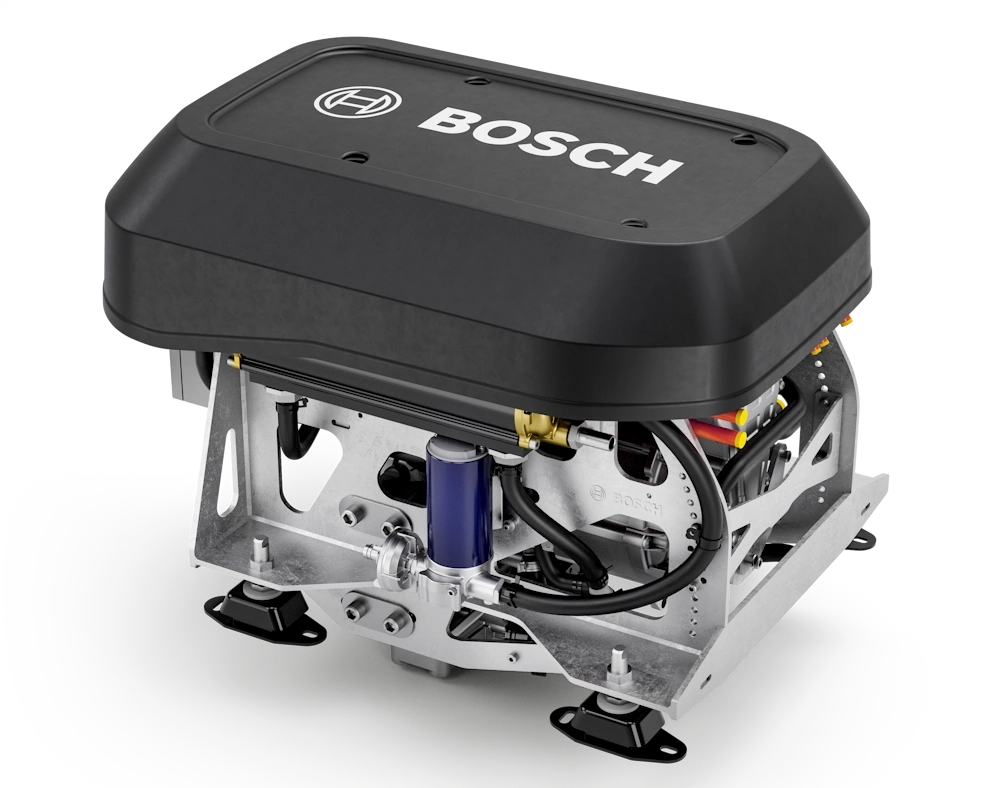
Bosch is applying a similar approach to electric propulsion, but integrating the main components into one compact unit.
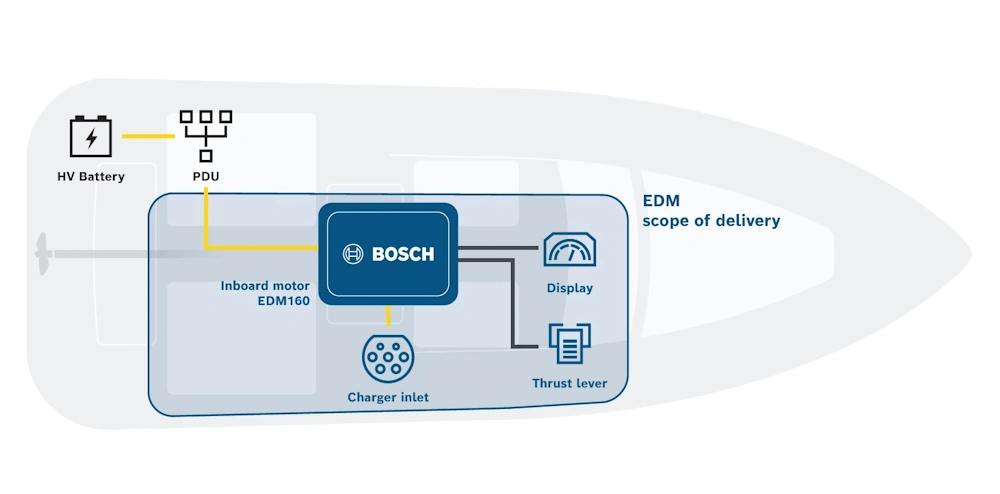
At the heart of the EDM is an electric motor, which drives the propeller shaft through an integrated gearbox. Alongside it are the inverter, onboard battery charger, heat exchanger, control unit and cooling pumps.
The system also comes with the necessary high- and low-voltage wiring, charging connection, display and control equipment.
In other words, rather than asking a boatbuilder to source individual components from different manufacturers and work out how to integrate them, Bosch supplies a largely complete propulsion package.
There is still installation and configuration work to do, but the complicated engineering has already been taken care of.
What does the inverter actually do?
For anyone familiar with petrol engines, the inverter is one of the less obvious parts of an electric propulsion system.
An electric motor needs electricity to operate, but the power supplied by a high-voltage battery is not necessarily in the form the motor requires.
The inverter acts as the electronic link between the battery and the motor. It converts the battery’s direct current (DC) into the controlled alternating current (AC) needed to drive the motor.
It also regulates how much power reaches the motor, controlling its speed and torque in response to the throttle.
Think of it as a highly sophisticated electronic engine management system. Instead of controlling fuel injection and ignition, it manages the flow of electrical energy to the motor.
This is one of the reasons electric propulsion can deliver such precise control, particularly at low speeds when manoeuvring in a marina.
160 HP in a compact package
The figures are interesting.
The Bosch EDM produces 120 kW, equivalent to approximately 160 hp, of continuous power, while weighing around 195 kg.
That is a decent amount of power for a relatively lightweight and compact installation.
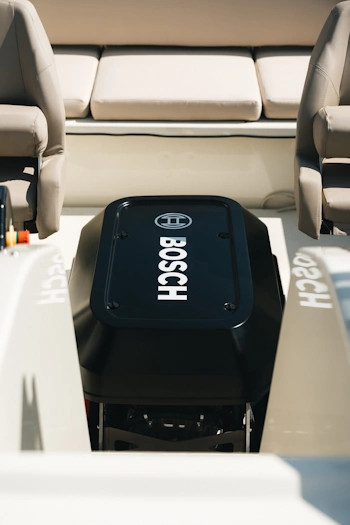
Bosch says its dimensions are comparable to those of a conventional inboard combustion engine producing similar power, which is important for boatbuilders. It means the system can potentially be incorporated into existing hull designs without having to rethink the engine compartment.
There is also some useful installation flexibility. The shaft coupling can be tilted by up to eight degrees in either direction, allowing the motor to be positioned to suit the available space and aligned with the propeller shaft.
This could make the system suitable for new boats as well as some repowering projects, where an existing petrol or diesel engine is replaced with electric propulsion.
The battery: the one thing you still need to choose
There is one important distinction. The battery is not included in Bosch’s complete drive package.
This is understandable because battery requirements vary considerably between boats. A lightweight sports boat used for short trips has very different energy requirements from a cruising boat expected to cover longer distances.
Rather than locking boatbuilders into one particular battery manufacturer, Bosch has designed the EDM with a standardised communication interface that allows it to work with various high-voltage batteries available on the market.
The system also incorporates thermal management, which helps regulate the temperature of the battery as well as the drive components.
This flexibility is important. Battery technology continues to develop, and allowing boatbuilders to choose a suitable battery based on the boat’s intended use, available space and budget will make the system more adaptable.
Of course, the battery remains a major part of the overall cost, weight and performance equation. Bosch has not yet provided specific range or charging-time figures, as these will depend on the battery and vessel installation.
What does this mean when you’re out on the water?
Electric motors have some inherent advantages over conventional combustion engines.
One of the biggest is the way they deliver power. An electric motor can produce substantial torque from very low speeds, without needing to build up engine revs. Power delivery is smooth and immediate, and there is no conventional engine vibration or exhaust noise.
For boat owners, that means a more relaxed experience, particularly when leaving the marina, approaching a berth or cruising in quieter surroundings.
Bosch has also demonstrated a manoeuvring mode designed to give the skipper precise control at low speeds.
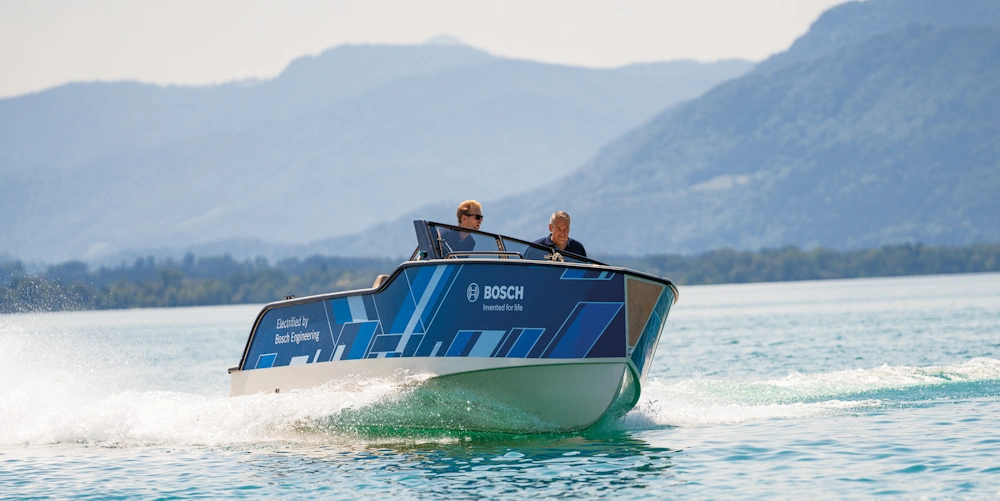
To demonstrate what the system can do, the company has built a 6.5-metre sports boat powered by the EDM.
The demonstration boat has a peak output of 140 kW (190 PS), rather more than the system’s 160 hp continuous rating. Bosch reports that it reaches planing speed in just four seconds and achieves 30 knots after 14 seconds.
These figures demonstrate that electric propulsion is no longer necessarily restricted to slow displacement boats and gentle harbour cruising.
The ability to combine strong acceleration with precise low-speed control is an interesting development for recreational boating.
Why this could be important for sailing yachts and catamarans
While much of the attention surrounding electric propulsion has focused on small motorboats, the technology could have considerable potential for sailing yachts and multihulls.
On a sailing yacht, the engine is often used for relatively short periods: leaving and entering harbour, manoeuvring in confined waters and making progress when the wind disappears.
An electric motor is particularly well suited to this type of operation, provided there is sufficient battery capacity for the intended journey.
For catamarans, the possibilities are particularly interesting. Many multihulls have two engines, one in each hull, and the installation space can be relatively constrained.
A compact electric drive could simplify the mechanical installation and potentially offer greater flexibility in how propulsion systems are arranged.
There is also the possibility of integrating electric propulsion with onboard solar generation. Solar panels can contribute energy to the battery while the boat is at anchor or sailing, reducing the need to rely entirely on shore power or a generator.
Solar panels alone are unlikely to provide all the energy needed for sustained motoring on a typical cruising yacht. Battery capacity, charging infrastructure and the boat’s actual energy consumption remain critical considerations.
The attraction is more about making better use of available energy and reducing reliance on conventional engines for everyday manoeuvring and shorter passages.
Automotive technology comes to the marine industry
Perhaps one of the most significant aspects of Bosch’s announcement is the company’s automotive background.
Bosch is one of the world’s major automotive technology suppliers, with decades of experience in electric motors, power electronics, control systems and vehicle engineering.
The EDM uses components sourced from Bosch’s automotive production, bringing established manufacturing processes and quality standards into the marine environment.
This is important because marine propulsion has traditionally been a relatively specialised market. Boatbuilders often have to integrate systems in relatively small production runs, sometimes for individual custom-built vessels.
Bosch says it will supply the complete EDM system from a quantity of just one, making the technology available to smaller boatbuilders and one-off projects as well as larger manufacturers.
It will also support customers from the initial installation design through to commissioning the drive on the water.
That could help remove another barrier to adoption: the lack of specialist engineering resources within smaller boatbuilding companies.
The future of boat propulsion?
There are still some significant challenges to overcome before electric propulsion becomes a straightforward replacement for conventional engines across the boating industry.
Battery cost, weight, energy density and charging availability remain important considerations, particularly for larger yachts and boats expected to travel long distances under power.
A conventional diesel engine can carry a substantial amount of energy in a relatively small volume of fuel. Replicating that energy capacity with batteries is still difficult, especially when range and sustained high-speed operation are required.
For this reason, electric propulsion is unlikely to be the right answer for every boat or every type of boating in the immediate future.
But the industry does not necessarily need one technology to replace everything. There is considerable potential for electric drives in dayboats, tenders, inland waterways, harbour craft, smaller motorboats and sailing yachts where the operating profile makes sense.
Bosch’s approach is interesting because it addresses a practical problem rather than simply introducing another electric motor.
By bringing the motor, gearbox, inverter, charger, cooling and control systems together into a single package, it makes the technology easier for boatbuilders to adopt.
And that may prove just as important as the performance figures themselves.
Electric propulsion has been waiting for the boating industry to catch up with the automotive world. With companies such as Bosch bringing established engineering and manufacturing expertise into the marine sector, that transition could start to accelerate.