
Maximum Hull Speed Calculator
The Theory of Maximum Hull Speed
What is it?
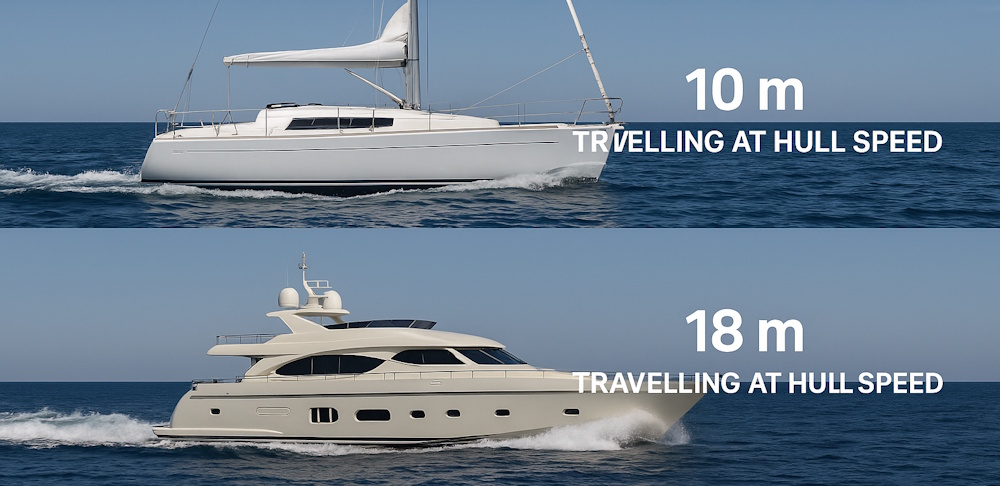
Maximum hull speed is the theoretical top speed a displacement hull can achieve before it begins to ride up on its own bow wave.
At this point, increasing speed requires disproportionate amounts of power because the boat is effectively trying to climb over the wave it creates.
Yacht Hull Speed Calculator
Work out the maximum displacement hull speed from the waterline length (LWL), or find the LWL required for a target hull speed. LWL units can be metres or feet (choose); speed is in knots.
Vhull ≈ 1.34 × √LWL(ft)
There are limits to this theory though, especially with vessels that have a large hull length to beam ration (including of course catamarans).
The Formula
For displacement hulls, the approximation is:

HS = hull speed in knots
LWL = waterline length in feet
The constant 1.34 comes from wave physics and relates to the speed of a deep-water wave of length equal to the LWL.
How It Works
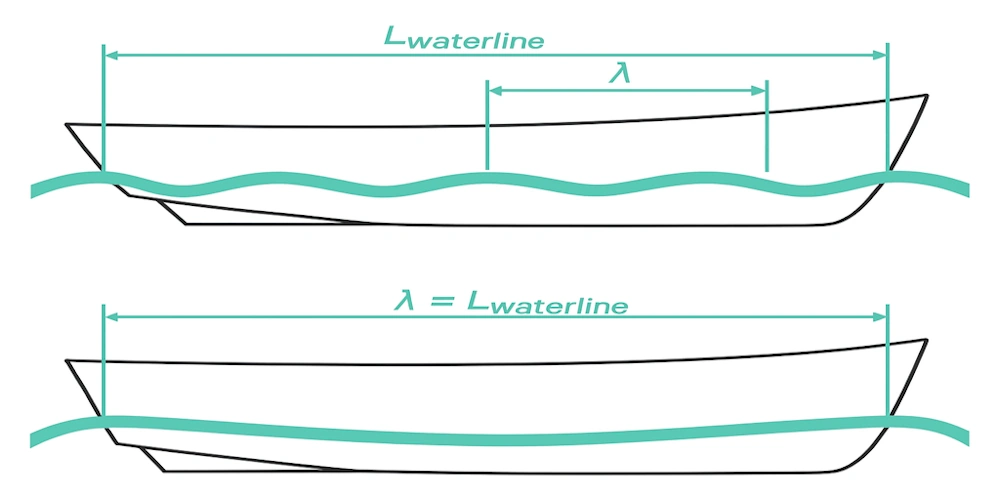
As a boat moves, it generates a bow wave at the front and a stern wave at the back.
At hull speed, the wavelength of the bow wave matches the boat’s waterline length.
The boat is effectively “trapped” between crest and trough, requiring much more extra energy to go faster.
Limitations
Planing hulls (speedboats, racing sailboats) can surpass hull speed by rising partially or fully out of the water, reducing drag.
Semi-displacement hulls can exceed hull speed with enough power.
The formula applies mainly to traditional displacement hulls.
Catamarans
Catamarans have long, narrow hulls with less wave-making resistance.
Because each hull is slender, the bow and stern waves interfere less, allowing higher speeds without requiring full planing.
Catamarans can therefore exceed the calculated hull speed for their LWL more easily than monohulls.
Practical Meaning
Hull speed is not a hard speed limit — it’s a guide to the top displacement speed for hulls without planing.
For cruisers, it’s a useful benchmark for expected passage speeds and power requirements.