
Lagoon 47









Lagoon 47 Review: A New Generation for the Mid-Size
Note: The Lagoon 47 makes its world premiere at the Cannes Yachting Festival in September 2026. This review is based on confirmed specifications and pre-launch information released by Lagoon and its dealer network. On-water performance data will be added following the launch.
Background
The Lagoon 46 was a success story. Launched in 2019, it sold around 700 units over seven years, making it the best-selling catamaran of its size ever built. That is a high bar for any successor, and the Lagoon 47 does not try to reinvent the wheel. Instead, it takes owner and dealer feedback and applies it systematically, adding new features and refining the layout in ways that matter for daily life on board.
The 47 slots between the outgoing 46 and the Lagoon 51. It is designed by the same team that shaped the recent generation: VPLP for the naval architecture and Nauta Design for the interior. The world premiere is set for Cannes in September 2026.
Key Changes from the Lagoon 46
- A door connecting the saloon directly to the forward cockpit (first time on a Lagoon under 60 feet)
- A 12 m² forward cockpit with seating and a table
- A flybridge with a side helm station rather than the central position used on the 46
- A “Smart Room” option: a flexible space configurable as a cabin, workspace, or utility room
- Transverse beds in guest cabins, oriented across the hull rather than fore-and-aft
- A VIP guest cabin with direct access to the aft cockpit
- Optional electric tender lift doubling as a bathing platform
- Vacuum infusion construction and partial use of bio-sourced materials including hemp fibres on non-structural components
The forward cockpit door is the big news. Previously reserved for Lagoon’s Signature models at 60 feet and above, it now makes an appearance in the 47. They have been careful to maintain the “flow” from aft forward.
Specifications at a Glance
| Hull length | 13.96 m / 45’10” |
| Length overall | 14.95 m / 49’1″ |
| Beam | 7.96 m / 26’1″ |
| Draft | 1.25 m / 4’1″ |
| Air draft | 23.2 m / 76’1″ |
| Displacement (EEC) | approx. 17.5 t |
| Sail area upwind | 128 m² / 1,377 sq ft |
| Mainsail (furling, std) | 58 m² / 624 sq ft |
| Engines | 2 x 57 HP |
| Water capacity | 700 L / 185 US gal |
| Fuel capacity | 860 L / 227 US gal |
| Berths | 6 to 13 |
| CE category A | 12 persons |
Design and Layout
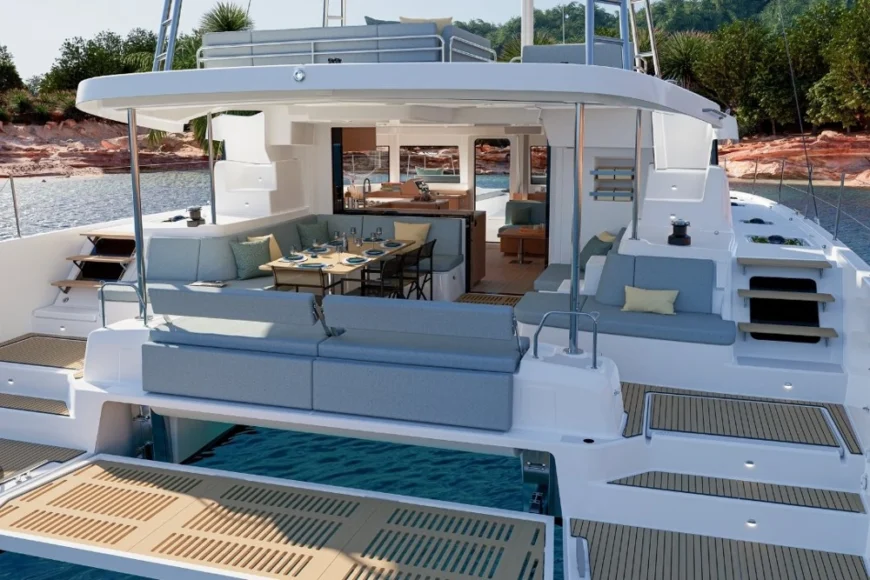
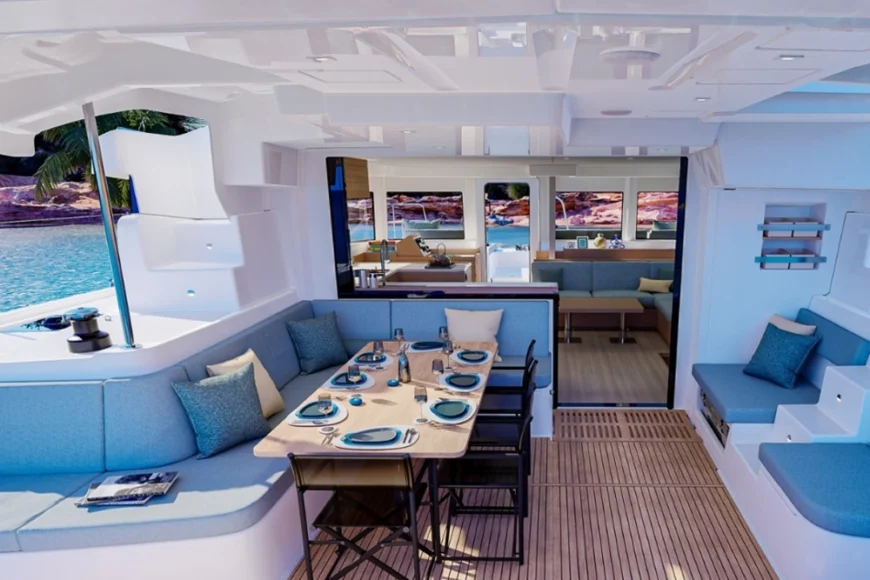
The 47 follows the design theme Lagoon introduced on the 38 and 43: clean coachroof lines, panoramic saloon windows and a level floor transition from the saloon into the cockpit. The idea is to remove visual and physical barriers between interior and exterior spaces.
The flybridge, so successful since 450 days, remains a key feature. Below, cabin layouts range from three to five cabins, with the Smart Room offering a third configuration.
The 7.96-metre beam is unchanged from the 46, but the hull form has been updated to increase volume forward, improving accommodation and storage in the bows.
Read More
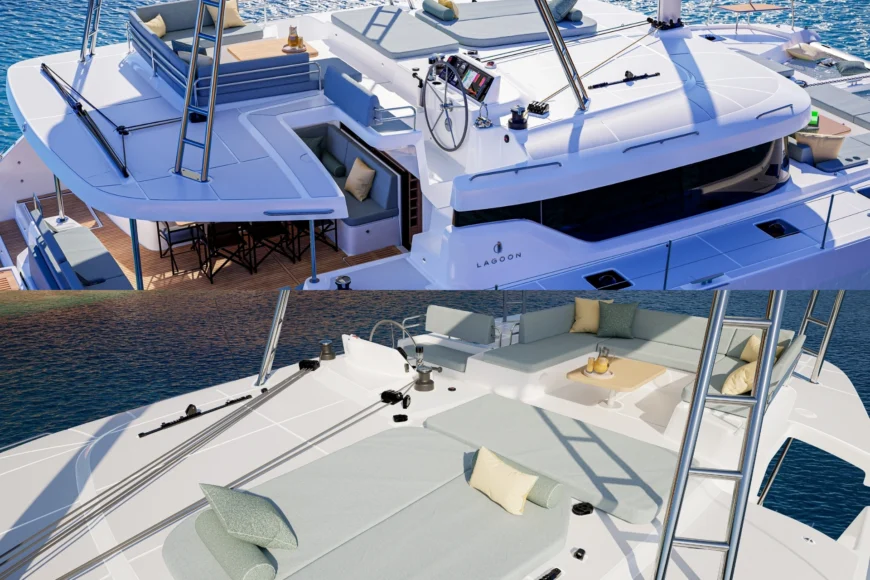
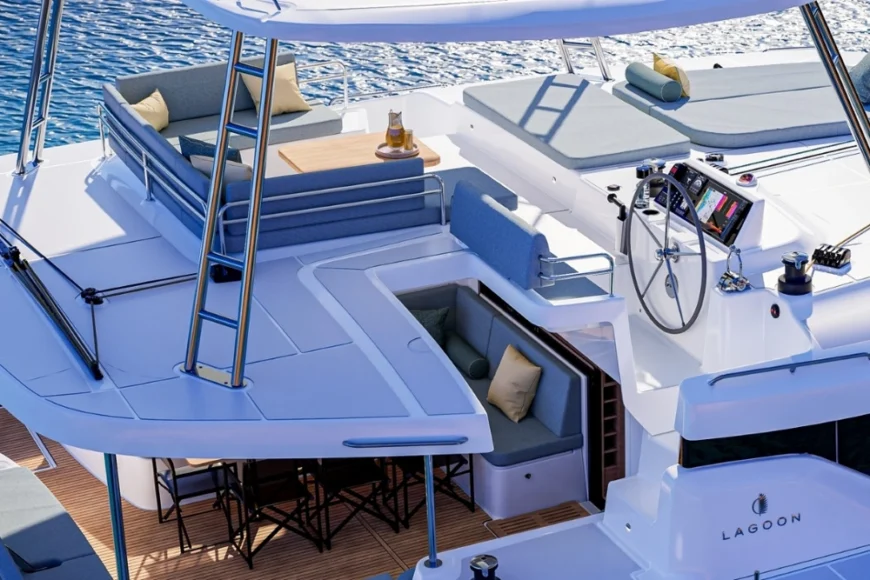
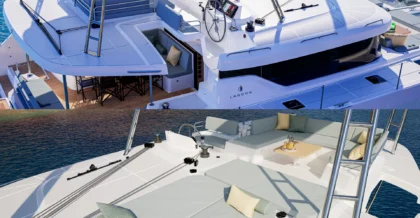
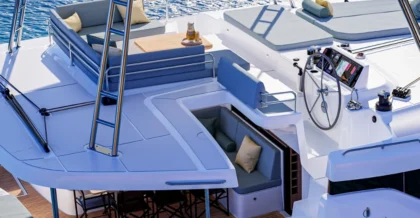
The flybridge is a big upper deck with bench seating, a coffee table, sun loungers and a side helm station. The side position of the helm is a deliberate change from the 46’s central station, allowing better communication between the helm and the main cockpit below though a gap in the coachroof. This also gives you visibility of the sugar scoops when you are docking.
The three-cabin layout or owner’s version is aimed at cruisers with two to three guests who will enjoy large en-suite heads and generous storage per cabin. The five-cabin layout is aimed at charters or larger families, maximising the berths while retaining good cabin sizes. In the port hull, thrr is a flexible space that can be used as a Smart Room rather than a cabin: a flexible multipurpose space.
Living Space
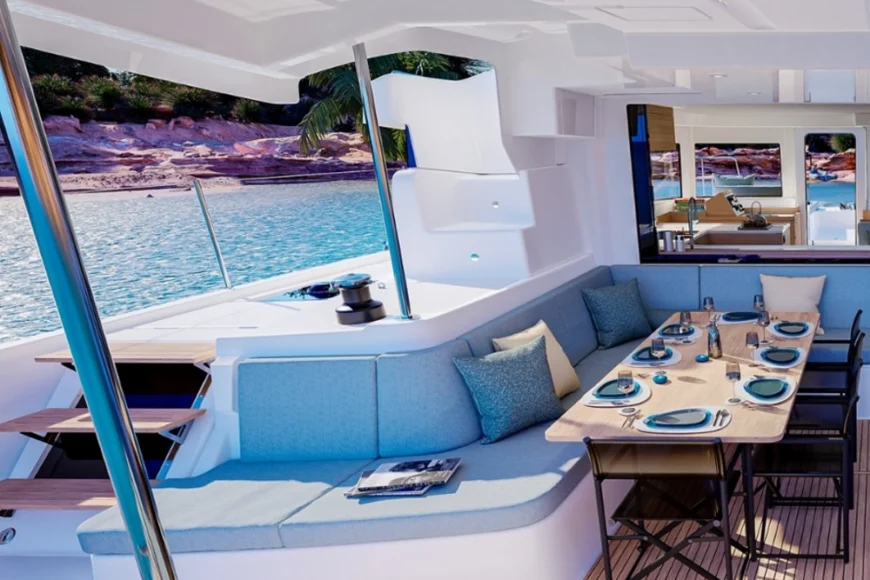
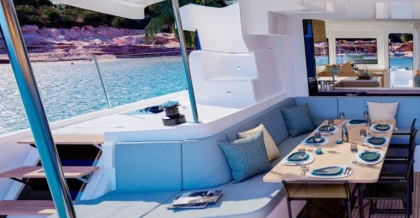
The saloon is designed around a single social hub. A level floor connects the saloon to the aft cockpit through sliding doors, with natural light entering through panoramic side windows. The galley is positioned on the port side to keep the cook connected to both interior and cockpit.
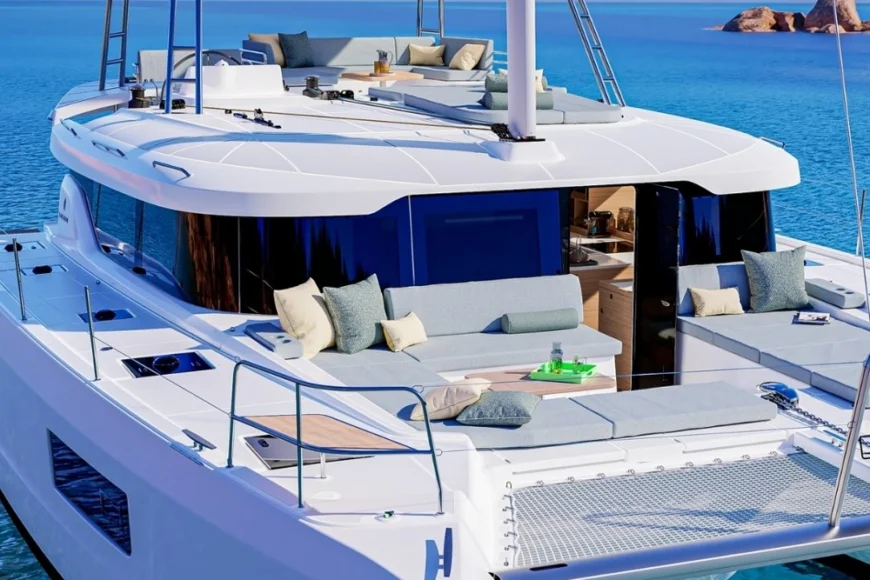
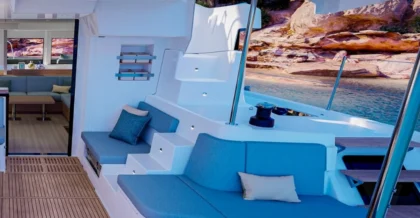
The big news is the forward cockpit. A door in the forward saloon wall opens directly onto a 12 m² deck area with a fixed table and bench seating. To port is a sun lounger. This is not just access to the nets: it is a social space forward with seating, offering a sheltered, forward-facing outdoor space that makes a fantastic, cool chill out area at anchor or on calmer days sailing. On anchor, it is likely to become the go-to spot for breakfast or a sundowner.
Read More
The forward cockpit design is the most significant design uopdate on the 47. On the L46, forward access is via the side decks. On the 47, the door creates a connected route from the saloon to the bow, simplifying movement on board whether at sea on calmer days or at anchor, and it makes for great ventilation too.
At 12 m², the space fits four to six people at the table. In the trade winds or on calmer days, this area will be a popular spot. In sportier conditions with beam or head seas, the water-tight door will be firmly locked.
This configuration as a trickle-down from the larger boats. It’s more difficult to get the right balance on a 46 footer, but they have pulled it off.
Up Top
The flybridge on the 47 is a living deck as well as a sailing hub with a U’shaped sofa, table and sun loungers to port.
The helm station has moved to the starboard of the flybridge rather than the centre. This positions the helmsman closer to the side of the boat, improving sight lines to both the sails and the cockpit crew below, and making communication more efficient during manoeuvres.
More about the flybridge helm
The side helm position is a good improvement for short-handed sailing.
The flybridge seating is separated from the working area, so the helm station does not intrude on the social space when guests are aboard and vice versa.
Down Below
The cabin arrangements on the 47 is a big step up, especially in the guest cabins.
The key change is the athwartship beds in the guest cabins. Rather than the traditional fore-and-aft berths, the beds are positioned across the hull, with views out to the ocean. This gives more width, makes climbing in and out easier and creates a better sense of space when the cabin is fitted out.
The VIP guest cabin is positioned with direct access to the aft cockpit, giving guests a separate entry and exit that does not require passing through the main saloon.
[EXPAND SECTION START — suggested label: “More on cabins and the Smart Room”]
More on cabins and the Smart Room
The Smart Room is the most flexible element of the layout below decks. It istes between the 2 guest cabins on the straboard side and can function as a workspace or office area with a dedicated desk. Or, it can be set up as an extra cabin with bunk beds, or as a utility room with storage. A separate guest head features in both the Smart Room and cabin variants.
In the 47, the forward part of the hulls has been designed with more volume than the 46, thanks to the new hull forms. This allows for a larger owner’s bathroom forward in the starboard hull, or a roomy berth forward in the 5 cabin version.
Storage throughout has been redesigned with watersports in mind. The aft sections of the hulls and the transom area offer organised, accessible stowage for paddleboards, snorkelling gear and your tenders (on the hydraulic swim platform)
Key Features that Make the 47 Stand Out
- Forward cockpit with saloon door: a first for a Lagoon in this size range, creating a third outdoor living zone connecting the full length of the boat
- Smart Room: a configurable space that makes the layout adaptable to different crews and trip types
- Side helm station on flybridge: an improvement for short-handed sailing and crew coordination
- Transverse guest beds: better cabin ergonomics
- VIP cabin with private cockpit access: useful for charter and for giving guests independence from the main saloon
- Electric tender lift: easier to manage your tender and it doubles up as a swim platform at the stern
- Bio-sourced materials: hemp fibres used on non-structural components, with bio-sourced resins and certified woodwork
Sailing
The 47 carries 128 m² of upwind sail area, split between her mainsail and a furling genoa. The rig is sized for easy management by a small crew: a manageable, powerful mainsail combined with a roller furling headsail that can be adjusted from the cockpit.
Draft is 1.25 m, which gives access to shallow anchorages that are out of reach for deeper-keeled cruising boats. This remains one of the practical advantages of a cruising catamaran in this class.
Displacement sits at approximately 18 tonnes. Once the breeze fills in above 12 to 15 knots, cruising catamarans of this type come into their own, particularly on a beam reach and off the wind. Save some budget for the Code 0 option. This set up gives you an SA/D of around 18-19.
Power
The standard power set-up is twin 57 HP diesel Yanmar engines, one per hull. This is more than adequate for marina manoeuvring, harbour entry and motorin
Fuel capacity is 860 litres (227 US Gal), giving good range under power. Water tankage is 700 litres (185 US Gal), and Lagoon offers the Uvoji water purification system as standard, which reduces dependency on marina water top-ups on extended passages.
More…
No hybrid or electric propulsion option has been announced for the 47, though the Beneteau Group is moving quickly in this direction, so we expect this to be not too far away. The standard diesel configuration will likely be offered alongside larger engine options for buyers who want more reserve power for offshore passages or charter use.
Solar panel capacity has not been confirmed, though recent Lagoon models have larger panel arrays on the coachroof and flybridge to reduce battery dependency on anchor. This is expected to continue on the 47.
Pros and Cons
Pros
- Forward cockpit with saloon door is a practical and well-thought-out addition
- Smart Room gives flexibility across different ownership and crew configurations
- Side helm station is an improvement for short-handed sailing (communication, visibility aft)
- Transverse guest beds work well
- Shallow 1.25 m draft for access to shoal anchorages
- Large fuel and water capacity for extended passages
- Established builder with a global dealer and service network
Cons
- The forward cockpit door will need to be managed in rough conditions. Keep it shut unless its calm
- 57 HP standard engines may feel underpowered for a boat of this displacement in adverse conditions
- No hybrid or electric propulsion options as yet
- At 18 tonnes, light-air performance will be modest. Invest in a Code 0.
FAQs
When does the Lagoon 47 launch?
The world premiere is at the Cannes Yachting Festival in September 2026. Production deliveries are expected to follow from early 2027.
What does it replace?
The 47 is the direct successor to the 46, which sold approximately 700 units since 2019. The 46 Iconic remains available in the Lagoon range in the interim.
How many cabin layouts are available?
Three configurations are offered: three cabins, five cabins and the Smart Room layout. The Smart Room can be fitted as a cabin, workspace or utility room.
Is a flybridge standard?
Yes.
What is the forward cockpit?
A 12 m² deck space at the bow, accessed via a door from the saloon. It is fitted with a fixed table and bench seating, functioning as an additional outdoor living area. This layout was previously only available on Lagoon’s larger models.
What engines are fitted as standard?
Twin 57 HP diesel engines, one per hull. Larger engine options may be available.
Is the Lagoon 47 suitable for charter?
Yes. The five-cabin layout is well suited to charter operations, and the VIP cabin with independent cockpit access is a practical feature for charter guests. The boat meets CE Category A for offshore ocean use.
How does the 47 compare to the Lagoon 51?
The 51 is a larger, heavier boat with more interior volume. The 47 is intended to sit between the 43 and the 51 in the range, offering more space and features while remaining more manageable and more affordable than the 51.
Summary
The Lagoon 47 is a clever evolution of one of the most successful production catamarans of the last decade. It addresses the design details ine the 46 in ways that owners will notice every day: a connected forward outdoor space, a helm station that improves visibility and communication with the crew, guest cabins that are easier to sleep in, and a flexible interior options that adapts to different crews and trip types.
The forward cockpit door is the big news, and it represents a shift in what is possible at this size. It connects the boat fore to aft without adversely affecting the flow in the boat and creates a living dynamic that is closer to the larger Lagoon models than waht was avaialble previously in the mid-forty-foot range.
For cruising owners looking at the mid-forty-foot market, the 47 will be a leading contender. It offers more than the 46 in terms of clever layout design and living space, without the cost and complexity of stepping up to the 51.
Full verdicts will follow once the boat has been tested at sea after the Cannes launch in September 2026.
Contact Katamarans
Share your details with us and we’ll be in touch to discuss further. Let us know if you would like help with configuring options and pricing.
"*" indicates required fields