
E-LEKTRA MARINE – Beneteau and Fountaine Pajot Join Forces to Electrify Sailing
E-LEKTRA MARINE Party
Two of the world’s largest sailing boat manufacturers, the Beneteau Group and the Fountaine Pajot Group, have just announced the creation of E-LEKTRA MARINE, a 50/50 joint venture dedicated to electric propulsion and intelligent onboard energy management.
This venture was announced at La Grande Motte on the 22 April 2026 at the International Multihull Show. This is looking like a pretty radical program for all of the parties involved aimed to kick start electric and hybrid-electric solutions for yachts.

The new entity brings together seven major sailing brands under a shared technical platform: Beneteau, Jeanneau, Lagoon Catamarans, Excess, Fountaine Pajot Sailing Catamarans, Fountaine Pajot Yachts and Dufour. Together, these brands ake up around 60% of the global sailing market.
While the brands will remain commercially independent, the joint venture is designed to create an open industry standard that other nautical players can also adopt.
Today, more than 99% of sailboats are powered by combustion engines. Even on a sailing yacht, a motor is essential for port manoeuvres, windless conditions, and meeting onboard energy needs.
E-LEKTRA MARINE’s goal is to convert between 10% and 15% of the global sailing market to electric propulsion by 2030, representing several hundred boats per year.
More than propulsion: the energy management challenge
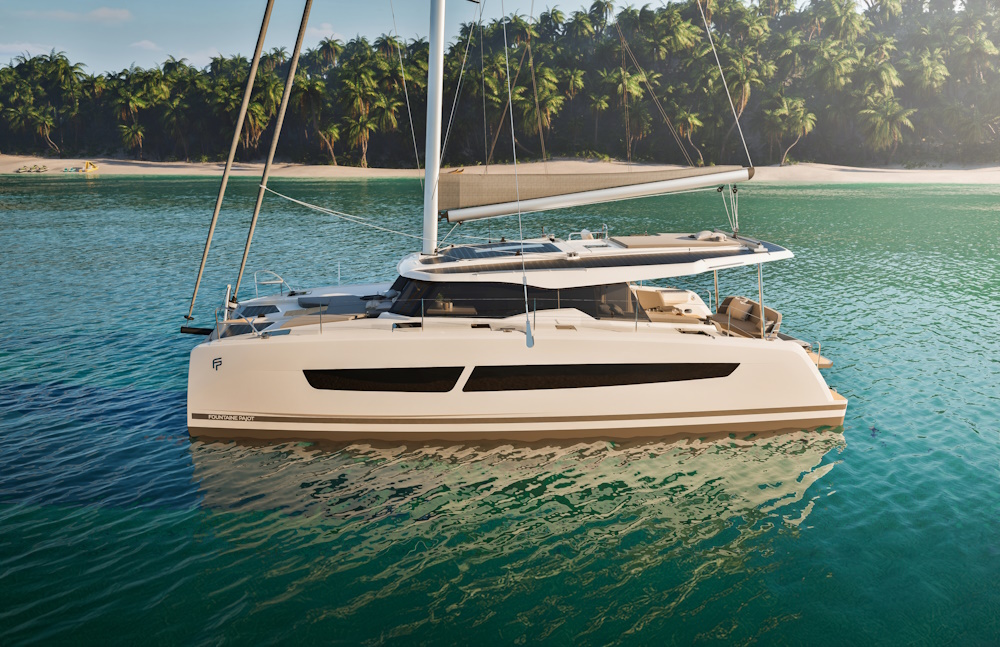
What sets sailing apart from other electrification challenges is the combination of propulsion and autonomous energy management. Unlike a Tesla or a BYD which connect to a charging point, a sailing yacht at sea must produce, store and distribute its own power across solar panels, batteries, a generator, drive motors and onboard comfort systems, all managed in real time and far from shore connections.
Then be able to power up quickly at the marine in diverse geographies.
E-LEKTRA MARINE is designed to address both challenges. A team of naval electrical systems architects will define, specify and validate standardised solutions for boats ranging from 9 to 24 metres, covering fully electric, low-voltage hybrid and high-voltage hybrid configurations.
An offer designed for simple, low-CO2-emission navigation solutions
The Aims
- Electric and Hybrid-Electric solutions for sailboats from 9 to 24 m, from fully electric to low voltage and high voltage hybrid.
- Optimised onboard energy management between solar power, engine, generator, house equipment and shore power connection
- Real-time monitoring of consumption via a user-friendly screen interface
- A standard system maintained by an approved and trained global network
- Constant evolution of the solutions offered to boaters, making them ever more competitive and efficient,
- A Refit Program to help current owners switch to electric
Technology partners
E-LEKTRA MARINE will draw on three specialist technology companies as partners: Alternatives Energies (La Rochelle), focused on electrical systems integration; Cirtem (Toulouse), specialising in energy conversion and management; and EVE System (Lyon), a battery pack design specialist.
Both parent groups bring proven field experience to the venture. The Beneteau Group has offered low-voltage electric solutions on sailing monohulls up to 12 metres for several years, including the Beneteau Oceanis range from 30 to 40 feet, and offers hybrid solutions on the Excess 11 catamaran and the Jeanneau Sea Loft 480.
Fountaine Pajot offers high-voltage hybrid systems on larger cruising catamarans, with the Aura 51 and Samana 59 starring as the group’s first hybrid-electric boats.
What E-LEKTRA MARINE Aims to Deliver
The platform aims to offer owners and builders a complete, scalable solution that includes onboard energy optimisation across solar, engine, generator, comfort systems and shore power; real-time consumption monitoring via a straightforward display screen; a global network of approved service centres trained to the standard; and a Refit programme allowing existing owners to transition from thermal to electric propulsion.
The ambition is to make low-emission sailing available without compromise on safety, ease of use or navigational freedom, and at a price point competitive with diesel engines, helped by the production volumes of the seven founding brands.
Why Scale Matters, and What Stands in the Way
The creation of E-LEKTRA MARINE is about combining two big names in a joint response to one of the hardest problems in marine electrification: how do you make a better technology affordable and accessible when your market is fragmented, seasonal and spread across thousands of harbours worldwide? Here is what the alliance actually brings to the table, where the genuine difficulties lie, and what it means for the smaller builders.
The industrial logic of the tie-up
The single most powerful thing E-LEKTRA MARINE does is pool volume. Beneteau and Fountaine Pajot together account for an estimated 60% of global sailing boat production. Battery packs, electric motors, energy management controllers and power electronics are all affected by steep manufacturing cost curves: the more units you produce to a common specification, the cheaper each unit becomes, and the easier it becomes to qualify suppliers, run quality control and build reliable supply chains.
By agreeing on shared technical standards across seven brands simultaneously, E-LEKTRA MARINE creates a procurement bloc large enough to negotiate with tier-one marine electrical component suppliers on industrial terms. No single brand in the sailing world could do this alone. Even Lagoon or Fountaine Pajot at their individual volumes would struggle to hit the thresholds needed to bring high-voltage lithium systems, smart energy management hardware and electric saildrives down to a price point that makes thermal substitution commercially viable.
The three specialist equity partners brought into the joint venture reinforce this logic.
Alternatives Energies brings systems integration experience from real marine installations.
Cirtem provides the power electronics engineering depth needed to handle bidirectional energy flows between solar arrays, battery banks, regenerative drives and shore power at high voltage.
EVE System, as a battery pack specialist, gives E-LEKTRA MARINE influence over pack architecture, cell selection and battery management software rather than simply buying off-the-shelf packs designed for other industries.
Together, they form a vertically integrated supply chain that the two parent groups will co-own and direct, rather than remain dependent on.
The open-standard model is equally important. By inviting other nautical industry players to adopt the platform, E-LEKTRA MARINE is attempting to turn its standard into the industry default. If a third or fourth builder adopts the same battery architecture and energy management protocols, total volumes increase further, costs fall again, and the service network that maintains these systems can be trained once and deployed everywhere. It is the same logic that drove USB-C adoption in consumer electronics, applied to marine power systems.
The Probable Roadblocks
The obstacles are not to be sniffed at.
The first is price. Electric and hybrid systems carry a significant upfront cost premium over conventional diesel installations. Most of that premium is in battery capacity. While costs have fallen sharply in automotive applications, marine batteries face additional demands: they must withstand constant vibration, salt air ingress, wide temperature swings and the particular challenge of being charged and discharged in irregular, unpredictable patterns depending on weather, crew habits and passage length.
Until E-LEKTRA MARINE’s combined volumes reduce the cost of marine-grade battery systems, buyers will continue to face a price gap relative to a diesel-powered equivalent. The 2030 target of 10 to 15% market penetration requires engineering progress AND commercial momentum, and that momentum depends on price.
The second challenge is marina infrastructure. A sailing yacht that returns to port with depleted batteries after several days at sea needs a reliable, high-capacity shore power connection to recharge in a reasonable timeframe. The overwhelming majority of marina berths worldwide offer only standard shore power, typically 16 or 32 amp single-phase connections, which are inadequate for fast-charging a high-voltage battery bank.
The third difficulty is internal alignment. Seven brands from two competing corporate groups are now asked to share technology, harmonise specs and avoid undermining one another commercially, while continuing to compete for customers. Brand identity, existing supplier relationships, different hull sizes and different customer expectations will create friction on engineering decisions. Joint ventures of this kind can slow down as the day-to-day commercial pressures reassert themselves.
But none of these are insurmountable. No-one said it was going to be easy!
Watch this space, as they say.